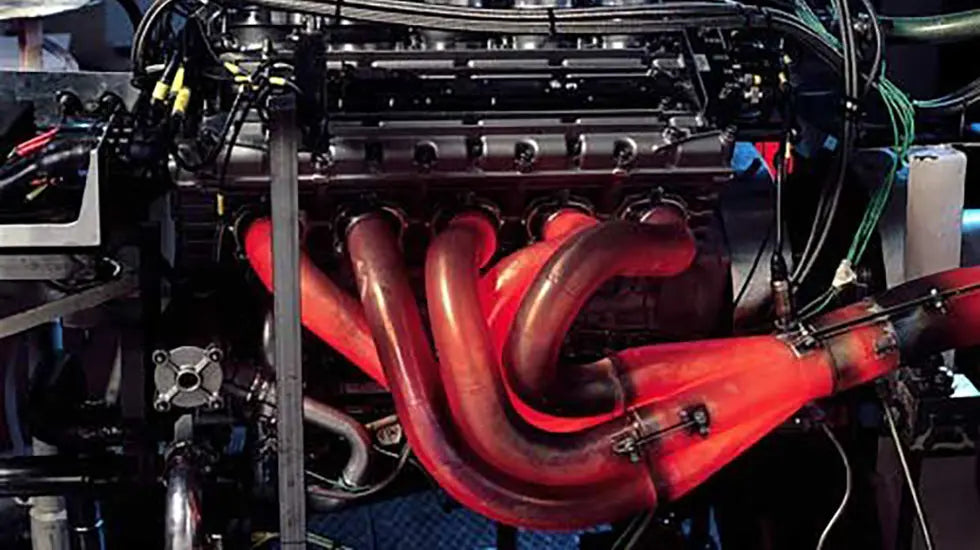
Exhaust headers get hot enough to burn skin, discolor metal, cook nearby wiring, and expose weak spots in your tune or exhaust setup. But the real answer depends on one important detail: are you talking about the outside surface temperature of the header tube, or the actual exhaust gas temperature inside the pipe?
For most street cars, the outside surface of exhaust headers may range from a few hundred degrees Fahrenheit at idle to around 900°F–1000°F or more under sustained load. The exhaust gas inside the tube can be much hotter, especially during wide-open throttle, towing, racing, or boosted operation. That is why two people can measure the same engine and get very different numbers depending on the tool, location, engine load, coating, and driving condition.
Quick answer: Exhaust header surface temperatures commonly fall around 300°F–600°F at idle, 500°F–900°F during normal driving, and 900°F–1000°F+ under sustained load. Actual in-tube exhaust gas temperature, or EGT, can be much higher. A naturally aspirated gasoline engine at wide-open throttle may see around 1200°F–1300°F, while boosted engines can run higher. The safest way to judge header heat is to compare readings under the same load, at the same distance from the flange, using the same tool.
This guide breaks down how hot exhaust headers get, what temperatures are normal, when heat becomes a warning sign, and how to protect your engine bay with better materials, heat shielding, ceramic coating, or a properly fitted performance exhaust header setup.
What Are Exhaust Headers?
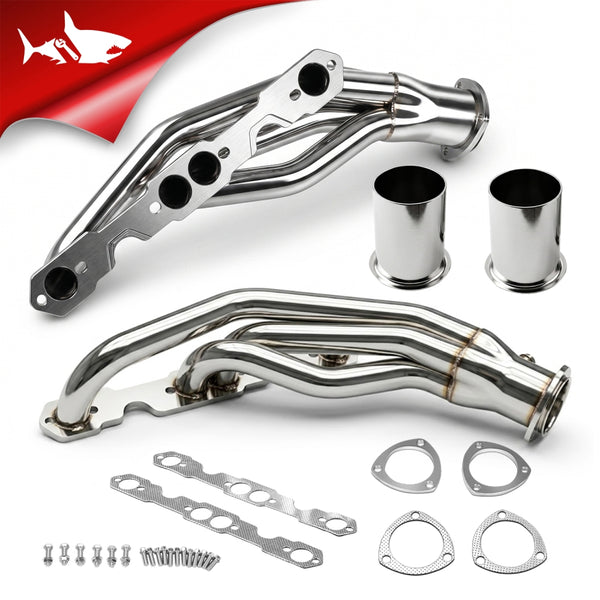
Exhaust headers are performance exhaust components that collect hot exhaust gases from each cylinder and route them into the rest of the exhaust system. Unlike many factory exhaust manifolds, which usually have short shared passages, headers use individual primary tubes to improve exhaust flow, reduce backpressure, and help the engine breathe more efficiently.
That extra flow is why headers are popular on V8 trucks, muscle cars, off-road builds, and modified street cars. A well-designed header can improve throttle response, change exhaust tone, and support more horsepower. But because headers often use thinner-wall tubing and longer exposed runners than cast manifolds, they can also radiate more heat into the engine bay.
Header material matters too. Mild steel, stainless steel, cast iron, titanium, ceramic-coated steel, and wrapped tubing all manage heat differently. A raw mild-steel header may radiate more heat and rust faster. A stainless header resists corrosion better. A ceramic-coated header can help keep more heat inside the tube and reduce under-hood heat around wires, hoses, and nearby plastic components.

Header Surface Temperature vs. Exhaust Gas Temperature
Before reading any exhaust temperature number, separate these two measurements:
- Header surface temperature: The temperature measured on the outside of the tube with an infrared thermometer or thermal camera.
- Exhaust gas temperature, or EGT: The temperature of the exhaust gas inside the tube, usually measured with a thermocouple probe.
These are not the same. A heat gun aimed at a coated or polished header tube is reading the outside surface, and that reading can be affected by coating, tube color, surface finish, distance, angle, and airflow. An EGT probe inside the tube reads the gas stream and reacts much more directly to combustion, air/fuel ratio, ignition timing, and engine load.
Mechanic's note: Do not tune an engine based on one idle header temperature reading. Idle readings can vary cylinder to cylinder because fuel distribution, airflow, camshaft overlap, and exhaust tube shape are not stable under no-load conditions. For a meaningful comparison, measure each tube at the same distance from the flange, under the same engine load, after the same amount of time.
Typical Exhaust Header Temperature Range
Header temperature changes constantly. A cold start, idle, stop-and-go traffic, highway cruise, towing, and wide-open throttle will all produce different readings. The table below gives a practical range for street and performance use.
| Driving Condition | Typical Header Surface Temperature | Typical EGT / In-Tube Temperature | What It Usually Means |
|---|---|---|---|
| Warm idle | 300°F–600°F | Varies widely | Useful for spotting a dead cylinder, but not ideal for tuning. |
| Normal street driving | 500°F–900°F | 900°F–1200°F+ | Usually normal if the engine runs smoothly and nearby parts are protected. |
| Hard acceleration or hill climbing | 800°F–1000°F+ | 1200°F–1400°F+ | Normal for short bursts, but sustained heat needs proper shielding and tune health. |
| Wide-open throttle / track use | 900°F–1100°F+ | 1200°F–1600°F+ | Expected in performance use; watch air/fuel ratio, timing, plug wires, and heat soak. |
| Boosted or racing applications | Can exceed 1000°F | Can exceed 1600°F | Requires stronger heat management, coating, wrap, shielding, and accurate monitoring. |
These numbers should be treated as practical ranges, not universal limits. A coated header may read much cooler on the outside than an uncoated header, even when the exhaust gas inside the tube is still very hot. A polished stainless header can also give misleading infrared readings because reflective surfaces affect heat-gun accuracy.
Factors That Affect Exhaust Header Temperature
Engine Load and RPM
Header heat rises when the engine works harder. Pulling a hill, towing, launching from a stop, or holding high RPM increases exhaust gas volume and combustion heat. A car cruising lightly at 2200 rpm will not create the same header temperature as the same engine at wide-open throttle.
Naturally Aspirated vs. Turbocharged or Supercharged Engines
A naturally aspirated engine usually produces less exhaust heat than a forced-induction engine with similar displacement and fuel. Turbocharged and supercharged engines pack more air and fuel into the cylinders, which creates more power and more exhaust heat. Turbo engines also place additional heat stress on the exhaust side because the turbocharger is driven by that hot exhaust energy.
Air/Fuel Ratio and Ignition Timing
A lean mixture, late ignition timing, misfire, or restricted exhaust can push more heat into the headers. If headers glow red during idle or light driving, do not treat it as a normal “performance” feature. Check for late timing, lean fueling, clogged catalytic converters, exhaust restriction, or a cylinder that is not burning correctly.
Header Design: Long Tube vs. Shorty
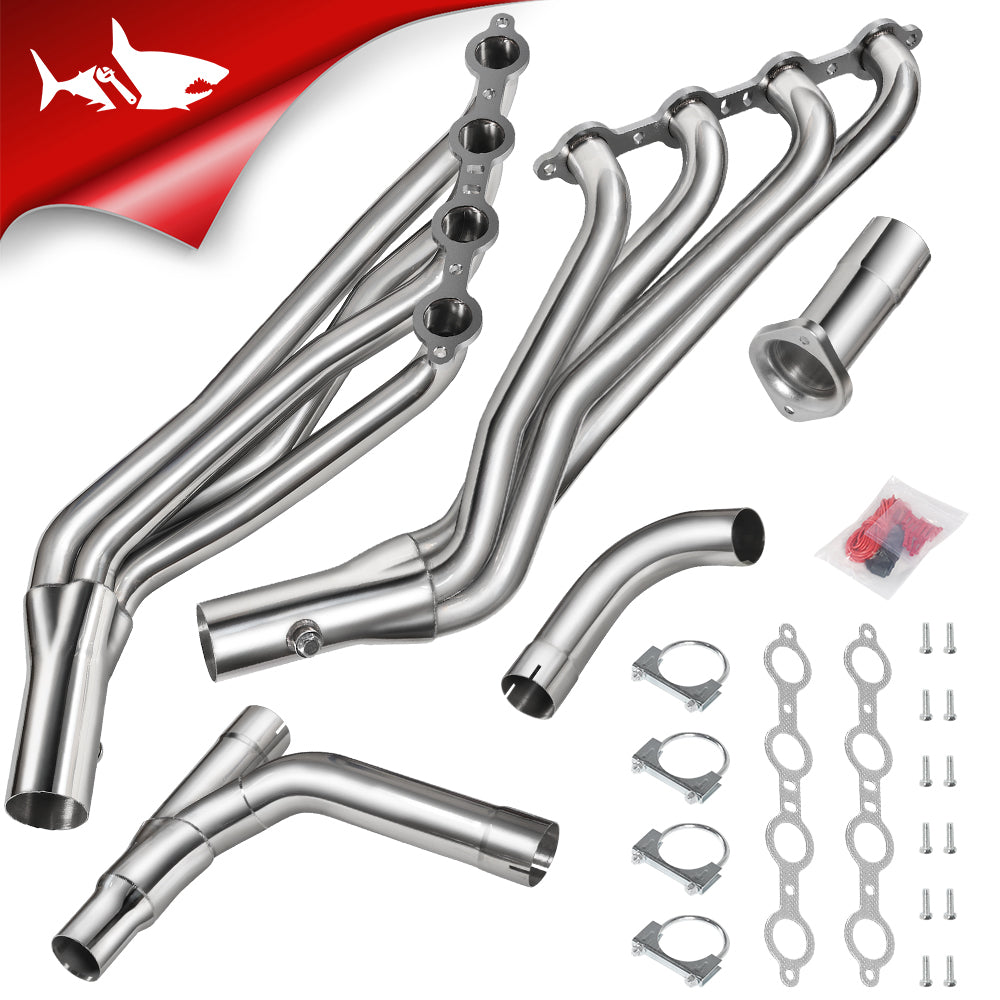
Long tube headers do not automatically create more exhaust heat, but they do expose more tube length inside the engine bay. That means more radiant heat near starter motors, plug wires, brake lines, steering shafts, and nearby plastic parts. Shorty headers are more compact and often easier to package, while long tube headers are usually chosen for stronger mid-range and high-RPM power. For a deeper comparison, see Flashark's guide on shorty vs long tube headers.
Material, Coating, and Engine Bay Airflow
Raw steel, stainless steel, ceramic coating, heat wrap, and heat shields all change how heat moves. Ceramic coating helps reduce radiant heat around the engine bay. Exhaust wrap keeps more heat inside the tube, but it can also trap moisture and accelerate corrosion if installed on the wrong material or used in wet conditions. Engine bay airflow matters too. A tightly packed swap car with poor ventilation will hold more heat than a truck engine bay with room around the headers.
How Hot Do Long Tube Headers Get?
Long tube headers can reach the same surface temperature range as other performance headers, but they often feel like they create more heat because the primary tubes are longer and run closer to sensitive parts. On a V8 truck or muscle car, long tubes may place heat near spark plug boots, transmission lines, starter wiring, O2 sensor harnesses, and floorboard areas.
During normal street driving, long tube header surface temperatures often fall in the 500°F–900°F range. Under sustained load, high RPM, towing, or track driving, surface readings can move near or above 1000°F depending on material, coating, tuning, and airflow. If you are installing long tube headers on a Silverado or Sierra V8, plan heat protection before the first test drive, not after the plug wires are already burned.
How Hot Do Headers Get on a V8?
V8 engines put a lot of exhaust heat into a relatively tight space. On small-block Chevy, LS, HEMI, Ford modular, and other V8 platforms, the headers can sit close to spark plug wires, valve covers, steering shafts, brake lines, and firewall insulation. That is why many V8 header installations include heat sleeves, high-temperature plug wires, ceramic-coated headers, or extra shielding around nearby components.
For a healthy V8, high header temperature alone is not always a problem. What matters is whether the heat is consistent, whether the engine is tuned correctly, and whether nearby components can survive the radiant heat. If one tube is dramatically colder than the others, suspect a dead cylinder, ignition problem, injector issue, or valve problem. If one tube is much hotter than the rest under load, investigate fueling, timing, air leaks, or tube routing.
When Are Exhaust Headers Too Hot?
Headers are supposed to get hot. The warning sign is not simply “high temperature.” The warning sign is abnormal heat for the situation.
- Glowing red at idle: Often points to late timing, lean mixture, misfire, or exhaust restriction.
- Burned plug wires or melted boots: Usually means poor routing, missing heat sleeves, or headers sitting too close to ignition components.
- Blue, purple, or gray discoloration: Can be normal on stainless steel, but extreme color change may suggest repeated high heat.
- Cracked welds or leaking gaskets: Heat cycling can loosen hardware and fatigue thin tubing over time.
- Loss of power under load: Excessive EGT may come from a lean condition, clogged converter, wrong timing, or poor tune.
- Burning smell after installation: Light smell during first heat cycles can be normal, but melting plastic or wire insulation is not.
Warning: Never touch headers after the engine has been running. Even a short idle period can make header tubes hot enough to cause serious burns. Let the exhaust system cool completely before inspection, tightening bolts, rerouting wiring, or checking for leaks.
Consequences of Excessive Header Heat
Material Fatigue and Cracking
Headers go through repeated heat cycles. They expand when hot and contract when cool. Over time, excessive heat can accelerate oxidation, weaken weld areas, loosen bolts, damage gaskets, and create small cracks near flanges or collectors.
Engine Bay Heat Soak
Hot headers can raise under-hood temperature. That heat can reduce intake air density, warm nearby fluid lines, and make already tight engine bays harder on rubber, plastic, electronics, and wiring.
Ignition and Sensor Problems
Spark plug wires, O2 sensor wiring, starter cables, and nearby connectors are common failure points after a header install. If a car runs well cold but develops misfires or sensor codes after heat soak, inspect anything routed near the headers.
Safety Risks
Headers are close to fuel lines, brake lines, wiring, insulation, and sometimes the floorboard. Poorly managed heat can create burning smells, melted insulation, or a fire hazard. This is especially important on engine swaps, older vehicles, off-road builds, and long tube header installs with tight clearances.
How to Measure Exhaust Header Temperature
A simple infrared thermometer can help you compare header tubes, but it has limits. Use it as a diagnostic tool, not as the only source of truth.
- Warm the engine fully. Do not compare one cold cylinder to a warm cylinder.
- Measure the same point on each tube. A good starting point is the same distance from the exhaust flange on every cylinder.
- Keep the angle and distance consistent. Changing angle or distance can change the reading.
- Understand the surface finish. Ceramic coating, polished stainless, and dark mild steel may all read differently.
- Compare patterns, not just one number. A single high reading matters less than a major difference between cylinders under the same condition.
- Use EGT probes for serious tuning. For race, boosted, or dyno tuning work, a thermocouple-based EGT setup is more meaningful than an infrared surface reading.
If you are only checking for a dead cylinder, a heat gun is useful. If one header tube is 250°F while the rest are 550°F, that cylinder may not be firing correctly. If you are trying to tune air/fuel ratio or ignition timing, use proper sensors, plug reading, wideband data, and dyno testing instead of relying only on header surface temperature.
How to Manage High Header Temperatures
Use Ceramic Coating
Ceramic coating is one of the cleanest ways to manage header heat. It helps keep heat inside the exhaust stream, lowers radiant heat around the engine bay, and can improve corrosion resistance. It is especially useful on tight V8 engine bays, off-road vehicles, and builds where plug wires or hoses sit close to the tubes.
Add Heat Shields Where Needed
Heat shields protect specific components without trapping moisture against the header tube. They are a smart choice around starters, brake lines, wiring harnesses, fuel lines, and floorboard areas.
Use Heat Wrap Carefully
Header wrap can reduce radiant heat, but it is not perfect for every build. It can hold moisture, hide cracks, and increase the thermal stress inside the tube. If you use wrap, install it cleanly, avoid wrapping damaged headers, and inspect it regularly.
Protect Spark Plug Wires and O2 Sensor Wiring
Use high-temperature plug wires, 90-degree boots where appropriate, heat sleeves, and proper routing. A small clearance issue can turn into a repeated misfire once the engine bay gets hot.
Choose the Right Header for the Vehicle
A good header is not only about maximum flow. Fitment, flange thickness, tube routing, collector design, O2 sensor position, and heat clearance all matter. If you are replacing a factory manifold, compare the benefits and tradeoffs in this guide to exhaust manifolds vs headers before buying.
Should You Upgrade Your Exhaust Headers for Heat Control?
Do not upgrade headers just because the factory exhaust manifold gets hot. All exhaust parts get hot. Upgrade when the factory setup is restrictive, cracked, leaking, poorly routed, or not matched to your performance goals.
If your main concern is engine bay heat, choose the header material and heat management strategy carefully. A raw, uncoated long tube header may improve flow but add more radiant heat. A ceramic-coated header, proper plug wire routing, and targeted heat shielding will usually be a better long-term solution for a street car than simply installing the largest header available.
For general performance builds, browse Flashark's long tube, shorty, and performance exhaust headers by vehicle fitment before choosing a setup.
FAQ
Q: How hot do exhaust headers get?
A: Many street headers measure around 300°F–600°F at idle, 500°F–900°F during normal driving, and 900°F–1000°F or more under heavy load. The exhaust gas inside the tube can be much hotter than the outside surface.
Q: How hot do long tube headers get?
A: Long tube headers can reach similar temperatures to other performance headers, but they expose more tube area inside the engine bay. Under normal driving, surface readings often fall around 500°F–900°F. Under sustained load, they can approach or exceed 1000°F depending on the engine, tune, coating, and airflow.
Q: How hot do headers get on a V8?
A: V8 headers commonly run several hundred degrees Fahrenheit during light driving and can reach 900°F–1000°F+ under load. Because V8 engine bays can be tight, heat protection for spark plug wires, boots, brake lines, and wiring is especially important.
Q: Is 1000°F normal for exhaust headers?
A: A 1000°F surface reading can be normal during sustained load, hard acceleration, or track use. It is more concerning if headers glow red at idle, melt nearby components, or show one cylinder dramatically hotter than the others.
Q: Are header surface temperature and EGT the same?
A: No. Header surface temperature is measured on the outside of the tube. EGT is the exhaust gas temperature inside the tube. EGT is usually higher and requires a thermocouple probe for accurate measurement.
Q: Why are my headers glowing red?
A: Headers may glow red from late ignition timing, lean fueling, misfire, a clogged catalytic converter, excessive load, or restricted exhaust flow. A slight glow during extreme use can happen, but glowing at idle or light throttle should be inspected.
Q: Can hot headers melt spark plug wires?
A: Yes. Headers can easily melt spark plug boots, plug wires, O2 sensor wiring, and nearby plastic if routing and heat protection are poor. Use proper wire routing, heat sleeves, and enough clearance around the tubes.
Q: Do ceramic-coated headers run cooler?
A: Ceramic coating usually reduces radiant heat from the outside of the header and helps keep more heat inside the exhaust stream. The exhaust gas itself is still hot, but the surrounding engine bay may see less heat exposure.
Q: Is exhaust wrap good for headers?
A: Exhaust wrap can reduce radiant heat, but it can also trap moisture and increase stress in the tube. It works best when used carefully on suitable materials and inspected regularly.
Q: How long do headers take to cool down?
A: Cooling time depends on material, coating, outside temperature, airflow, and how hard the engine was driven. As a safety rule, wait at least 30–60 minutes before working near headers, and always confirm by temperature rather than touch.
Conclusion: Header Heat Is Normal, But Poor Heat Management Is Not
Exhaust headers are designed to handle extreme heat. Seeing several hundred degrees Fahrenheit on a header tube is normal, and hard driving can push temperatures much higher. The key is knowing what you are measuring, where you are measuring it, and whether the heat matches the driving condition.
For a healthy street car, focus on consistent cylinder readings, safe routing, proper heat shielding, strong gaskets, and a tune that keeps air/fuel ratio and ignition timing under control. For performance builds, towing, off-road use, or racing, treat header heat as part of the whole system: header design, material, coating, plug wire protection, engine bay airflow, and exhaust restriction all work together.
If your headers are burning nearby parts, glowing under light load, cracking repeatedly, or causing misfires after heat soak, the problem is not simply that headers get hot. The problem is that the heat is not being managed correctly.

Steven Chen
Automotive Performance Specialist | Engine & Exhaust Systems
Steven focuses on practical engine performance, exhaust fitment, and real-world upgrade paths for classic and modern enthusiast vehicles. He reviews small-block Ford, LS, truck, and street/strip applications with one goal in mind: helping builders choose parts that actually work together. His philosophy: "Good power starts with the right combination, not the biggest part."