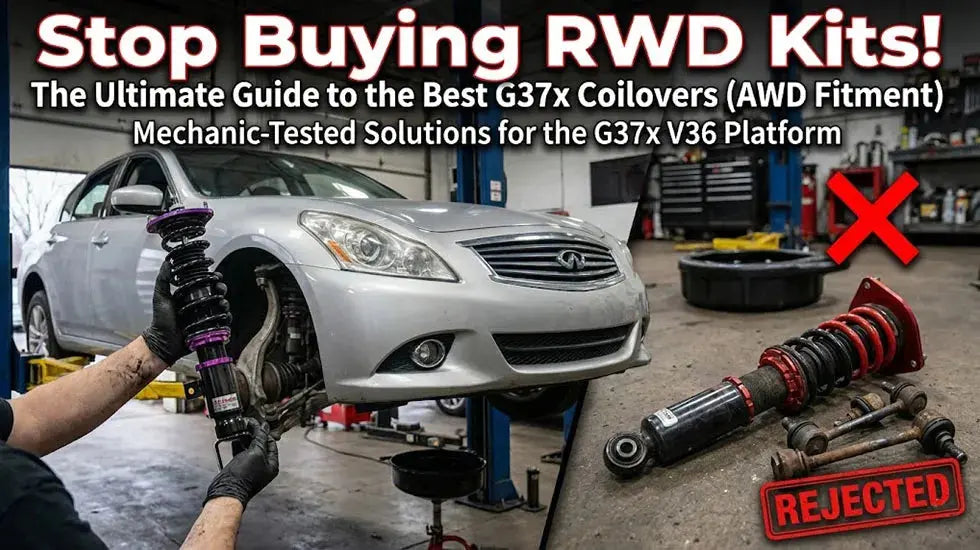
I’ve been wrenching on Nissan and Infiniti platforms for over 15 years. My hands are permanently stained with anti-seize, and my ears constantly ring from the sound of air impacts. But if there is one thing that spikes my blood pressure faster than a snapped exhaust stud, it’s seeing another G37x AWD chassis sitting helplessly on a two-post lift, completely torn apart, while the owner stares blankly at a brand-new rear-wheel-drive suspension kit that absolutely will not fit.
Let's be brutally honest. The Infiniti G37x is a beast of a daily driver. The ATTESA E-TS all-wheel-drive system grips the pavement like superglue. But from the factory? Infiniti shipped these cars with a wheel gap so massive it looks like a crossover SUV. You want to lower it. I get it. Every G37x owner does.
But before you whip out your credit card and hit "checkout" on some random forum recommendation, we need to have a serious talk. The AWD geometry is notoriously picky. Buying the wrong parts won't just waste your weekend; it will destroy your axles. Let's cut the crap and talk about what actually works.
The TL;DR on G37x AWD Suspension Upgrades
If you are reading this while your car is already jacked up in the driveway, here is the absolute bottom line you need to know before touching a single bolt:
- If your goal is daily driving comfort with an aggressive drop (1.5" to 2"): You cannot use standard G37 parts. You strictly need g37x coilovers engineered with a specific U-type/clevis front lower mount to clear the AWD front axles.
- If you are deciding between lowering springs and full assemblies:
- Putting drop springs on 10-to-15-year-old OEM shocks will blow the hydraulic seals within a month. Upgrading to true coilovers is mechanically superior because it allows you to adjust ride height independently of spring preload.
- The Verdict for Budget & Performance: Flashark provides a 100% direct bolt-on setup for the 2003-2013 M35/M45/G35x/G37x platforms. It’s the safest way to kill the SUV wheel gap without compromising the factory ATTESA E-TS drivetrain.
Why You Can’t Just Buy Any G37 Suspension (AWD vs. RWD Fitment)
I see it every single week. A guy jumps on a Facebook group, asks "What's the best suspension for my G?", and ten people instantly shout out a brand. The problem? Nine of those guys drive RWD models. They don't know your pain.
The Front Fork Dilemma
Here is the mechanical reality: the rear-wheel-drive G37 uses a standard lower eyelet mount on the front shock. A single bolt runs straight through a bushing into the lower control arm. Simple. Beautiful. Easy to work on.

The AWD G37x? Not so much. Because your car sends power to the front wheels, there is a thick CV axle sitting exactly where that RWD shock wants to mount. To get around this, Nissan engineers designed a specific clevis bracket (a U-shaped fork) that straddles the front axle and mounts to the lower arm. If the kit you buy doesn't have this fork welded to the bottom of the front strut housing, it is literally impossible to install.
🔧 From the Mechanic's Bay: A Hard Lesson
Back in the fall of 2019, I had a kid tow his 2011 G37x sedan to my shop on a flatbed. It was raining sideways. He had spent his entire Saturday soaking his rusty bolts in PB Blaster, fighting rusted end links, and finally ripping his entire front suspension out in his driveway. When he went to slide the new strut in... clunk. It hit the CV axle. He had bought a used RWD kit. He had to pay for a tow truck, pay me three hours of shop labor to reinstall his blown OEM suspension, and then wait two weeks to order the correct AWD kit. Don't be that guy. Double-check your fitment.
That right there is exactly why I tell my customers to stop hunting for universal bargains and buy a dedicated AWD setup. Investing in properly engineered g37x coilovers will save your axles and your sanity.
Tested & Tuned: Finding the Best G37x Coilovers for the Street
Over the last decade, I’ve bolted on everything from $300 eBay specials that leak after a month, to $3,000 European track setups that rattle your teeth out over a manhole cover.
Here is my honest mechanic's advice: If you are building a dedicated time-attack race car, spend the three grand on a top-tier track suspension. I won't stop you. But if you are like 95% of my customers—you daily drive your G37x to work, hit a canyon road on the weekends, and just want to kill that ugly SUV wheel gap safely—you don't need to empty your bank account.
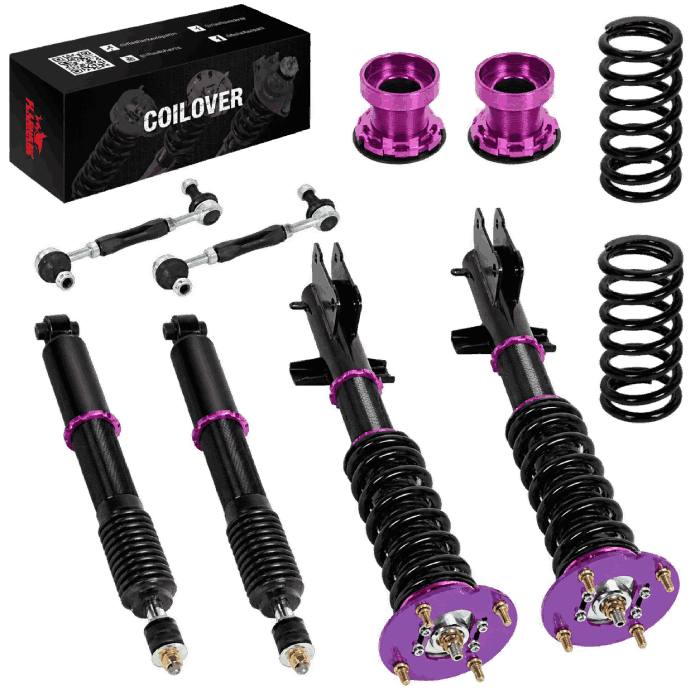
That is exactly why my go-to recommendation for street cars is the Flashark G37x coilover kit. It solves the AWD headache completely, and it keeps your budget intact for wheels and tires.
True 100% Bolt-On Fitment for the AWD Chassis
Unlike universal kits that just slap a generic fork onto a standard shock body, the Flashark units are specifically modeled for the heavy-duty all-wheel-drive front end of the 2003-2013 M35/M45/G35x/G37x platform. The lower clevis bracket is engineered to perfectly clear your front CV boots, even at full steering lock. No grinding, no welding, no sketchy spacers.

Spring Rates Built for the Real World (The 10k/8k Sweet Spot)
Look, you don't want a suspension so stiff that your dashboard rattles every time you hit a bridge expansion joint. Flashark typically ships these with a 10 kg/mm front and 8 kg/mm rear spring rate. This is the golden ratio for the heavy VQ37VHR engine up front and the AWD transfer case. Pair that with their adjustable dampening, and you're in control. Dial the clickers to 12 clicks from full-soft for grabbing groceries, or crank them up to 24 clicks when you want to carve up a mountain road with zero body roll.
The Drop: Erasing the SUV Stance Safely
These independent-height-adjustable bodies mean you lower the car by threading the shock body into the lower mount, not by compressing the spring. You keep your full shock travel whether you drop it 1 inch or 2.5 inches. But hear me now: do not slam your G37x more than 2.5 inches. If you do, the extreme angle will bind up your front CV axles, and they will snap under hard acceleration. A 1.5-inch drop gives you that perfect flush fitment over a set of 19-inch wheels while keeping your drivetrain safe.
OEM vs. Flashark Coilovers: The Hard Numbers
| Specification | OEM Shocks + Lowering Springs | Flashark AWD Coilovers |
|---|---|---|
| Ride Height Adjustability | Fixed (Stuck at the spring's drop rate) | Fully Independent (1" to 3" Drop) |
| Dampening Control | None (Soft factory valving) | Multi-level Adjustable Clicks |
| Shock Travel | Reduced (Prone to bottoming out/leaking) | 100% Retained Factory Travel |
| AWD Axle Clearance | OEM Fitment | Custom Clevis Bracket (Direct Fit) |
3 Things to Check Before Lowering Your G37x
Alright, so you bought the kit. It's sitting in your garage. Before you put the car on jack stands, listen to a guy who has made all the mistakes so you don't have to. The G-chassis is heavy, and parts seize up over time.
1. Rusty Sway Bar End Links (Have the Angle Grinder Ready)

To get the front struts out, you have to disconnect the sway bar end links. The factory end links use a stupid hex-key center to hold the stud while you turn the nut. After 10 years of road salt and grime, that hex key will strip out immediately. I don't even try anymore. Save yourself two hours of swearing: buy a pair of new front end links before you start the job, and just take an angle grinder or a Sawzall to the old ones.
⚠️ Mechanic's Tire Wear Warning: Do You Need Front Upper Camber Arms (FUCA)?
Here is the dirty secret of lowering a double-wishbone suspension like the G37. The factory front upper arms have ZERO camber adjustment. If you drop your AWD G37x more than 1.5 inches, your front wheels will tilt inward at around -2.5 degrees of camber. You will literally chew through the inner tread of a $1,200 set of Michelin Pilot Sport 4S tires in less than 8,000 miles. If you want to go low, budget for an aftermarket adjustable Front Upper Camber Arm (FUCA) kit so the alignment shop can get your specs back to factory green.
2. The Rear Spring Bucket Trap
The rear of the G37x uses a divorced spring setup (the spring and shock are separate). The rear spring sits in a lower control arm commonly called the "spring bucket." When you swap to your new adjustable rear spring perch, make sure the rubber isolator is seated perfectly. If it sits crooked, you'll hear a maddening squeak over every single speed bump, and you'll have to drop the arm all over again.
3. Mark Your Eccentric Bolts
When you unbolt the rear suspension to get the old springs out, you might have to loosen the camber/toe eccentric bolts on the subframe. Before you touch them, take a silver Sharpie and draw a line across the bolt head and the subframe. This ensures you can line them back up to their rough factory position so the car is actually drivable on your way to the alignment shop.
Quick DIY Tips for G37x Coilover Installation
If you're ignoring my advice to take it to a professional and deciding to bust your knuckles in the driveway this weekend, fine. I respect the hustle. But before you start snapping bolts, listen up. The service manual leaves out a few miserable realities about the Infiniti AWD front end.
First, getting that factory front strut out of the lower control arm is a nightmare. It doesn't just slide out. Once you unbolt the clevis bracket, the suspension is still under tension. Do not hit the aluminum control arm with a metal hammer. Grab a heavy rubber mallet, spray the lower fork mount down with PB Blaster, and use a 4-foot pry bar pushing down on the wheel hub while you wiggle the shock free. It takes muscle.
Second, when you go to install your new setup, do not tighten the lower shock bolts while the car is in the air. This is the number one rookie mistake I see. If you tighten the bushings at full droop, the moment you put the car on the ground, the rubber bushings will be twisted and bind up. They will tear completely within 5,000 miles. Put a floor jack under the lower control arm, jack the suspension up until it lifts off the jack stand slightly (simulating ride height), and then torque everything down to spec.
Stop Guessing. Fix Your AWD Stance Right Now.
I've spent 15 years fixing other people's suspension mistakes. Stop trying to force RWD parts onto your AWD chassis. If you want a setup that actually clears your front axles, rides smooth on your daily commute, and completely kills that ugly factory wheel gap, you know what to do.
Get The Correct G37x Coilovers HereFrequently Asked Questions (G37x AWD Suspension Upgrades)
Still have questions before pulling the trigger? Here are the exact answers I give my customers at the shop desk every single week.
Q1: Do regular G37 coilovers fit the G37x?
A1: Absolutely not. The front lower mounts on the RWD G37 use a standard eyelet bushing. The AWD G37x requires a specific U-shaped clevis bracket to straddle the front CV axles. If you buy RWD parts for your AWD, they physically will not bolt onto your car.
Q2: What is the best spring rate for a daily driven G37x?
A2: For a street-driven G37x, you want 10 kg/mm in the front and 8 kg/mm in the rear. This perfectly balances the heavy VQ37VHR engine and the AWD transfer case upfront without rattling your teeth loose over speed bumps.
Q3: Will lowering my G37x ruin the AWD system (ATTESA E-TS)?
A3: Lowering the chassis won't ruin the ATTESA E-TS system, but running staggered tire sizes with drastically different rolling diameters will. Keep your overall tire diameters within 1% of each other front-to-rear, and the AWD system will be perfectly fine.
Q4: How much does it cost to install coilovers on a G37x?
A4: If you bring it to a reputable performance shop, expect to pay between $400 and $600 for the labor to swap all four corners. You will also need to budget another $100 to $150 for a mandatory four-wheel alignment afterward.
Q5: True coilover vs. OEM style rear setup for G37x: Which is better?
A5: A "true coilover" conversion moves the rear spring onto the shock body, deleting the spring bucket. It makes height adjustments slightly easier, but it puts all the load on the upper shock mount, which wasn't designed for it. For 99% of street setups, keeping the OEM divorced style (separate spring and shock) is perfectly fine and highly reliable.
Q6: Do I need an alignment right after installing coilovers?
A6: Yes, but don't do it the very same day. Drive the car for about a week, or roughly 100 miles, to let the new suspension springs "settle" into their final ride height. Once they settle, take it to the alignment rack immediately before you destroy your tire tread.
Q7: Can I just use lowering springs on my G37x instead?
A7: You can, but it’s a terrible long-term investment. Pairing aggressive lowering springs with 10-to-15-year-old factory OEM shocks forces them to operate outside their designed stroke range. You will blow the hydraulic seals incredibly fast. Buying full assemblies saves you from paying labor twice.
Q8: How low can I drop my G37x before hitting the front axles?
A8: A 1.5-inch to 2-inch drop is the absolute sweet spot for the AWD platform. If you drop it further (like 3 inches), your lower control arms will point upward, and your CV axles will bind. Going too low on an AWD car requires extensive geometry correction parts.
Q9: How do I adjust the dampening on my new suspension?
A9: Most quality kits come with clicker knobs on the top of the shock tower. Turn the knob clockwise until it stops (full stiff), then back it out counter-clockwise about 16 clicks. Drive it around the block. If it feels too bouncy, turn it a few clicks harder. If it's too harsh, turn it softer. It's all about personal feel.
Q10: How long do aftermarket coilovers usually last on a G-series?
A10: If you buy a reputable brand and avoid slamming your car into massive potholes, a quality set driven daily should last roughly 40,000 to 60,000 miles before the dampeners start to feel tired and need a rebuild or replacement.