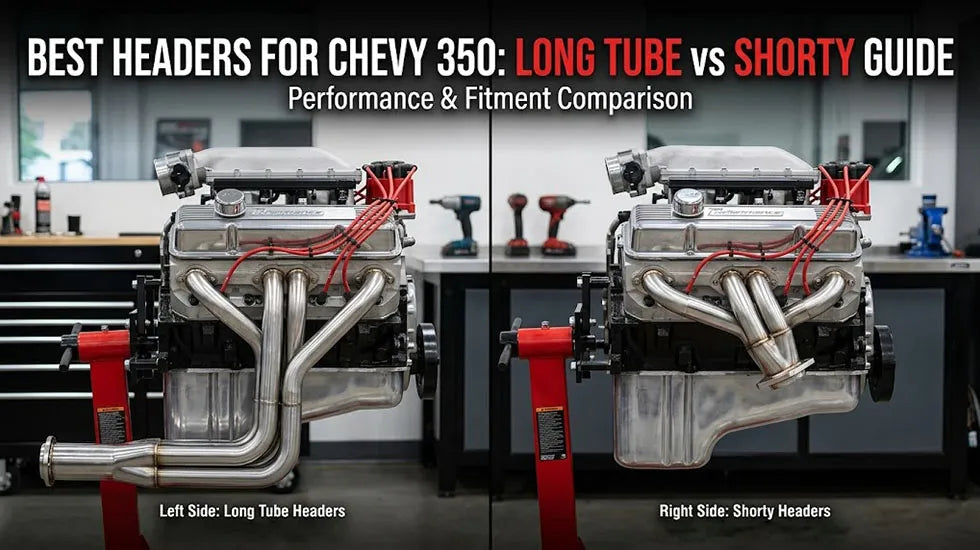
Upgrading your Chevy 350 with the right headers is one of the cleanest ways to wake up a small block. Not magic. Not a miracle part. Just better exhaust flow, less restriction, sharper throttle response, and that deeper small-block sound most people are chasing in the first place.
But here is where a lot of builders get it wrong: the best headers for a Chevy 350 are not always the biggest headers on the shelf. A mild street 350, a lifted 4x4 truck, a lowered C1500, and a cammed Camaro do not want the exact same header setup.
Quick Answer: What are the best headers for a Chevy 350?
For most mild street Chevy 350 / SBC builds, 1 5/8-inch long tube headers with a 2.5-inch collector are usually the best all-around choice for power, torque, and sound. Shorty headers make more sense for 1988–1997 Chevy/GMC trucks, 4x4 setups, lowered trucks, or tight engine bays where ground clearance and easier installation matter more than peak high-RPM horsepower.
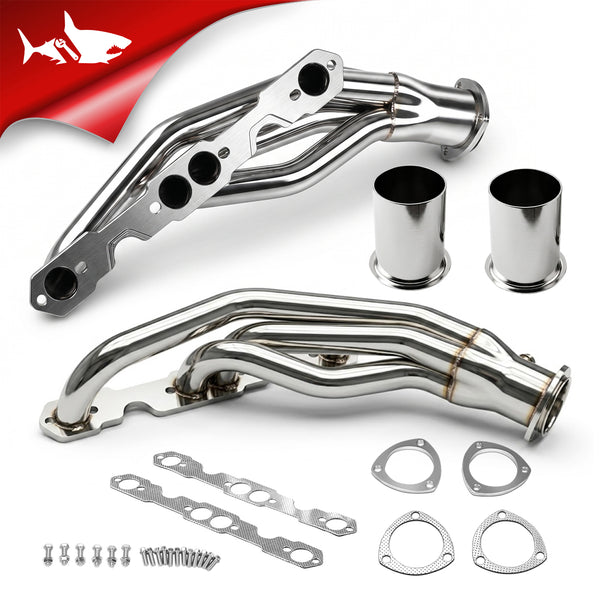
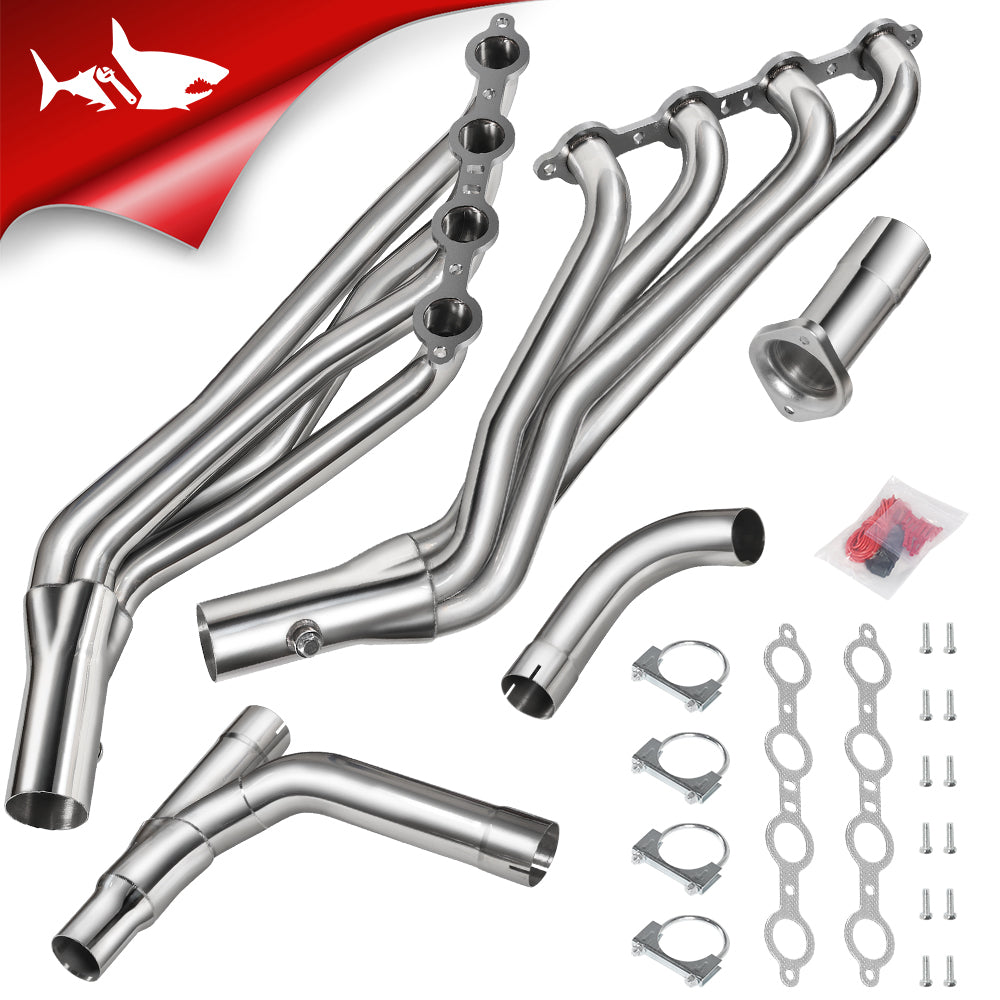
Top Recommendation: If you own a 1988–1997 Chevy/GMC truck with a 305 or 350 small block, the Chevy 350 long tube headers are the strongest pick for flow and sound. If clearance is the bigger concern, the Chevy 350 shorty headers are the safer street-truck option.
Garage Note
Do not choose headers by horsepower claims alone. On a street-driven small block Chevy, tube size, collector size, ground clearance, spark plug access, starter heat, and exhaust hookup matter just as much as peak dyno numbers.
Chevy 350 Headers Selection Table
If you only want the practical answer, start here. This table covers the most common Chevy 350 header setups and where each one makes sense.
| Build Type | Best Header Type | Primary Tube Size | Collector Size | Best For | Be Careful If |
|---|---|---|---|---|---|
| Mild street Chevy 350 | Long tube headers | 1 5/8" | 2.5" | Best all-around torque, sound, and street power | Your truck is lowered or has poor ground clearance |
| Daily-driven Chevy/GMC truck | Shorty or mid-length headers | 1 5/8" | Stock-compatible or 2.5" | Ground clearance, easier install, low-to-mid RPM use | You want maximum high-RPM horsepower |
| Camaro, Chevelle, Nova street car | Long tube headers | 1 5/8" to 1 3/4" | 2.5" to 3" | Classic muscle sound and stronger upper-RPM pull | Steering box, clutch linkage, or spark plug clearance is tight |
| Cammed or high-RPM 350 | Long tube headers | 1 3/4" | 3" | Track use, bigger cam, better heads, higher RPM power | The engine is stock or mostly stock |
| SBC swap or tight engine bay | Block hugger headers | Usually compact 1 1/2" to 1 5/8" | Application-dependent | Street rods, swaps, custom chassis clearance | You need maximum performance from a full exhaust system |
Introduction to Headers for Chevy 350
Exhaust headers replace the factory cast exhaust manifolds on a Chevy 350 small block. Instead of forcing exhaust gases through a compact, restrictive manifold, headers use individual primary tubes to guide exhaust flow out of each cylinder more efficiently.
That cleaner path can reduce backpressure, improve exhaust scavenging, sharpen throttle response, and add horsepower when the rest of the engine combination can use the extra flow. On a mild small block Chevy, a quality header upgrade commonly feels strongest through better response, stronger pull through the midrange, and a more aggressive exhaust note.
Still, the right choice depends on the vehicle. A 1988–1997 C/K truck needs a different fitment conversation than a classic Camaro or Chevelle. A lowered truck has different problems than a drag car. And a stock 350 with a mild cam does not need the same tube size as a high-compression, high-RPM weekend warrior.

Long Tube vs Shorty Headers for Chevy 350
Long Tube Headers
Long tube headers are usually the best choice when you want stronger horsepower and that classic small-block sound. They use longer primary tubes before the collector, which helps exhaust pulses move more efficiently at higher RPM. On the right Chevy 350 combination, that can mean better scavenging, stronger pull, and a more serious exhaust tone.
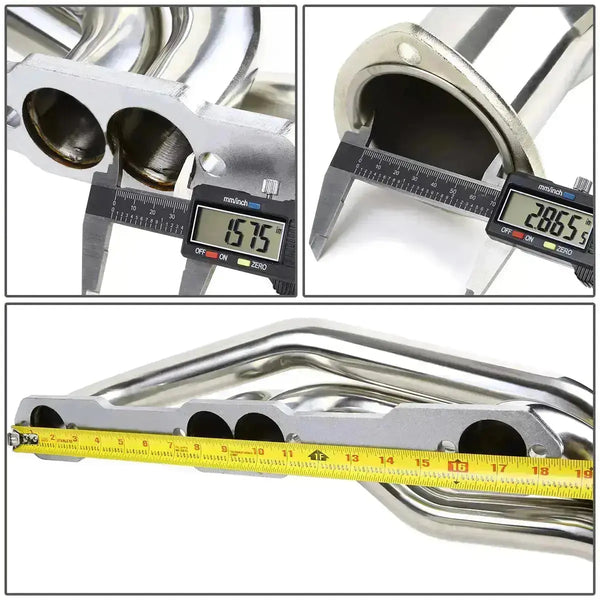
For most street small blocks, 1 5/8-inch long tube headers are the sweet spot. They keep exhaust velocity high enough for throttle response while still flowing better than the factory manifolds. If the engine has better cylinder heads, a larger cam, more compression, or spends more time above 5,000 RPM, stepping up to 1 3/4-inch primaries can make sense.
Mechanic's Take
Long tubes are great, but they are not always friendly. Check ground clearance, collector location, transmission crossmember clearance, starter heat, and spark plug wire routing before you order. Most header complaints start with fitment, not horsepower.
Shorty Headers
Shorty headers are more compact. They usually fit easier, tuck higher, and cause fewer clearance headaches. On a 1988–1997 Chevy/GMC C1500, K1500, C2500, or similar truck, shorties can be the smarter choice if the truck is lowered, used daily, or still has a mostly stock exhaust layout.
No, shorty headers usually do not make the same top-end power as long tubes. But they can still improve flow compared with restrictive factory manifolds, especially when paired with a healthy exhaust system. For a street truck that needs to stay easy to service, shorties are often the no-drama option.
Block Hugger Headers
Block hugger headers are common on swaps, street rods, and tight engine bays. They sit close to the engine block, giving you more room around the frame, steering, and suspension. If your Chevy 350 is going into a custom chassis, the SBC small block hugger headers may be worth looking at.
The trade-off is flow. Block huggers are built for packaging first. They are not usually the best choice when the goal is maximum horsepower from a strong 350.
What Size Headers Are Best for a Chevy 350?
Tube size matters. Too small can choke the engine at higher RPM. Too big can slow exhaust velocity and make a mild street motor feel lazy down low. Bigger is not automatically better.
| Header Size | Best Use | Why It Works | Avoid If |
|---|---|---|---|
| 1 1/2" primary | Stock or very mild low-RPM street builds | Keeps exhaust velocity high | You have better heads, cam, or high-RPM goals |
| 1 5/8" primary | Most street Chevy 350 engines | Best balance of torque, response, and flow | Dedicated racing engine with serious airflow needs |
| 1 3/4" primary | Cammed, higher-compression, high-RPM 350 builds | Supports stronger upper-RPM airflow | Your engine is mostly stock and street-driven |
| 1 7/8" primary | Large-displacement or serious race combinations | Flows a lot of exhaust at high RPM | Typical 350 street builds |
Collector size follows the same logic. A 2.5-inch collector is usually a good match for a mild street 350. A 3-inch collector starts to make more sense when the engine has enough cam, head flow, compression, and RPM range to use it.
Chevy 350 Header Fitment: Trucks, 4x4, Camaro, Chevelle & Nova
This is the part too many buying guides skip. Header performance means nothing if the tubes hit the frame, cook the starter, block the spark plugs, or dump the collector into the wrong place.
1988–1997 Chevy/GMC C/K Trucks
For 1988–1997 Chevy and GMC trucks with 305 or 350 small blocks, fitment depends heavily on whether the truck is 2WD or 4WD, stock height or lowered, and how the exhaust is routed. Long tube headers give the bigger sound and power potential, but shorty headers can be easier to live with on daily-driven trucks.
- Best power choice: long tube headers for better exhaust flow and stronger sound.
- Best clearance choice: shorty headers for lowered trucks, tighter installs, and simpler exhaust routing.
- Watch closely: starter clearance, steering shaft clearance, front driveshaft clearance on 4WD models, and collector location.
4x4 Chevy Trucks
On a 4x4 truck, do not order headers without thinking about the front driveshaft, transfer case, suspension travel, and collector angle. Long tubes can work in some setups, but they are more likely to need careful checking. Shorty headers are often the safer pick when the truck still gets used like a truck.
Lowered C1500 Trucks
If the truck is lowered, ground clearance becomes the whole game. Long tube collectors can hang low enough to scrape on speed bumps, driveway angles, and rough roads. For a lowered C1500, shorty headers may give up a little peak horsepower, but they can save you from smashing collectors.
Camaro, Chevelle, and Nova
Classic muscle cars usually respond well to long tube headers, especially when the engine has a cam, intake, carburetor, or cylinder head upgrade. For 1967–1981 Camaro, 1968–1979 Chevelle, and Nova-style SBC builds, the 1967–1981 Chevy 350 headers are the better direction if you want classic long-tube sound and stronger upper-RPM pull.
Still, check steering box clearance, spark plug boot clearance, clutch linkage, and transmission type before installing. Old muscle cars are famous for having “almost fits” problems.
Key Factors to Consider When Choosing Chevy 350 Headers
1. Engine Combination
A stock 350, a mild cam street engine, and a high-compression weekend car do not need the same header. For a mostly stock or mild street engine, 1 5/8-inch headers are usually the safest pick. For a hotter 350 with better heads and a bigger cam, 1 3/4-inch long tubes may be worth it.
2. RPM Range
If the engine spends most of its life under 4,500 RPM, keep the setup street-friendly. Strong exhaust velocity helps torque and throttle response. If the engine is built to pull hard above 5,000 RPM, larger long tubes and collectors become more attractive.
3. Vehicle Clearance
Ground clearance, steering clearance, starter clearance, frame clearance, and exhaust routing all matter. This is where a lot of header installs go sideways. Always match the header to the chassis, not just the engine.
4. Material and Coating
Stainless steel is a strong choice for corrosion resistance and long service life. Ceramic-coated headers can help reduce engine bay heat, which is useful when spark plug wires, starters, brake lines, and wiring are close to the tubes.
5. Street Use and Emissions Rules
Headers can affect emissions equipment depending on the vehicle, year, and state. For street-driven vehicles, check your local laws before removing, relocating, or modifying emissions-related components. This matters especially in states with strict inspection rules.
Legal Note
This guide is for general performance and fitment education. Always verify emissions legality for your vehicle, year, and location before installing aftermarket headers on a street-driven vehicle.
Performance Benefits of Upgrading Headers for Chevy 350
The factory exhaust manifolds on many small block Chevy applications are durable, but they are not designed for maximum flow. Headers help the engine breathe better by separating exhaust pulses and moving gases away from the cylinder heads more efficiently.
Depending on the engine combination, exhaust system, tune, and header style, a Chevy 350 header upgrade can commonly add around 10–20 horsepower over restrictive manifolds. On some mild builds, the difference may feel more like sharper response and stronger sound than a massive dyno jump. On a better-breathing engine with the right cam and intake, the gains can be more noticeable.
- Better exhaust flow: less restriction than many factory manifolds.
- Improved throttle response: especially when the carburetor or EFI setup is adjusted correctly.
- Stronger sound: deeper, sharper, more aggressive small-block tone.
- More upgrade headroom: useful when adding cam, intake, carburetor, or cylinder head upgrades.
If you are also learning how exhaust heat affects surrounding parts, read our guide on how hot exhaust headers get. Heat management is not theory. It can decide whether your plug wires, starter, and nearby wiring survive.
How to Install Headers on a Chevy 350
Installing headers on a Chevy 350 is not the worst job in the world, but do not rush it. Most problems come from poor prep, cheap gaskets, uneven bolt tightening, and not checking clearance before final assembly.
1. Prepare the Truck or Car
- Disconnect the battery.
- Raise the vehicle safely if you need underbody access.
- Spray old manifold bolts with penetrating oil before removal.
- Check that your new headers match the cylinder heads and chassis.
- Lay out the gaskets, bolts, reducers, and collector hardware before starting.
2. Remove the Factory Exhaust Manifolds
Remove the old exhaust manifolds carefully. Old bolts can break, especially on trucks that have seen years of heat cycles and rust. Take your time. If a bolt feels like it is about to snap, stop and work it back and forth with more penetrating oil.
3. Test-Fit the Headers
Before you install gaskets and tighten everything, test-fit the headers. Look at spark plug access, steering shaft clearance, starter clearance, brake lines, transmission linkage, and collector position. If something is close now, it will be worse once the engine moves under load.
4. Install Gaskets and Tighten Evenly
Use good header gaskets and tighten the bolts evenly from the center outward. Do not crank down one side and then the other. Uneven tightening can create sealing problems. After the first few heat cycles, re-torque the header bolts. This one step prevents a lot of annoying ticking leaks.
5. Connect the Exhaust System
Long tube headers may require reducers, collector adapters, or exhaust modification. Shorty headers are usually easier to connect to an existing exhaust system, depending on the application. Make sure the exhaust is not pulling the header out of alignment.
6. Check for Leaks and Heat Issues
Start the engine and listen carefully. A header leak often sounds like a sharp tick near the flange or collector. Also check spark plug wires and the starter after the first drive. If anything is too close to the tubes, add heat protection before it becomes a failure.
Common Install Mistake
Do not skip the re-torque. Header bolts loosen after heat cycles. A perfect install can turn into an exhaust leak after a few drives if the bolts are never checked again.
Recommended Headers for Chevy 350
Here are the Chevy 350 header options that make the most sense by vehicle and use case. Instead of saying one header is “best” for every small block Chevy, match the part to the chassis first.
Best Long Tube Headers for 1988–1997 Chevy/GMC 305/350 Trucks

The FLASHARK long tube headers for 1988–1997 Chevy/GMC 305/350 trucks are the strongest choice in this guide if your goal is exhaust flow, sound, and performance from a truck-based small block.
| Best For | 1988–1997 Chevy/GMC C/K trucks with 305 or 350 SBC engines where power and sound are the priority. |
| Why Choose It | Long tube design improves exhaust flow and helps the small block pull harder compared with restrictive manifolds. |
| Watch Out For | Ground clearance, 4WD clearance, collector location, and exhaust hookup. |
Best Shorty Headers for 1988–1997 Chevy/GMC C1500/2500 Trucks

The FLASHARK shorty headers for 1988–1997 Chevy/GMC C1500/2500 trucks are the better pick when you care more about clearance, daily driving, and easier installation.
| Best For | Street trucks, lowered trucks, tighter installs, and users who want better flow without long tube clearance headaches. |
| Why Choose It | Compact routing, simpler fitment, and better service access than many long tube setups. |
| Watch Out For | Peak high-RPM gains will usually be lower than long tube headers. |
Best Long Tube Headers for Camaro, Chevelle, and Nova SBC Builds

The FLASHARK headers for 1967–1981 Camaro, 1968–1979 Chevelle, and Nova SBC applications are aimed at classic muscle car builds using 283, 327, 350, or 400 small block engines.
| Best For | Classic Camaro, Chevelle, and Nova owners who want stronger sound and performance from an SBC street car. |
| Why Choose It | Long tube layout supports better exhaust scavenging and classic muscle-car tone. |
| Watch Out For | Steering box clearance, spark plug access, clutch linkage, and exhaust alignment. |
Chevy 350 Header Problems to Watch For
Headers are simple parts, but the install environment is not simple. Heat, vibration, old bolts, tight chassis packaging, and exhaust alignment can all create problems.
| Problem | Common Cause | How to Prevent It |
|---|---|---|
| Header leak or ticking sound | Loose bolts, poor gasket seal, uneven tightening | Use good gaskets, tighten evenly, re-torque after heat cycles |
| Burned spark plug wires | Plug boots too close to hot tubes | Use heat sleeves, proper wire routing, and angled boots if needed |
| Starter heat soak | Header tubes near the starter | Add a starter heat shield or wrap nearby sections carefully |
| Collector scraping | Long tubes on lowered trucks or low chassis | Choose shorty headers or verify collector height before final install |
| Exhaust alignment issues | Collector angle does not match existing pipes | Plan for reducers, adapters, or exhaust shop work |
Related Small Block and Exhaust Guides
If you are building a broader engine and exhaust plan, these related guides may help:
- How Hot Do Exhaust Headers Get?
- 5.3 Vortec Engine Guide: Specs, Problems & Upgrades
- 6.0 Vortec Engine Guide: Performance, Reliability & Upgrades
Conclusion
The best headers for a Chevy 350 depend on the engine, the chassis, and how the vehicle is actually used. For most mild street SBC 350 builds, 1 5/8-inch long tube headers with a 2.5-inch collector are the best all-around choice. They bring the sound, the flow, and the performance most small-block owners want.
But if you are working with a lowered truck, tight engine bay, 4x4 setup, or daily driver where ground clearance matters, shorty headers may be the smarter choice. Less drama. Easier fitment. Fewer scraped collectors.
Match the header to the build. Check clearance before final install. Use good gaskets. Re-torque the bolts. That is how you get a Chevy 350 header upgrade that actually works instead of becoming another weekend headache.
Frequently Asked Questions
Q: What are the best headers for a Chevy 350?
A: For most mild street Chevy 350 engines, 1 5/8-inch long tube headers with a 2.5-inch collector are the best all-around choice. They offer a strong balance of torque, horsepower, and classic small-block sound. Shorty headers are better when clearance and easy installation matter more than maximum high-RPM power.
Q: Are long tube or shorty headers better for a Chevy 350?
A: Long tube headers are usually better for horsepower and upper-RPM performance. Shorty headers are better for tight engine bays, lowered trucks, 4x4 applications, and easier exhaust hookup. The best choice depends on the vehicle and how you drive it.
Q: What size headers are best for a mild Chevy 350?
A: A mild street Chevy 350 usually works best with 1 5/8-inch primary tubes. This size keeps exhaust velocity strong for street torque while still flowing better than restrictive factory manifolds.
Q: Are 1 3/4-inch headers too big for a stock 350?
A: In many cases, yes. A mostly stock Chevy 350 may feel better with 1 5/8-inch headers because they maintain better low-to-mid RPM response. 1 3/4-inch headers make more sense with better heads, a larger cam, higher compression, or high-RPM use.
Q: How much horsepower do headers add to a Chevy 350?
A: A quality header upgrade can commonly add around 10–20 horsepower, depending on the engine combination, exhaust system, carburetor or EFI adjustment, and header design. On a mild street engine, the biggest difference may be sharper response and better sound.
Q: Are long tube headers worth it on a Chevy 350 truck?
A: Long tube headers can be worth it on a Chevy 350 truck if you want stronger sound and better flow. However, check ground clearance, 4x4 clearance, collector location, and exhaust routing first. For a lowered or daily-driven truck, shorty headers may be more practical.
Q: Do shorty headers fit better on 1988–1997 Chevy/GMC trucks?
A: Shorty headers are usually easier to fit on 1988–1997 Chevy/GMC trucks because they are more compact and often create fewer ground clearance and exhaust routing problems. They are a good choice for daily drivers and lowered trucks.
Q: What headers fit a 350 small block swap?
A: It depends on the chassis. For tight swaps, block hugger headers are often the easiest to package. For classic muscle cars and trucks with enough room, long tube headers can provide better performance. Always check steering, frame, starter, and spark plug clearance.
Q: Do Chevy 350 headers need a tune or carb adjustment?
A: Basic headers may not require a full tune on every setup, but carburetor jetting or EFI adjustment can help the engine take advantage of the improved exhaust flow. If the engine runs lean, surges, or feels flat after installation, tuning should be checked.
Q: How do I stop Chevy 350 headers from leaking?
A: Use quality gaskets, clean the cylinder head surface, tighten bolts evenly from the center outward, avoid forcing the exhaust into alignment, and re-torque the bolts after several heat cycles. Most header leaks come from poor sealing or bolts loosening over time.
Q: Are Chevy 350 headers street legal?
A: It depends on your vehicle year, emissions equipment, and local laws. Some headers are intended for off-road or racing use only. For street vehicles, especially in emissions-inspection states, verify legality before installation.
References
- Chevrolet Performance: Small-Block Engine Timeline
- MotorTrend: Header Theory and Sizing
- Speedway Motors: Choosing the Right Headers

Steven Chen
Automotive Performance Specialist | Engine & Exhaust Systems
Steven focuses on practical engine performance, exhaust fitment, and real-world upgrade paths for classic and modern enthusiast vehicles. He reviews small-block Ford, LS, truck, and street/strip applications with one goal in mind: helping builders choose parts that actually work together. His philosophy: "Good power starts with the right combination, not the biggest part."