Listen, if you own a 6.7L Powerstroke, you already know you are driving a heavy-duty beast. Ford built a phenomenal V8 diesel, but straight from the factory, it is breathing through a massive restriction. To keep the EPA happy, your truck is lugging around a DPF (Diesel Particulate Filter), an SCR, and an EGR system. They choke the airflow, spike your Exhaust Gas Temperatures (EGTs), and eventually lead to a tow truck ride when a sensor inevitably fails.

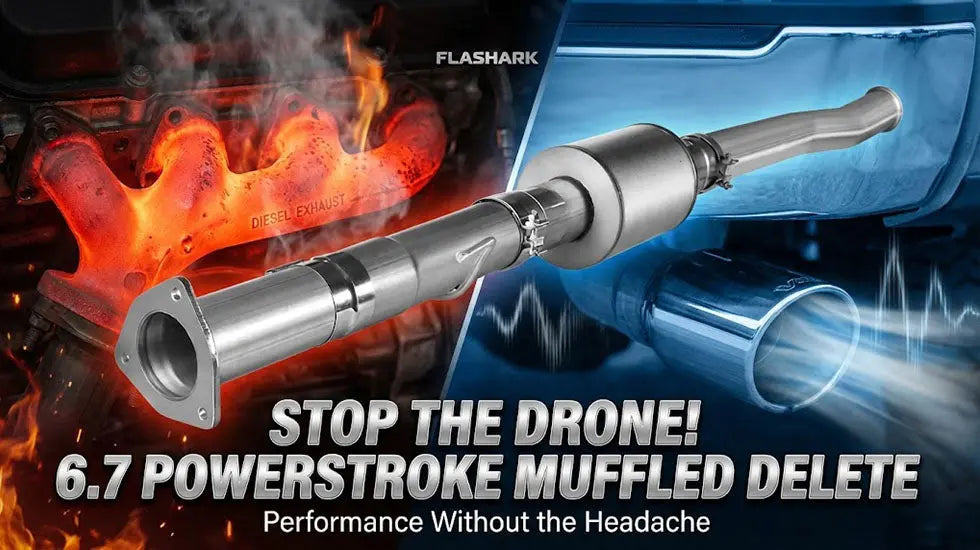
Naturally, your first thought is to rip it all out. A full delete. But here is the dirty little secret nobody tells you on the forums: if you just throw a straight pipe on a 6.7L Powerstroke, it is going to scream like a jet engine, and the cabin drone will rattle your teeth out on the highway. Honestly, I've wrenched on hundreds of these trucks over the last 15 years, and fixing bad exhaust setups is my bread and butter. If you want the performance without needing earplugs, a 6.7 Powerstroke DPF delete pipe with a muffler is exactly what you need.
TL;DR: The Bottom Line on Muffled vs. Straight Pipe Deletes
Choosing between a straight pipe and a muffled delete pipe depends entirely on how you use your truck. Here is the reality:
- For Dedicated Towing/Family Hauling: A high-flow muffled delete pipe is mandatory. It eliminates the 1800 RPM highway cab drone, keeps the VGT turbo whistle manageable, and still drops EGTs by roughly 100°F to 150°F under heavy load.
- For Pure Track/Off-Road Competition: A straight pipe offers the absolute lowest backpressure, but be prepared for extreme in-cab noise and a harsh, rasp-heavy exhaust note.
- The Performance Truth: A straight-through diesel muffler does not restrict power. Dyno tests show the difference between a straight pipe and a straight-through muffler on a deleted 6.7L is a negligible 2 to 3 rear-wheel horsepower (whp).
The 6.7L Powerstroke Sound Profile (Why It's So Loud)
Before you start cutting pipes, you need to understand why the 6.7 sounds the way it does. Ford designed this engine with "reverse-flow" cylinder heads. The exhaust manifolds are in the valley of the engine, feeding directly into a single Variable Geometry Turbocharger (VGT).
Because the exhaust path from the block to the turbo is incredibly short, this engine moves exhaust gas violently and efficiently. When you remove the giant DPF honeycombs, that VGT whistle is no longer muffled by factory ceramics. It sounds like a Boeing 737 spooling up at a stoplight. Fun for about ten minutes. Agonizing on a four-hour road trip.
Straight Pipe vs. Muffled Delete: Hard Numbers and Reality
Let's look at the actual differences. I always have guys asking me if adding a muffler defeats the purpose of deleting the truck. The short answer is no. A proper diesel performance muffler is a "straight-through" design. You can literally look through one end and see out the other. It just has acoustic packing on the outer shell to absorb high-frequency sound waves.

| Feature / Metric | Straight Pipe Delete | Muffled Delete Pipe |
|---|---|---|
| In-Cab Drone (70mph / 1800 RPM) | Severe. Requires raised voices to speak to passengers. | Minimal to None. You can comfortably listen to the radio. |
| Turbo Whistle | Piercing, high-pitched screech under acceleration. | Noticeable but controlled. Deep V8 rumble is more prominent. |
| EGT Reduction (Under Load) | ~150°F to 180°F drop | ~140°F to 170°F drop (Negligible difference) |
| Performance Gain | Approx. 10-15 whp (Tune dependent) | Approx. 10-13 whp (Tune dependent) |
Master Tech Case File: The Drone is Real
If you don't believe the table, let me give you a real-world example from my shop floor.
🔧 Shop Notes: I remember back in '18, we had a 2017 F-350 Dually come into the shop. The owner was a hotshot trucker hauling a 40-foot flatbed across state lines. He read some forum posts and decided to go with a cheap 5-inch straight pipe. After just one trip from Texas to Colorado, he was back in my bay. He said the low-frequency drone in the cabin was giving him severe migraines, and he couldn't hear his CB radio over the turbo scream. When we tore it down, we chopped a section out and TIG-welded a high-flow muffler into the mid-pipe section. The next week he called me from the road—the drone was completely gone, he could talk on his phone, and the truck still pulled like a freight train up the grades. That's the day I stopped recommending pure straight pipes for tow rigs.
How to Kill Exhaust Drone on Your 6.7
Okay, so you want to do this right. How do you keep the aggressive V8 sound but kill the headache? It comes down to two main factors when choosing your 6.7 Powerstroke DPF Delete Pipe with Muffler.
- Pipe Diameter Matters: A 4-inch exhaust system is the sweet spot for the 6.7L. It flows plenty of air for anything up to 600 horsepower, and it naturally keeps exhaust gas velocity high, which reduces drone. If you step up to a 5-inch pipe, you are creating a massive echo chamber. A 5-inch pipe requires a good muffler unless you hate your eardrums.
- Tailpipe Exit Location: Never dump the exhaust directly under the cab or over the rear axle (axle dump) if you want a quiet interior. The sound waves will bounce directly off the pavement and hammer the bottom of your floorboards. Run the tailpipe all the way out to the factory side-exit location.

Why Choose a Pre-Welded Muffled Delete Pipe?
You could buy a straight pipe, order a separate muffler, drag out your welder, and try to piece it all together under the truck. Honestly? It's a massive pain. You risk exhaust leaks and messing up the alignment of the factory hangers.
This is where getting a purpose-built DPF delete pipe from Flashark changes the game. Our pre-welded 6.7 Powerstroke kits come with the muffler already integrated into the exact wheelbase length of your truck. They use T409 or T304 stainless steel, slide right into the factory flange, and utilize the OEM rubber isolator hangers. It turns a frustrating weekend welding project into a simple 2-hour bolt-on job. You get the perfect sound, zero drone, and perfect fitment right out of the box.
Installation Reality Check: Don't Strip the Sensors
Removing the massive factory DPF/SCR assembly on your driveway is a heavy, dirty job. It weighs well over 80 pounds and is awkward to handle. But that isn't even the hardest part.
⚠️ Stop Stripping EGT Sensors
A lot of newbies watch online tutorials and directly slap a wrench on the EGT (Exhaust Gas Temperature) sensors in the factory DPF, snapping them right off. I highly recommend you never do this. Those threads have gone through thousands of extreme heat cycles. You must soak those sensors in penetrating oil (like PB Blaster or Kroil) at least 24 hours before you start turning wrenches. Even better, apply some heat with a MAP gas torch before you try to crack them loose. If you break one, the truck won't run right, even with a tune.
Also, remember that you cannot just install the hardware and turn the key. The ECM will freak out looking for the missing pressure and temperature readings. You must flash a custom delete tune (using EZ Lynk, SCT, etc.) at the exact same time you install the pipe.
Why Choose a Pre-Welded Muffled Delete Pipe?
You could buy a straight pipe, order a separate muffler, drag out your welder, and try to piece it all together under the truck. Honestly? It's a massive pain. You risk exhaust leaks and messing up the alignment of the factory hangers.
This is where getting a purpose-built DPF delete pipe from Flashark changes the game. Our pre-welded 6.7 Powerstroke kits come with the muffler already integrated into the exact wheelbase length of your truck. They use T409 or T304 stainless steel, slide right into the factory flange, and utilize the OEM rubber isolator hangers. It turns a frustrating weekend welding project into a simple 2-hour bolt-on job. You get the perfect sound, zero drone, and perfect fitment right out of the box.
Frequently Asked Questions (FAQ)
Q1: Will a muffled DPF delete pipe restrict my 6.7 Powerstroke's horsepower?
A1: No. Diesel performance mufflers use a straight-through perforated core design. They do not use restrictive baffles or chambers like a gas engine muffler. You will still see the exact same horsepower and torque gains as a straight pipe, usually between 10-15 whp depending on your tuning.
Q2: Does adding a muffler lower exhaust gas temperatures (EGTs) as much as a straight pipe?
A2: Yes. The primary restriction causing high EGTs is the densely packed ceramic honeycomb inside the factory DPF and SCR. Once that is removed, a straight-through muffler provides virtually zero backpressure, allowing EGTs to drop by 100°F to 150°F under heavy load, identical to a straight pipe.
Q3: What does cab drone sound like on a deleted 6.7?
A3: Cab drone is a deep, resonating low-frequency vibration that typically hits its peak when the engine is under slight load at highway speeds (around 65-75 mph or 1600-1900 RPM). It can cause interior trim pieces to rattle and gives passengers headaches on long trips.
Q4: Can I use my factory tailpipe with a muffled delete pipe?
A4: Yes, most high-quality delete pipes are designed as "competition replacement pipes." They bolt directly to your factory downpipe flange in the front and connect seamlessly to your factory over-axle tailpipe section in the rear.
Q5: Is a 4-inch or 5-inch exhaust better for a 6.7 Powerstroke?
A5: For 90% of drivers, a 4-inch exhaust is optimal. It supports plenty of horsepower, maintains good exhaust velocity, and keeps noise levels in check. A 5-inch exhaust offers a deeper tone but drastically increases the chance of cabin drone if a muffler isn't used.
Q6: Do I have to tune my truck if I install a DPF delete pipe?
A6: Absolutely. Removing the emissions hardware without flashing the engine control module (ECM) with a custom tune will instantly trigger dozens of diagnostic codes and lock the transmission into a low-speed "limp mode." Hardware and software must be done together.
Q7: Can I just buy a straight pipe now and add a muffler later?
A7: You can, but it requires cutting your installed pipe and using either band clamps or a welder to install a universal muffler. It is much more cost-effective and structurally secure to buy a pre-welded muffled delete pipe from the start.
Q8: Will a muffled delete pipe still let me hear the VGT turbo whistle?
A8: Yes. The 6.7L's variable geometry turbo produces a very distinct whistle. A muffler will take the harsh, ear-piercing "screech" off the top end of that sound, but you will still clearly hear the turbo spooling up and down.
Q9: Are muffled DPF delete pipes street legal?
A9: No. Regardless of whether it has a muffler or not, removing factory emissions equipment (like the DPF or SCR) is illegal for on-road use in the United States under the Clean Air Act. These products are strictly for closed-course competition or off-road use.
Q10: How long does it take to install a DPF delete pipe?
A10: For an experienced DIYer working on jack stands, dropping the factory exhaust and installing a bolt-in muffled delete pipe typically takes 2 to 4 hours. The hardest part is usually wrestling the heavy factory DPF out from under the chassis.