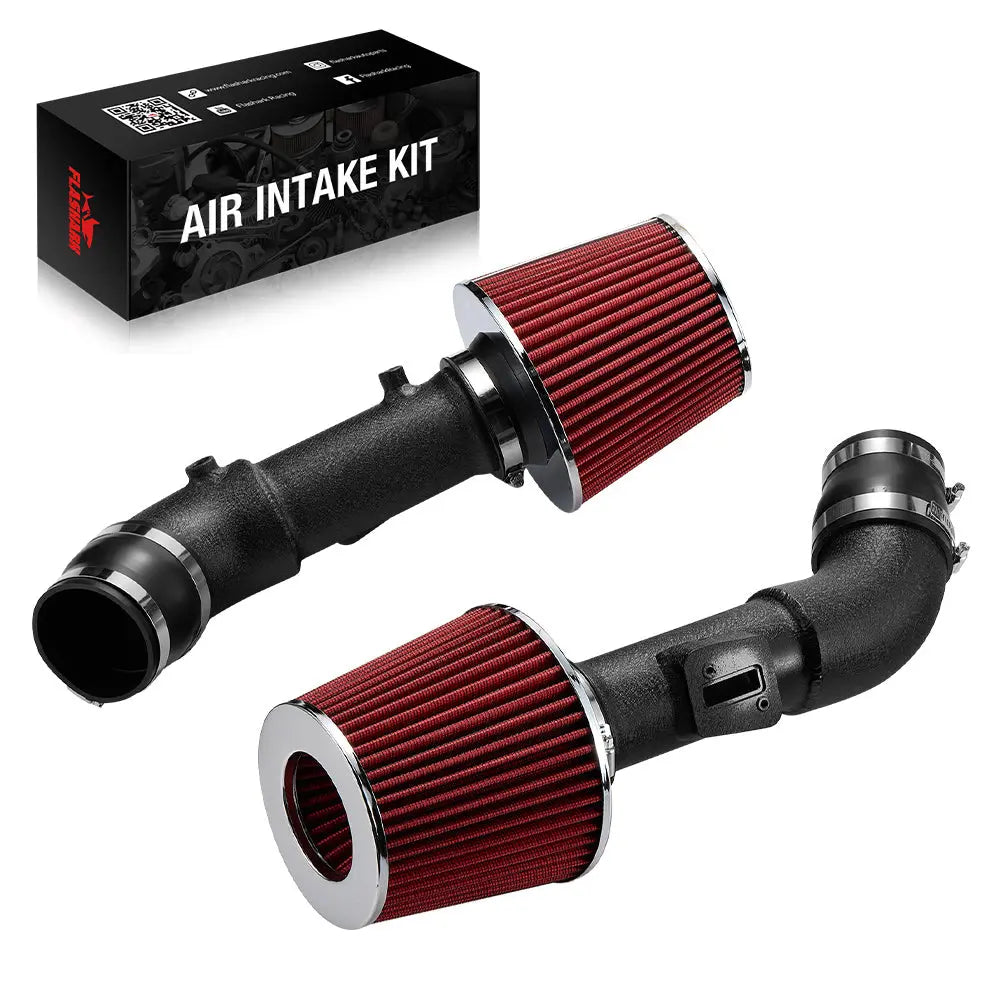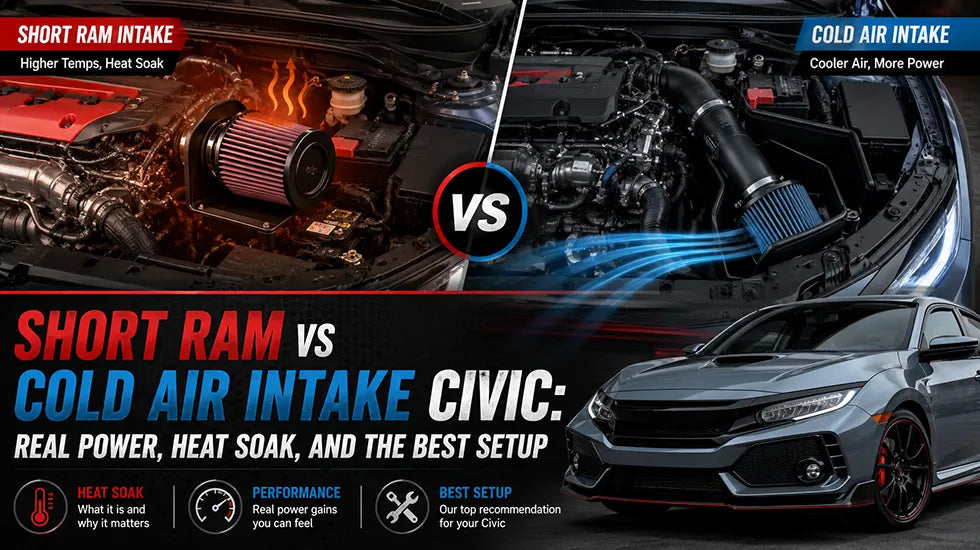
Short intake tube. Big red filter. Loud induction noise. It looks fast before you even close the hood.
Then somebody in a Civic forum calls it a “hot air intake,” another owner says a cold air intake will hydrolock the engine in the first rainstorm, and a third guy claims his intake added 15 horsepower without showing a dyno sheet, intake temperature log, or even the engine under the hood.
That is why the short ram vs cold air intake Civic debate gets messy. Owners are often comparing product names when they should be comparing filter position, heat shielding, tube diameter, sensor strategy, engine type, road conditions, and how the car is actually driven.
A 2008 Civic LX with an R18, a 2014 Civic Si with a K24Z7, and a 2020 Civic 1.5T do not need the same intake. Not even close. The best setup for a daily-driven Civic in Seattle may also be the wrong setup for a track-driven Civic in Phoenix.
Mechanic’s rule: Do not buy an intake because the pipe is shiny, the filter is huge, or the listing says “racing.” Find out where the filter sits after installation, whether the pipe fits your exact engine, and whether the ECU can correctly interpret the airflow change.
Quick Answer: Which Intake Should You Choose?
- Choose a properly routed cold air intake when consistent intake temperature and repeated high-load performance matter more than easy filter access.
- Choose a shielded short ram intake when you want stronger induction sound, simpler installation, and less exposure to standing water.
- Avoid an unshielded engine-bay filter if you spend a lot of time idling in hot traffic or making repeated pulls.
- Avoid a low-mounted cold air filter if your Civic is heavily lowered or regularly driven through flood-prone roads.
- Keep the factory airbox when the only alternative is a poorly fitted universal tube with no secure brackets, sensor provision, or heat management.
- Expect modest power on a stock naturally aspirated Civic. On an R18, a clean same-day test may show roughly 2–5 whp from a well-designed intake, with favorable peak comparisons occasionally reaching 5–8 whp. Sound and throttle feel are usually more noticeable than the raw number.

Short Ram vs Cold Air Intake Civic: What Is the Real Difference?
Let us strip away the advertising language. A short ram intake and a cold air intake are both trying to reduce restriction ahead of the throttle body or turbocharger. They simply attack the problem from different directions.
A short ram uses a short, direct path. A cold air system moves the inlet toward a cooler air source. Neither layout is automatically better. The execution decides whether the system works.
For a deeper explanation of the parts and airflow path, read this guide to how a cold air intake works.
How a Short Ram Intake Works
A short ram intake normally replaces the factory resonator, molded plastic tube, and enclosed panel filter with a shorter pipe and cone filter. The filter usually remains high in the engine compartment.
That short path has a few real advantages:
- Less tubing to install and fewer tight bends.
- Easier filter access for inspection and cleaning.
- Strong induction noise because the filter is no longer buried in a sealed airbox.
- Lower exposure to road splash than a filter mounted behind the bumper.
- Quick throttle sound and, on turbo Civics, more audible compressor and bypass-valve noise.
The problem is obvious once the hood is closed. The radiator, cylinder head, exhaust manifold, catalytic converter, and—on turbo models—the turbocharger are all releasing heat. An exposed filter can inhale that heat while the car is stopped or moving slowly.
Listen to me on this one: the short tube itself is not the enemy. A short ram with a sealed airbox and a functional front-air duct can behave very differently from a bare cone filter hanging beside the radiator fan.

How a Cold Air Intake Works
A true cold air intake moves the filter or inlet away from the hottest part of the engine bay. Depending on the Civic generation, the filter may sit behind the bumper, inside the fender area, below the headlight, or inside a sealed box connected to an outside-air duct.
The goal is not to make the pipe as long as possible. The goal is to feed the engine air that stays closer to ambient temperature while keeping the route smooth enough to avoid unnecessary pressure drop.
A cold air system usually gives you:
- Lower inlet temperatures during steady road speed.
- Better consistency during repeated acceleration.
- Less sensitivity to heat radiating from the radiator and exhaust side of the engine.
- A deeper intake note, although a sealed system may be quieter than an open short ram.
You pay for that cooler location with a longer installation, harder filter access, and greater sensitivity to road water if the filter sits very low.

Why the Product Name Can Mislead You
I have seen plenty of kits sold as “cold air intakes” even though the filter ends up six inches from the radiator. Some include a thin metal panel that blocks direct radiant heat but leave the top and rear completely open. Others use a sealed box that pulls from the factory grille duct and actually control air temperature well.
Do not judge the system by the title. Check these details:
- Where does the filter physically sit after installation?
- Is the filter exposed to radiator-fan discharge?
- Does the heat shield seal against the hood or surrounding bodywork?
- Does the system retain or replace the factory fresh-air duct?
- How close is the pipe to the exhaust manifold, catalytic converter, or turbocharger?
- Does the tube include the correct sensor port and mounting angle?
- Are brackets included, or will the intake hang from a silicone coupler?
- Can the filter be reached without removing half the front end?
Factory Airbox vs Short Ram vs Cold Air Intake
The table below gives you a practical baseline. The horsepower figures are realistic working ranges for an otherwise healthy, mostly stock naturally aspirated Civic—not promises for every engine, weather condition, dyno, or product.
| Parameter | Factory Airbox | Short Ram Intake | Cold Air Intake |
|---|---|---|---|
| Filter location | High-mounted, enclosed factory box | Usually exposed or semi-shielded in the engine bay | Fender, bumper area, or sealed outside-air box |
| Intake path | Longer molded path with resonators | Short and direct | Longer route to a cooler location |
| Example aftermarket pipe size | Model-specific molded tubing | Often 2.5–3 inches, depending on engine and sensor strategy | The featured Flashark R18 kits use a 3-inch, 76 mm main pipe |
| Typical stock R18 wheel-power change | Baseline | Roughly 0–4 whp when cool; an exposed setup may give some back after heat soak | Roughly 2–5 whp across a clean test; favorable peaks may reach 5–8 whp |
| Heat-soak sensitivity | Low to moderate due to enclosure and ducting | Highest with an exposed filter | Usually lower when the filter is isolated correctly |
| Induction sound | Quiet | Usually the loudest | Deep and noticeable; volume depends on enclosure |
| Typical DIY install time | No modification required | About 45–75 minutes | About 60–120 minutes, depending on filter location |
| Standing-water exposure | Low | Low | Moderate if the filter is mounted low |
| Best use case | Quiet, reliable daily driving | Sound, simple service, wet-road confidence | Temperature consistency and repeated high-load driving |
Important: A 3-inch pipe is not automatically an upgrade. If the engine uses an airflow sensor in the tube, changing the housing diameter or sensor position can change the reading seen by the ECU. Bigger can mean leaner, rougher, and slower when the calibration does not match.
Which Intake Makes More Power on a Honda Civic?
Here is the part nobody likes putting in giant letters on the box: a naturally aspirated Civic does not gain huge power from an intake alone.
That does not make the upgrade pointless. A good intake can reduce restriction, sharpen the way the engine responds near the upper half of the rev range, and remove enough factory sound suppression to make the car feel more alive. Just keep the numbers in the real world.
Cooler Air vs a Shorter Airflow Path
A short ram gives air a shorter route. A cold air intake gives the engine access to a cooler air source. The fight is between pressure drop and air density.
Cooler air is denser. At the same pressure, it carries more oxygen per unit of volume. But a badly routed cold air tube with tight bends, crushed couplers, or an undersized filter can add restriction. Likewise, a smooth short ram can flow well on a cool dyno pull and then lose its advantage after ten minutes in traffic.
There is no magic length that wins on every engine. Tube diameter, taper, bend radius, filter area, throttle-body size, cam timing, manifold design, and RPM range all matter.
Peak Dyno Numbers vs Repeatable Street Power
A dyno sheet can be honest and still tell only part of the story.
Suppose a short ram produces a 4 whp peak increase on the first run with the hood open. That sounds useful. Now close the hood, let the car idle for twelve minutes, and make three back-to-back pulls. If intake temperature rises sharply and the ECU reduces ignition timing, that first peak is not what you feel merging onto the freeway after sitting at a red light.
Before trusting an intake test, look for:
- A same-car, same-day baseline.
- The same fuel and tire setup.
- Hood position stated clearly.
- Ambient temperature and intake-air temperature.
- Whether the ECU was stock or tuned.
- More than one pull.
- Wheel horsepower rather than an unexplained crank estimate.
- The full torque curve, not only the highest number on the page.
On a stock 1.8L R18, I would call a repeatable 2–5 whp improvement useful. I would not call it life-changing. On a Civic Si with a K-series engine and a calibration developed for the intake diameter, 5–10 whp is a more realistic working window. On a turbo Civic, the intake may make a larger difference once boost, tuning, intercooler performance, and other supporting changes enter the picture—but then the intake is no longer the only variable.
Naturally Aspirated Civic vs Turbocharged Civic
A naturally aspirated engine has to pull air through the entire intake system using pressure created by the descending piston. Remove restriction and it may breathe more easily at higher RPM. Still, the stock R18, D17, D16, K20, or K24 remains limited by its throttle body, intake manifold, cylinder head, cam profile, exhaust, and calibration.
On a turbo Civic, the compressor is also drawing through the filter and inlet tube. Reducing inlet restriction can help the turbo work with less effort, and the sound change is immediate. You hear the compressor, suction, and bypass valve that the factory airbox was designed to suppress.
But do not confuse louder spool with a massive horsepower gain. A stock-calibration 1.5T may show roughly 3–7 whp from a well-designed inlet and intake under favorable conditions. Tuned combinations may show more, but the added boost and calibration deserve much of the credit.
Why Some Short Ram Intakes Lose Power When Hot
An exposed short ram can make a clean first pull because the engine bay has not heat-soaked yet. After idling, the filter starts drawing air warmed by the radiator and surrounding metal.
That can lead to:
- Higher intake-air temperature.
- Reduced ignition advance under knock-sensitive conditions.
- Lower air density at the inlet.
- Less repeatable torque during consecutive pulls.
- A car that feels crisp at night but flat during a hot afternoon commute.
Again, this is mainly an exposed-filter problem. A short intake enclosed in a properly sealed box and fed by a grille duct can behave closer to a cold air system than a traditional open short ram.
Heat Soak: The Biggest Short Ram Intake Problem

What Heat Soak Feels Like From the Driver’s Seat
Heat soak does not usually arrive with a warning light. The Civic simply feels less eager.
You may notice that it pulls cleanly on the first drive of the morning, then feels softer after sitting in a drive-through. Throttle response becomes dull. The top end loses some bite. Once road speed brings cooler air through the engine bay, the car starts feeling normal again.
This is why owners argue about the same intake. One tests it on a cool evening highway run. Another spends forty minutes in downtown traffic with the air conditioning running. Both are telling the truth about their own conditions.
Shop Case: The 2010 Civic LX That Felt Fast Only When Cold
I remember a 2010 Civic LX that came in with exactly that complaint. The owner had installed an open short ram and loved it for the first week. The sound was sharp, installation looked clean, and the car felt responsive during his early-morning commute.
Then summer traffic arrived. On a roughly 91°F afternoon, the logged intake temperature climbed to about 138–142°F after the car sat idling with the hood closed. Once we drove at a steady 45–50 mph, the reading dropped near 108–112°F. Nothing was “broken.” The filter was simply sitting in the radiator fan’s hot discharge air.
We built a better enclosure, sealed it against the factory fresh-air duct, and secured the panel so it did not leave a gap behind the headlight. The car did not suddenly gain 20 horsepower. What improved was consistency. The owner stopped getting one strong pull followed by a soft one.
When Heat Soak Matters Most
Heat soak deserves more attention when your Civic sees:
- Long stop-and-go commutes.
- Ambient temperatures above roughly 85–90°F.
- Frequent air-conditioning use at low road speed.
- Track sessions or repeated wide-open-throttle pulls.
- A filter mounted near the exhaust manifold, catalytic converter, radiator fan, or turbocharger.
- A dark engine bay with limited underhood airflow.
Drivers in Arizona, Texas, Florida, Nevada, and inland Southern California need to look closely at filter isolation. A bare cone can sound fantastic and still be a poor match for the way the car is used.
Can a Heat Shield Fix a Short Ram Intake?
It can help. A thin shield blocks some radiant heat and direct fan discharge, but a piece of aluminum with three open sides is not a sealed airbox.
Think of heat protection in levels:
- Bare filter: maximum sound, minimum temperature control.
- Simple shield: blocks direct radiant heat but still draws surrounding engine-bay air.
- Semi-enclosed box: better control, especially when it seals against the hood.
- Sealed box with outside-air duct: the strongest high-mounted solution for many daily drivers.
Check the rubber edge seal. Check the rear corner near the firewall. Check the opening around the intake tube. Air follows the easiest route. One large gap can turn an attractive box into engine-bay decoration.
Cold Air Intake and Hydrolock: How Big Is the Risk?
Hydrolock is serious. It can bend a connecting rod because water does not compress like air. But ordinary rain hitting the bumper does not automatically fill the cylinders.
The dangerous condition is usually a low filter becoming substantially submerged while the engine is drawing air. Splashing a few droplets onto a filter is not the same thing.

Rain Is Not the Same as Submerging the Filter
A properly installed cold air intake can be driven in normal rain. The bumper cover, splash shield, fender liner, and filter location all reduce direct exposure.
Risk rises when:
- The road water is deep enough to cover the filter.
- The inner fender liner is missing or torn.
- The Civic is lowered enough to place the filter unusually close to the road.
- The filter sits directly in the tire’s spray path.
- The driver maintains throttle while entering standing water.
- The filter is already saturated or poorly secured.
Warning: No intake, bypass device, filter wrap, or splash shield makes a Civic safe to drive through floodwater. When you cannot judge the depth, turn around.
Which Civic Owners Should Avoid a Low-Mounted Filter?
A low filter may not be worth the stress when the car is a daily driver in an area with flash flooding, poor drainage, deep roadside puddles, or frequent tropical storms.
I would also think twice when the Civic is aggressively lowered, the fender liner has been removed for wheel clearance, or the owner rarely inspects the filter. In those situations, a high-mounted shielded short ram or a sealed high-airbox system is easier to live with.
Do Bypass Valves and Water-Resistant Filter Covers Work?
A bypass valve may provide an alternate air path when the main filter becomes heavily restricted by water. A water-resistant pre-filter can reduce direct splash and keep large droplets away from the filter media.
Both are risk-reduction tools. Neither is permission to drive through axle-deep water.
Short Ram vs Cold Air Intake Civic Sound Comparison
For many owners, sound is the real reason for the upgrade. That is fine. Just be honest about it.
A stock Civic airbox contains chambers and resonators designed to cancel induction noise. Remove them and the engine becomes much more vocal, even when the dyno gain is small.
How a Short Ram Intake Sounds
An open short ram is usually the loudest setup because the filter is close to the driver and has little enclosure around it.
On a naturally aspirated Civic, expect:
- A deeper growl as the throttle opens.
- A sharper intake roar in the upper RPM range.
- A more dramatic VTEC crossover on engines where the change is already noticeable.
- Relatively quiet cruising when the throttle remains light.
On a turbo Civic, expect more compressor suction, spool noise, and bypass-valve sound. It is addictive. It also causes a lot of drivers to use more throttle, which is one reason fuel economy sometimes drops after an intake install.
How a Cold Air Intake Sounds
A cold air intake still makes the engine louder, but the final volume depends on the layout. A low open filter can be loud. A sealed system may produce a deeper, cleaner note without as much high-frequency hiss.
Longer tubing can also change resonance. Two intakes using the same filter may not sound alike if one uses a long fender route and the other stops behind the headlight.
For a more focused breakdown, see how much an intake changes engine sound.
Why Louder Does Not Mean Faster
The human brain is easy to fool. More sound makes the throttle feel more dramatic. A smoother tube can also alter throttle response without adding much peak power.
Do not use intake volume as a dyno. Check data, compare acceleration under the same conditions, and pay attention to repeatability after the engine bay is fully hot.
Does a Honda Civic Need a Tune After Installing an Intake?
Sometimes yes. Sometimes no. Anyone answering this question without asking which Civic, which engine, and which intake is guessing.
Standard Sensor Housing vs Oversized Housing
Some Civics measure incoming airflow in or near the intake tube. Others rely heavily on manifold pressure, temperature, throttle angle, and modeled airflow. The exact strategy changes by generation and engine.
When an airflow sensor sits inside the tube, the housing diameter matters. Increase the diameter and the same amount of air travels past the sensor at a different speed. The ECU may interpret that signal incorrectly unless the housing and calibration were designed together.
A direct-fit intake that preserves the intended sensor geometry may run correctly on the stock calibration. A race-size or big-bore housing may require Hondata, KTuner, or another proper calibration before the engine is driven hard.
Signs the Intake or Calibration Is Wrong
Stop and inspect the installation when you notice:
- A check-engine light immediately after installation.
- Rough or hunting idle.
- Hesitation when the throttle opens.
- Lean or rich mixture codes.
- Unusually large fuel-trim corrections.
- Stalling when coming to a stop.
- Inconsistent boost or throttle closure on a turbo model.
- Knock activity that was not present before the change.
Do not immediately blame the ECU. First look for a loose clamp, pinched hose, disconnected breather line, sensor installed backward, cracked coupler, or air leak after the sensor.
When Hondata FlashPro or KTuner Becomes Necessary
Plan on tuning when:
- The intake manufacturer explicitly requires it.
- The system uses a substantially larger sensor housing.
- The engine has a larger throttle body or intake manifold.
- You have added a turbocharger, upgraded turbo, or increased boost.
- The intake is part of a larger header, exhaust, intercooler, and fueling combination.
- You want to optimize ignition, fueling, cam control, and throttle mapping rather than relying on ECU correction limits.
Technician’s note: A tune should correct the calibration for the hardware. It should not be used to hide a vacuum leak, badly located sensor, collapsing coupler, or filter that is too small for the engine.
Which Intake Is Better for Each Honda Civic Generation?
Honda has used a long list of engines and intake layouts under the Civic badge. Shopping by year alone is how owners end up with the throttle-body coupler on the wrong side of the bay.
For a separate generation-by-generation buying guide, see our breakdown of the best cold air intake for Honda Civic by generation.
1992–2000 Civic
Older EG, EK, and related Civic chassis may carry D-series, B-series, or swapped engines. At this age, the engine under the hood matters more than the VIN description.
Check:
- The exact engine code.
- The throttle-body location and diameter.
- Whether the battery or fuse box has been relocated.
- Breather and idle-control hose connections.
- Manual or automatic transmission clearance where applicable.
- Whether a swap has changed the original sensor arrangement.
A low cold air route can work well on these cars, but many are lowered. Measure filter-to-ground clearance before celebrating the stance.
2001–2005 Civic
The regular D17-powered Civic and the K20-powered Si use entirely different intake layouts. A listing that says only “2001–2005 Honda Civic” is not enough.
D17 daily drivers usually benefit more from a secure, correctly routed system than from an oversized pipe. On the Si, check the throttle-body orientation, battery position, and whether the intake was designed for the K20A3 layout.
2006–2011 Civic
This generation is where fitment mistakes become especially common. The standard DX, LX, EX, EX-L, and GX models use the 1.8L R18 layout. The Civic Si uses the 2.0L K20Z3. The Hybrid is different again.

For the non-Si R18, Flashark offers a 2006–2011 Honda Civic 1.8L short ram and cold air intake kit with long-ram and short-ram configurations. That choice is useful because an owner in a hot, dry climate may prioritize the longer cooler-air route, while a driver in a flood-prone city may prefer the higher filter position.
Fitment warning: The kit is for compatible 1.8L non-Si applications. It is not the correct intake for the K20Z3 Civic Si or Hybrid.

2006–2011 Civic 1.8L R18
Flashark Short Ram / Long Ram Intake Options
Designed for compatible DX, LX, EX, EX-L, and GX coupe or sedan models. Choose the intake configuration according to filter-position, heat, and wet-road priorities.
$106.00 $150.13
Price and availability may change. Confirm the selected intake style on the product page.
2012–2015 Civic
The regular 1.8L Civic and the K24Z7 Civic Si again need different intake systems. Do not order by generation alone.

For a compatible non-Si 1.8L sedan or coupe, the 2012–2015 Honda Civic 1.8L cold air intake kit uses a 76 mm main pipe, a 70 mm secondary section, a dry cone filter, and vehicle-specific mounting hardware.
That 76 mm dimension is useful information, but do not turn it into a universal horsepower guarantee. Engine condition, ambient temperature, baseline restriction, exhaust setup, and test procedure still decide the result.

2012–2015 Civic 1.8L
Flashark 3-Inch Cold Air Intake Kit
A direct-fit system for listed non-Si DX, EX, LX, SE, and Touring applications with the 1.8L engine. Includes dual-diameter piping, filter, brackets, couplers, and mounting hardware.
$102.99 $114.23
Price and availability may change. Verify your engine, trim, and live price before ordering.
2016–2021 Civic
The 10th-generation Civic includes the naturally aspirated 2.0L, turbocharged 1.5L, Civic Si, and Type R. These are not interchangeable applications.
For the 1.5T, intake sound is often the first noticeable change. You will hear the turbo work. Performance depends on inlet restriction, airbox design, filter position, and whether the ECU calibration is stock or modified.
The Type R has different airflow demands and underhood packaging. A system sized for an ordinary 1.5T should never be assumed to fit or support the K20C1.
2022 and Newer Civic
The latest Civic continues to mix naturally aspirated, turbocharged, Si, Type R, and market-specific configurations. Verify the engine and trim before you buy.
Pay close attention to:
- Sensor placement.
- Turbo inlet compatibility.
- Airbox sealing against the hood.
- Clearance around the battery and wiring.
- Transmission- or trim-specific hardware.
- Whether a tune is optional, recommended, or required.
Short Ram or Cold Air Intake for Daily Driving?
Best Choice for Hot Climates
For a hot climate, I prefer a system that separates the filter from radiator discharge and exhaust heat. That may be a true low-route cold air intake, or it may be a high-mounted sealed box supplied by a front duct.
The worst setup is usually a bare cone sitting in the hottest pocket of the bay. It may sound wild. It may also spend half the commute inhaling air 30–50°F above ambient while the car is crawling through traffic.
Best Choice for Rainy or Flood-Prone Areas
A high-mounted short ram or sealed factory-style airbox makes more sense when standing water is a routine concern. That does not mean every cold air intake is dangerous in rain. It means filter height matters more than the word printed on the box.
Keep the splash shield and fender liner intact. Do not remove them because an installation video called them “optional.” They are part of the protection system.
Best Choice for Commuters
A commuter needs stable idle, secure mounting, good filtration, easy maintenance, and reasonable noise at cruise. One or two peak horsepower is not worth a rubbing pipe or a filter that takes an hour to inspect.
For a daily-driven Civic, prioritize:
- Exact engine fitment.
- A secure bracket that prevents vibration.
- Correct breather and vacuum connections.
- A washable or replaceable filter with known service instructions.
- A filter location appropriate for local weather.
- Enough enclosure to control hot-air ingestion.
Best Choice for Weekend and Track Builds
A track setup should be judged after the engine bay is hot, not during the first pull after unloading the car.
Log intake-air temperature, ignition correction, throttle closure, boost on turbo models, and fuel trims. Inspect the filter mount after every event. Track vibration can loosen a clamp that survived months of street driving.
A well-isolated cold air system usually offers better consistency, but an enclosed short intake with a large front duct can also work. Data wins the argument.
Installation Difficulty and Post-Install Checks
Short Ram Intake Installation
A short ram is normally the simpler job. Many Civic kits can be installed in roughly 45–75 minutes with metric sockets, screwdrivers, pliers, and patience.
The basic process is:
- Disconnect the negative battery terminal when required by the vehicle or instructions.
- Remove the factory intake tube, resonator connections, and airbox.
- Transfer the required sensor carefully without touching the sensing element.
- Install the coupler and tube without fully tightening the clamps.
- Connect the breather and vacuum hoses.
- Install the filter and support bracket.
- Adjust the entire system for clearance.
- Tighten the bracket first, then the couplers and filter clamp.
- Start the engine and listen for air leaks.
- Recheck the clamps after the first few heat cycles.
Cold Air Intake Installation
A true cold air system may require removing the front bumper cover, splash shield, or inner fender liner. Plan for 60–120 minutes. Rusted clips and previous body repairs can stretch that estimate.
Before closing everything, turn the steering from lock to lock and verify that the tire cannot contact the filter or pipe. Check clearance around fog-light wiring, washer-fluid hoses, and bumper supports.
Installation Case: The Intake That Kept Pulling Itself Apart
I have seen new owners slide every tube together, tighten the clamps first, and install the support bracket last. The bracket does not line up, so they bend it toward the mounting hole and force the whole system sideways.
A few weeks later, the engine movement starts pulling one coupler off the throttle body. The owner tightens the clamp harder. That crushes the edge of the coupler but does not correct the alignment.
Do not do that. Leave the joints slightly loose, position the pipe without stress, attach the bracket, verify filter clearance, and then tighten everything progressively. The bracket should support the tube—not drag it into position.
Common Post-Installation Checks
- Confirm that every sensor points in the intended direction.
- Make sure the breather hose is not kinked.
- Verify that no unused port has been left open.
- Check at least 1/4 inch of clearance around vibrating pipes where possible.
- Confirm that the filter cannot touch a belt, fan, pulley, tire, or hot exhaust part.
- Inspect the system after the first drive and again after several heat cycles.
- Scan for codes instead of assuming the dashboard light will clear itself.
- Check fuel trims when diagnostic equipment is available.
Common Mistakes Civic Owners Make When Buying an Intake
Buying by Model Name Without Checking the Engine
“2014 Honda Civic intake” is not a complete fitment description. The 1.8L regular Civic and 2.4L Civic Si have different engines and different layouts.
The same problem exists in 2006–2011 and 2016–2021 applications. Always match year, trim, engine, and any important body-style exclusions.
Assuming Every Cone Filter Is a Cold Air Intake
A cone filter does not create cold air by itself. If the filter sits in an open engine bay, it is drawing whatever air surrounds it.
Look for physical routing, sealing, and ducting. Ignore the product title for a minute and study the installed photos.
Choosing the Biggest Pipe Without Planning a Tune
A massive pipe looks impressive on a workbench. On a small engine, it may reduce air velocity, complicate sensor readings, create poor low-speed behavior, or simply add no useful flow.
The right diameter is the one the engine and calibration can use. Not the one that wins a tape-measure contest.
Ignoring California Emissions Requirements
For a street-driven vehicle in California, check whether the exact intake part number has a valid CARB Executive Order covering your specific model year and engine.
A brand having approval for one product does not automatically make every product from that brand legal. Keep the paperwork and required label with the vehicle.
Buying Only for a Claimed Horsepower Number
Ask how the number was produced. Was it wheel horsepower? Was the hood open? Was the car tuned? Was the baseline tested on the same day? Was the comparison the best aftermarket pull against the worst stock pull?
A repeatable 4 whp gain across a useful part of the curve is more valuable than a one-point 9 hp spike that disappears when the engine gets hot.
Removing Useful Factory Ducting
Honda spent real engineering time controlling water, noise, filter service life, and inlet temperature. The factory system is not perfect for maximum airflow, but it is not random plastic clutter either.
If an aftermarket system can use the original fresh-air opening, keep it functional. Do not block a good air source and then wonder why the new filter inhales heat.
How to Choose the Right Intake for Your Civic
Start with the car, not the catalog.
Choose a Cold Air Intake If…
- You want lower and more stable inlet temperatures.
- You make repeated high-RPM pulls or attend track days.
- Your local roads do not regularly flood.
- You are comfortable inspecting a lower-mounted filter.
- The system is designed for your exact engine and sensor arrangement.
- You are willing to tune the ECU when the selected pipe requires it.
Choose a Short Ram Intake If…
- Intake sound is a major priority.
- You want simpler installation and filter access.
- You drive in heavy rain or flood-prone areas.
- You choose a system with useful heat shielding or outside-air ducting.
- Your driving is mostly street use rather than repeated hot laps.
Keep the Factory Airbox If…
- Your budget only covers a universal filter and unsupported pipe.
- You want factory-level noise control and water protection.
- You are unwilling to verify sensors, hoses, and fuel trims.
- The car must remain fully compliant with strict local regulations.
- You expect a dramatic acceleration change from an intake alone.
When you are ready to compare applications beyond the two Civic kits discussed here, browse the complete range of performance cold air intake kits. For Civic-specific fitment, start with the collection of Honda Civic cold air intake kits by generation.
Final Verdict: Short Ram or Cold Air Intake for a Civic?
The answer to short ram intake vs cold air intake Civic depends on where the filter sits, how the system manages heat, and how you use the car.
For a performance-focused Civic that sees hot weather, repeated acceleration, or track use, a properly routed cold air intake generally offers the better temperature strategy. For a daily driver where sound, easy maintenance, and reduced standing-water exposure matter more, a shielded high-mounted short ram can be the smarter setup.
There is one option worse than both: a poorly supported universal pipe with an exposed filter sitting in hot radiator air.

My practical ranking is simple:
- A vehicle-specific, well-sealed cold air system with correct sensor geometry.
- A shielded short ram connected to an outside-air duct.
- The stock airbox with a clean filter.
- An exposed universal filter with questionable fitment.
The best intake is not the loudest one or the longest one. It is the setup that delivers stable air temperature, correct ECU data, secure fitment, proper filtration, and repeatable performance in the conditions your Civic actually sees.
Frequently Asked Questions
Q1: Is a short ram or cold air intake better for a Honda Civic?
A1: A cold air intake is generally better for stable intake temperatures and repeated high-load driving. A shielded short ram is often better for easy installation, louder induction sound, simple filter access, and reduced exposure to standing water. The correct answer depends on your Civic engine, local climate, and filter location.
Q2: Does a cold air intake add more horsepower than a short ram intake?
A2: It can, especially after the engine compartment becomes heat-soaked. On a stock naturally aspirated R18 Civic, a properly designed cold air intake may produce roughly 2–5 whp in a consistent test, with favorable peaks occasionally reaching 5–8 whp. An exposed short ram may produce a small cool-run gain but lose part of it in hot traffic.
Q3: Can a short ram intake make a Civic lose power?
A3: Yes, an exposed short ram can lose power when it draws hot engine-bay air. The issue is most noticeable after idling, during hot weather, or during repeated pulls. A sealed or well-shielded short ram supplied by an outside-air duct is less vulnerable.
Q4: Will a short ram intake make my Civic louder?
A4: Yes. Removing the factory resonators and enclosed panel filter makes induction noise much more noticeable. Naturally aspirated Civics gain a stronger growl at high RPM, while turbo Civics produce more suction, compressor, and bypass-valve sound.
Q5: Can a cold air intake hydrolock a Honda Civic?
A5: Hydrolock is possible when a low-mounted filter becomes substantially submerged and the engine draws water into a cylinder. Ordinary rain is not the same as submerging the filter. Risk depends on filter height, road-water depth, splash-shield condition, vehicle ride height, and driver behavior.
Q6: Is a cold air intake safe in the rain?
A6: A properly installed cold air intake is generally usable in normal rain when the splash shields and fender liners remain intact. Avoid deep standing water, inspect low filters regularly, and do not continue through water when you cannot judge its depth.
Q7: Does a Honda Civic need a tune after installing an intake?
A7: Not every intake requires a tune. A direct-fit system that preserves the intended sensor geometry may operate on the factory calibration. A large-diameter sensor housing, race intake, forced-induction change, or product specifically marked “tune required” needs appropriate ECU calibration.
Q8: Can I install a short ram intake without Hondata FlashPro?
A8: Many vehicle-specific short ram intakes can be installed without FlashPro when the tube and sensor arrangement are designed for the stock calibration. Do not assume this applies to an oversized housing or a system intended for tuned applications. Follow the instructions for the exact part number.
Q9: Will an intake cause a check-engine light on a Civic?
A9: A correctly designed and installed intake should not automatically cause a check-engine light. Common causes include a loose clamp, disconnected hose, vacuum leak, reversed sensor, incorrect sensor housing, damaged wiring, or calibration mismatch.
Q10: Is a short ram intake good for a daily-driven Civic?
A10: A shielded short ram can be a good daily-driver choice because it is easy to install, easy to service, and keeps the filter higher in the engine bay. An unshielded filter may suffer from heat soak in slow summer traffic, so look for a sealed box or functional fresh-air duct.
Q11: Is a cold air intake worth it on a stock Honda Civic?
A11: It can be worth it when you want stronger induction sound, slightly better high-RPM breathing, and more responsive throttle feel. Do not expect a stock naturally aspirated Civic to gain 15–20 whp from an intake alone. A repeatable low-single-digit wheel-horsepower gain is more realistic.
Q12: Is the stock Civic airbox better than a short ram intake?
A12: The stock airbox can outperform a poorly located open short ram after heat soak because it is sealed and supplied by factory ducting. A properly shielded short ram may flow better and sound stronger, but replacing the factory box with an exposed universal filter is not automatically an upgrade.
Q13: Does a heat shield stop short ram intake heat soak?
A13: A heat shield reduces radiant heat and direct radiator-fan discharge, but a thin panel cannot completely control inlet temperature. A sealed enclosure connected to an outside-air duct provides better protection than a shield with large open gaps.
Q14: Which intake is best for a Civic Si?
A14: The best Civic Si intake depends on the generation and engine. A K20Z3, K24Z7, L15 turbo, and K20C1 do not share the same intake requirements. Verify the engine, sensor strategy, pipe diameter, tune requirement, and intended use before choosing a system.
Q15: Which intake is best for a turbo Honda Civic?
A15: A turbo Civic benefits from an intake that reduces inlet restriction without corrupting sensor data or drawing excessive heat. A sealed cold-air box is a strong street solution. Tuned cars may benefit from a larger inlet, but pipe size and calibration must be selected together.
Q16: Can a cold air intake improve Civic gas mileage?
A16: A small improvement is possible during steady light-throttle driving, but it is not guaranteed. Many owners use more throttle after installing an intake because they enjoy the sound, which can erase any efficiency gain. Intake condition, tire pressure, traffic, and driving style have a larger effect.
Q17: Will a cold air intake void my Honda warranty?
A17: An aftermarket intake does not automatically erase every part of a vehicle warranty. However, a warranty claim may be disputed when a failure is linked to the intake, incorrect installation, contamination, water ingestion, or calibration changes. Keep the factory parts and installation records.
Q18: Are cold air intakes legal in California?
A18: A street-driven California vehicle generally needs an intake with a valid CARB Executive Order covering the exact part number, model year, and engine. Approval for another vehicle or another product from the same brand is not enough. Confirm current requirements before installation.
Q19: How often should I clean an aftermarket Civic intake filter?
A19: Inspect the filter during normal oil-service intervals and clean it according to the filter manufacturer’s instructions. Dusty roads, construction zones, heavy rain, and a low-mounted filter require more frequent inspection. Never apply filter oil to a dry filter unless its instructions specifically require oil.
Q20: Can I convert a cold air intake into a short ram intake?
A20: Some two-piece systems allow the lower tube to be removed so the filter can be mounted higher. That changes inlet temperature, sound, water exposure, and sometimes bracket support. Use only a configuration supported by the product design rather than improvising an unsupported filter position.

Steven Chen
Automotive Performance Specialist | Engine & Exhaust Systems
Steven focuses on practical engine performance, exhaust fitment, and real-world upgrade paths for classic and modern enthusiast vehicles. He reviews small-block Ford, LS, truck, and street/strip applications with one goal in mind: helping builders choose parts that actually work together. His philosophy: "Good power starts with the right combination, not the biggest part."