Let’s not dress this up like a catalog page. A 5.3 Silverado with stock manifolds is not automatically choking to death. GM did not accidentally bolt useless iron lumps to millions of trucks. Those manifolds are quiet, durable, compact, and honestly better than a lot of people want to admit.
But I get why truck owners keep asking about 5.3 shorty headers vs stock manifolds. The factory setup can look ugly, tick when bolts snap, rust around the flanges, and make a V8 truck sound way too polite. So the real question is not “Do shorty headers work?” The real question is: do they work enough to justify the money, labor, and busted-knuckle risk?
Old-school answer from the garage floor: sometimes. Not always. And if someone tells you every stock 5.3 Silverado will suddenly feel like it picked up 40 horsepower from shorties alone, close that tab and go check your manifold bolts.
Quick Answer: Are Shorty Headers Worth It on a 5.3 Silverado?
- For a mostly stock daily driver: shorty headers are usually a mild upgrade, not a huge horsepower part. Expect better tone, cleaner response, and maybe small power gains if the rest of the exhaust is not restrictive.
- For sound and appearance: they make more sense. The tone usually gets sharper and cleaner, especially if the truck already has a cat-back exhaust.
- For maximum horsepower: long tube headers usually win. Shorties keep the layout closer to stock, but they do not create the same scavenging effect as long tubes.
- For cracked manifolds or broken bolts: shorty headers can be a smart replacement upgrade if you already have to tear the old manifolds off.
- For emissions-conscious or low-drama builds: shorties are often easier to live with because many setups retain the factory-style Y-pipe and catalytic converter location.
Bottom line: shorty headers are worth it when you want a cleaner-flowing, better-looking, slightly louder replacement for stock manifolds. They are not worth it if you expect long-tube-level gains on a bone-stock 5.3.
Shorty Headers vs Stock Manifolds Silverado: What Actually Changes?
When people compare shorty headers vs stock manifolds Silverado setups, they usually jump straight to horsepower. That is the wrong first move. Start with the shape.
Factory exhaust manifolds are usually cast iron. Thick. Heavy. Quiet. They hold heat well and fit tight in the engine bay. The job is simple: collect exhaust gas from each cylinder bank and send it into the rest of the exhaust system without noise complaints, warranty problems, or emissions drama.
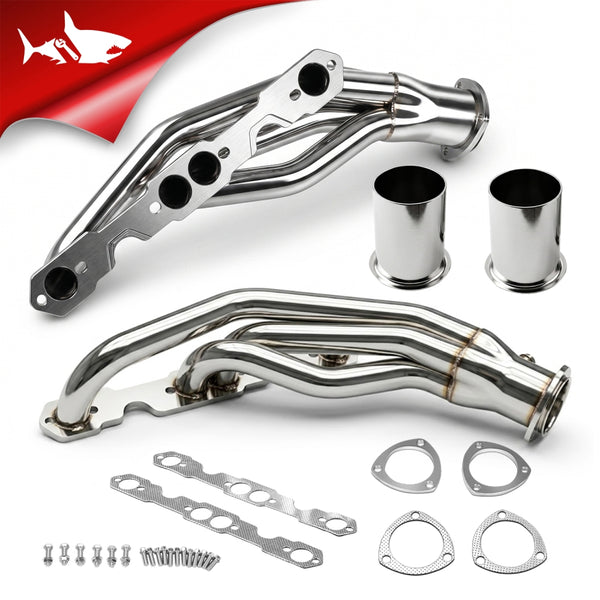
Shorty headers use tubular runners instead of a compact cast manifold body. Each cylinder gets a more defined path into the collector. The idea is to reduce restriction and clean up exhaust pulse movement without moving the collector far downstream like a long tube header does.
Expert Tip: A shorty header can improve flow compared with a stock manifold, but runner length is still short. That means the gain is usually more about mild flow improvement and tone, not some wild high-rpm power change.

Exhaust Flow and Runner Design
A stock manifold dumps exhaust into a compact chamber quickly. It is built to package tightly around steering shafts, frame rails, plug wires, heat shields, and emissions equipment. That is why it works so well for a daily truck.
A shorty header gives the exhaust pulses a smoother exit path. On a mild 5.3, the difference may show up as slightly cleaner throttle response and a sharper exhaust note. On a tuned or cammed setup, the improvement can be easier to feel because the engine is actually moving more air.
But listen closely: shorty headers do not turn a stock 5.3 into a different engine. If the cam, tune, intake, cats, and muffler are still factory-style, the header is only one piece of the breathing system.
Weight, Heat, and Engine Bay Appearance
Shorty headers are usually lighter than factory cast manifolds. That matters a little, but let’s not pretend your Silverado suddenly becomes a track truck because you took a few pounds off the nose.
The bigger benefit is packaging and appearance. A polished stainless shorty header looks cleaner in the engine bay. A quality flange also gives you a better shot at sealing properly after the old manifolds have been heat-cycled for 15 or 20 years.
If you are shopping by fitment, start with platform-specific pages, not generic “5.3 headers” listings. Flashark’s Silverado 1500 exhaust headers collection is the better place to filter for truck-specific applications instead of guessing from photos.

Sound Difference: Louder or Just Cleaner?
Shorties usually do not make a Silverado obnoxiously loud by themselves. If the factory cats and muffler are still in place, the sound change is often more of a cleaner edge than a huge volume jump.
At idle, it may be subtle. On cold start, you may hear a little more bite. Under throttle, especially from 2,500 rpm upward, the V8 note can sound sharper and less muffled. If you already have a cat-back, the shorties become easier to hear.
If your truck has a muffler delete or a cheap straight-through setup, different story. Then shorties can add rasp or metallic bite. Not always bad. Just not always mature.
5.3 Shorty Headers vs Stock Manifolds: Real Horsepower Expectations
This is where the internet gets loud and useful at the same time.
You will see claims all over the place. 5 hp. 8 hp. 12 hp. “Up to 20 hp.” A dyno chart from a truck with headers, exhaust, and other supporting parts. A forum guy saying he felt nothing. Another guy saying the truck woke up. All of them might be telling the truth from their own setup.
For a mild 5.3 Silverado, a realistic shorty-header-only gain is often in the 5–12 wheel horsepower range when the exhaust behind it is not choking the truck. Sometimes less. With a tune and better exhaust behind it, the setup has more room to show itself. With stock everything, you may feel more sound than power.
| Category | Stock Manifolds | Shorty Headers | Real-World Note |
|---|---|---|---|
| Typical wheel HP change | Baseline | Often around 5–12whp on mild setups | Can be less without tune or supporting exhaust parts |
| Sound | Quiet, muted, factory tone | Sharper, cleaner, slightly more aggressive | Cat-back and muffler choice matter more than the header alone |
| Install difficulty | Already installed, no work unless leaking | Moderate; easier than long tubes | Broken manifold bolts can turn it ugly fast |
| Y-pipe compatibility | Factory fit | Often closer to factory layout | Always confirm by year, drivetrain, and product fitment |
| Tune requirement | No tune needed | Usually optional, helpful on modified trucks | Tune matters more with cam, intake, cat-back, or long tubes |
| Best use case | Quiet daily driver, stock replacement | Mild sound, cleaner bay, manifold replacement upgrade | Not the best choice for max horsepower builds |
Why Dyno Numbers Are All Over the Place
A dyno number without context is just a number wearing a cowboy hat.
Ask these questions before believing any gain claim:
- Was it shorty headers only, or headers plus cat-back?
- Was the truck tuned before and after?
- Were the catalytic converters changed?
- Was the truck tested on the same dyno, same day, same temperature range?
- Was the gain measured at peak horsepower or through the midrange?
- Was it wheel horsepower or crank horsepower?
One well-known 2008 5.3L Chevy truck test with JBA headers and exhaust showed a gain of about 14.7 peak horsepower and 27.6 lb-ft of peak torque, with strong midrange torque improvement. Good result. But that was not a clean “shorty headers only” test, so do not copy-paste that number onto every stock Silverado in America.
What a Stock 5.3 Silverado Driver May Actually Feel
On a bone-stock 5.3, the seat-of-the-pants gain can be small. Maybe the throttle feels a little less lazy. Maybe the truck sounds happier climbing past 3,000 rpm. Maybe it feels the same until you step out and hear it from behind.
That does not mean the part did nothing. It means the rest of the combo is still stock. The muffler still controls sound. The tune still controls throttle and fuel. The cam still decides how much air the engine wants. The cats still sit downstream doing their job.
When Shorty Headers Make More Sense
Shorties make the most sense when the truck already has a reason to come apart.
- The stock manifolds are cracked.
- The truck has a cold-start exhaust tick from a leaking manifold gasket.
- One or more manifold bolts are already broken.
- You already have a cat-back exhaust and want a sharper tone.
- You want to keep a factory-style Y-pipe and catalytic converter layout.
- You want a cleaner engine bay without the extra install drama of long tubes.
- You plan to tune the truck later, but you are building in stages.
For broader shopping across platforms, Flashark’s long tube and shorty exhaust headers page is useful when you are comparing different header styles instead of locking yourself into one truck generation too early.
When Stock Manifolds Are Still the Smarter Choice
Stock manifolds win when you want quiet, cheap, reliable, and boring. Boring is not an insult. A lot of daily trucks need boring parts that seal properly and do not start fights with emissions testing.
Keep the stock manifolds if:
- You only care about horsepower per dollar.
- Your truck is completely stock and running fine.
- You hate exhaust leaks more than you like shiny parts.
- You live in a strict emissions state and do not want questions.
- You plan to skip shorties and go straight to long tubes later.
Stock Manifolds Are Not Always the Enemy
Some guys talk about stock manifolds like they are made of wet cardboard. They are not.
On a stock cam, stock head, stock tune 5.3, the factory manifolds are not always the first choke point. They are compact, they keep noise down, and they usually work fine until age, rust, heat cycling, or broken bolts get involved.
Why GM Stock Manifolds Work Better Than People Think
The 5.3 truck engine was built for broad torque, long service life, emissions compliance, and daily abuse. The factory manifold supports that mission. It is not pretty. It does not make your engine bay look like a show truck. But it does its job.
That is why forum answers can sound harsh when someone asks about shorty headers vs stock manifolds Silverado gains. A lot of owners have installed shorties expecting a night-and-day change, then felt only a small difference. Their frustration is real. Their expectation was the problem.
Durability and Noise Control
Cast manifolds are thick. That helps with noise control. They also hold heat well, which can help emissions systems come up to temperature and keep the truck behaving like a factory vehicle.
The downside? Weight, appearance, and age. Once the bolts start snapping or the gasket starts leaking, that “factory reliability” conversation changes fast.
The Downside: Cracks, Rust, and Broken Bolts
Now we get to the ugly part. Silverado manifold bolts like to break, especially the rear bolts. Heat cycles, rust, and time work together like a bad crew.

First-Person Garage Case: The “It’s Just a Header Swap” Truck
I remember a 2018 shop day with a GMT800 Silverado 5.3 that rolled in for what the owner called a “quick shorty header install.” Nice truck. Clean enough on top. But it had lived through Midwest winters, and underneath it told the truth.
We soaked the manifold bolts, waited, worked them slowly, and still found two rear bolts already snapped flush before we even got serious. The owner thought the ticking sound was lifter noise. It was not. It was a manifold leak puffing right at the head.
At that point, the conversation changed. We were not debating whether shorty headers would add 8whp or 12whp. We were fixing a sealing problem. And that is where shorties can make sense: when the old manifolds are already coming off and you want a cleaner stainless replacement instead of bolting the same tired cast setup back on.
If your truck has a tick on cold start and you are not sure where it comes from, read Flashark’s guide on Silverado exhaust manifold leak symptoms before buying parts. Do not guess. Diagnose first.
Installation Reality: Shorty Headers Are Easier Than Long Tubes, But Not Always Easy
Shorties are easier than long tubes. That does not mean easy.
On paper, shorty headers keep the collector closer to the stock location. That means less Y-pipe drama, fewer ground clearance concerns, and usually less fabrication. Great. But the old manifold bolts do not care what the product page says. A rusted rear bolt near the firewall can ruin your whole Saturday.
Tools and Prep That Save You Pain
Do not crawl under the truck with a cheap socket set and hope. That is how people round bolts, snap hardware, and invent new curse words.

- Spray penetrating oil on manifold bolts 24–48 hours before removal.
- Work on a cold engine unless your removal method specifically requires controlled heat.
- Use six-point sockets, not sloppy twelve-point tools.
- Disconnect the battery before working around wiring and starter areas.
- Inspect plug wires and boots before reinstalling.
- Clean the head sealing surface carefully.
- Test-fit both headers before final tightening.
- Heat cycle the truck and re-check bolts after roughly 20–50 miles.
Broken Manifold Bolts Can Ruin the Weekend
Many new DIY installers watch one video and go straight at the bolts with an impact. Bad move. I have seen that turn a normal job into a broken-bolt extraction session before lunch.
If a bolt feels wrong, stop. Work it back and forth. Add heat if you know what you are doing. Add more penetrant. Patience is cheaper than drilling against the firewall.
Gaskets, Flanges, and Exhaust Leaks
A header leak can sound exactly like valvetrain tick. That is why flange quality matters. A thick flange, clean gasket surface, and proper tightening sequence are not small details. They are the difference between “sounds great” and “why does my new setup tick worse than the old one?”
The Flashark shorty header product for 4.8L/5.3L GM trucks lists stainless steel construction, 1.66-inch primary tubes, 7/16-inch head flange thickness, 3/8-inch outlet flange thickness, and a 2.5-inch outlet. For the right 1999–2006 application, the 2000-2006 Silverado 5.3 shorty headers are the kind of mild bolt-on option I would look at when the goal is sound, replacement, and factory-style packaging rather than maximum race power.

Mild Bolt-On Replacement Option
Flashark Shorty Header for 1999-2006 Chevy/GMC 4.8L & 5.3L Trucks
A compact stainless shorty header option for Silverado, Sierra, Tahoe, Suburban, Avalanche, Yukon, and Yukon XL 1500 applications where owners want a cleaner exhaust path without jumping into long tube fitment drama.
Sale Price: $149.99 $199.99
Check FitmentDo Shorty Headers Need a Tune?
Usually, not always. That is the honest answer.
If the shorty headers keep the factory catalytic converter layout and the O2 sensors stay where the computer expects them to be, many trucks can run without a tune. But “runs” and “optimized” are not the same word.
A tune can help with throttle response, fuel trims, transmission behavior, and overall drivability, especially if you already have a cold air intake, cat-back, cam, or larger tire setup. On a stock truck, I would not call a tune mandatory for shorties. On a modified truck, I start leaning harder toward tuning.
Shorty Headers vs Long Tube Headers vs Stock Manifolds
This is where a lot of buyers get stuck. They start shopping shorties, then someone says, “Just get long tubes.” Then someone else says, “Stock manifolds are fine.” Everyone sounds confident. Nobody knows your truck.
So break it down by use case.
| Setup | Best For | Main Upside | Main Downside |
|---|---|---|---|
| Stock Manifolds | Quiet daily drivers, emissions-sensitive trucks | Reliable fitment, quiet operation | Rust, cracks, broken bolts, muted sound |
| Shorty Headers | Mild street builds, manifold replacement upgrades | Better tone, cleaner bay, closer-to-stock layout | Limited power compared with long tubes |
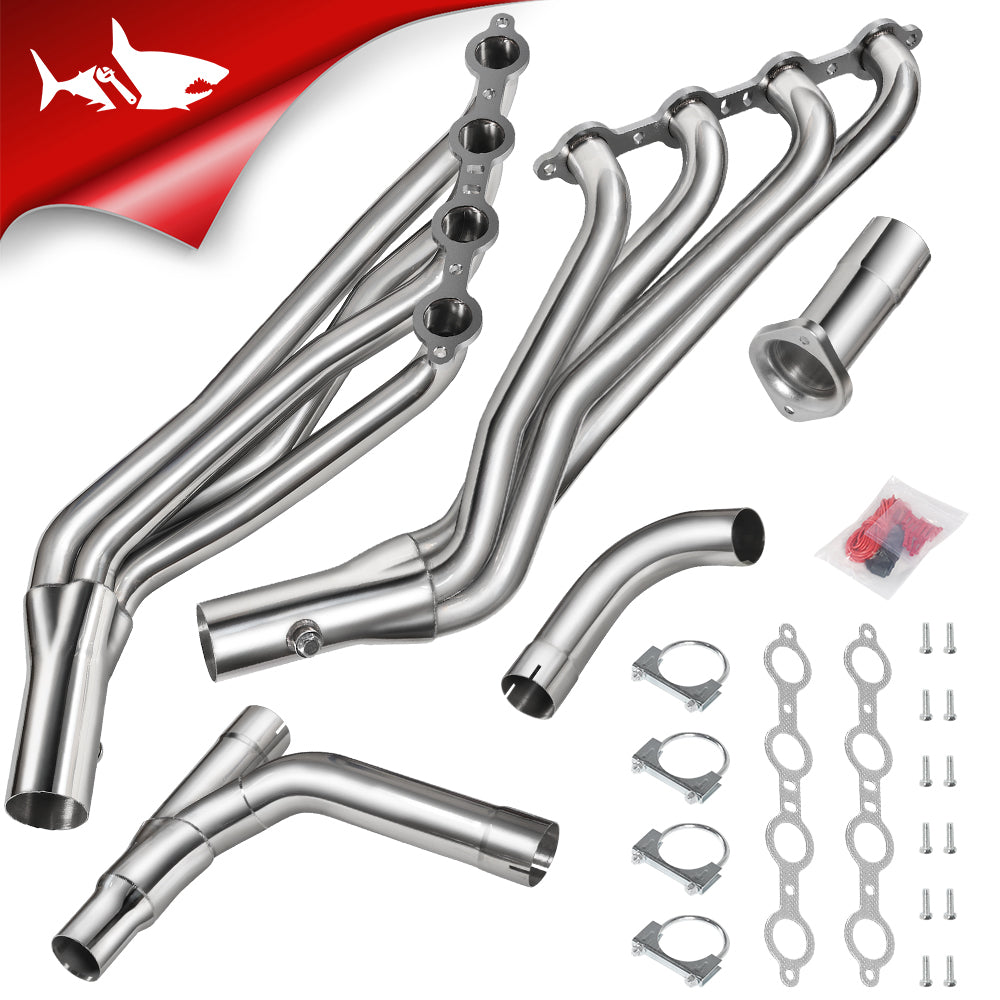
| Long Tube Headers | Tuned, cammed, higher-output 5.3 builds | Best power potential | Harder install, Y-pipe changes, louder sound, emissions concerns |
Best for a Daily Driver
For a daily driver, I like low drama. Stock manifolds are best if nothing is wrong. Shorties are fine if the manifolds are leaking, rusty, ugly, or already coming off. Long tubes? Great when the truck is built for it. Annoying when the truck just needs to get to work without codes or exhaust leaks.
Best for Towing
Towing changes the conversation. You care about heat, sealing, low-to-mid rpm torque, and reliability. A cheap header with thin flanges is not a towing upgrade. It is a future leak.
For tow rigs, I would rather see a high-quality shorty or a properly installed stock-style replacement than a poorly fitted long tube setup rubbing, leaking, or cooking plug wires.
Best for Cammed or Tuned 5.3 Builds
If the truck has a cam, tune, intake, and a real exhaust behind it, long tubes usually make more sense. They give the engine more room to breathe, especially higher in the rpm range.
If you are still debating the broader header choice, Flashark’s article on long tube vs shorty headers for a 5.3 Silverado goes deeper into power, sound, fitment, and cost tradeoffs.
Best for Emissions-Conscious Builds
This is where shorties can make real sense. Many shorty setups are designed to stay closer to the factory exhaust path. That can make them easier to pair with factory-style catalytic converter locations compared with long tubes.
But do not assume legal compliance. Check your local laws. California and CARB-regulated areas are not the place to guess.
Fitment Notes for Silverado 5.3 Owners
A 5.3 Silverado is not one truck. A 2001 GMT800, a 2011 GMT900, a 2017 K2XX, and a newer 2019+ truck all ask different fitment questions.
GMT800, GMT900, K2XX, and Newer Trucks
Before buying anything, confirm:
- Year range
- Engine size: 4.8L, 5.3L, 6.0L, or 6.2L
- Truck platform
- 2WD or 4WD
- Cab and chassis layout
- Factory Y-pipe style
- Catalytic converter position
- EGR or emissions equipment differences
- O2 sensor location
If you are browsing by GM truck application, Flashark’s Chevy exhaust headers page is a better fit than using one random product page for every Vortec truck.
2WD vs 4WD Clearance
4WD trucks can have different clearance concerns around the front driveline, frame, and exhaust routing. Shorties usually avoid the worst of the long tube clearance fight, but “usually” is not “always.”
Check the product fitment notes before ordering. Not after the truck is half apart. That mistake is expensive and embarrassing.
Factory Y-Pipe and Catalytic Converter Compatibility
This is one of the biggest reasons owners choose shorty headers. A shorty setup often has a better chance of working with a factory-style Y-pipe than a long tube setup. Long tubes move the collector farther back. That often means a matching Y-pipe or fabrication.
If you are considering long tubes later, read the Flashark guide on 5.3 long tube headers install mistakes before you order. The Y-pipe section alone can save you from buying the wrong parts.
Common Mistakes Before Buying 5.3 Shorty Headers
Buying Only for Peak Horsepower Claims
Peak horsepower does not tell the whole story. A truck lives in the low and midrange. If the only thing you see is a big number with no dyno setup, no tune information, and no baseline, treat it like a fish story.
Ignoring Rust and Broken Bolts
Many new owners budget for headers and forget the labor risk. Then one broken rear bolt adds hours. Sometimes the bolt extraction costs more than the part.
Check before you buy. Look for missing bolt heads. Listen for cold-start ticking. Smell for exhaust near the engine bay. Look for soot marks around the manifold flange.
Pairing Headers With the Wrong Exhaust Setup
Shorty headers with a good cat-back can sound clean. Shorties with a hacked muffler delete can sound raspy. Shorties with a factory muffler may sound too subtle for someone expecting drama.
Match the part to the sound goal. Do not just remove parts until the truck gets loud. Loud is easy. Good tone takes planning.
Expecting Long Tube Results From Shorty Headers
This is the big one. A shorty header is not a long tube header wearing a smaller shirt. It has a different job.
Shorties are about compact fitment, mild flow improvement, better looks, and controlled sound. Long tubes are about stronger scavenging and bigger performance potential. Pick the tool that matches the job.
Who Should Buy Shorty Headers and Who Should Skip Them?
Buy Shorty Headers If...
- You want a cleaner V8 tone without going full loud.
- Your stock manifolds are leaking, cracked, or rusty.
- You want a stainless upgrade while keeping a factory-style layout.
- You already have a cat-back and want the front half to breathe a little better.
- You want easier fitment than long tubes.
- You care about engine bay appearance.
- You are building a mild street truck, not a max-effort race setup.
Skip Shorty Headers If...
- You only care about the biggest horsepower number.
- You expect 25–40whp from headers alone on a stock truck.
- Your stock manifolds are perfect and your budget is tight.
- You are already planning a cam, tune, and long tube setup.
- You live somewhere with strict emissions checks and the product is not approved for your use.
- You hate any chance of exhaust leak troubleshooting.
Product Selection Guide: What to Look for in 5.3 Silverado Shorty Headers
Material: Stainless Steel vs Coated Steel
Stainless steel resists corrosion better than basic mild steel. That matters on trucks. Especially trucks that see rain, salt, mud, or winter roads.
Coated headers can help with heat and surface durability, but coating quality matters. A cheap coating that flakes after a few heat cycles is not a win.
Flange Thickness and Weld Quality
Look at the flange. I care more about that than shine. A thicker flange helps resist warping and gives the gasket a better chance to seal. Clean welds matter too, but the sealing surface is where a lot of cheap headers fail.
Included Hardware and Gaskets
Do not assume the box includes everything. Confirm:
- Header gaskets
- Collector gaskets
- Header bolts
- Collector hardware
- O2 sensor provisions if applicable
- EGR compatibility if your truck needs it
One important fitment note: the Flashark 1999–2006 4.8L/5.3L shorty header listing notes that there is no interface reserved for EGR. If your truck needs EGR compatibility, check before buying. That one sentence can save you a return.
CARB, EPA, and Street-Use Notes
For the U.S. market, emissions language matters. Not every header is legal for every street-driven truck in every state. Some products are for off-road or competition use depending on the application and local law.
If you live in California or another strict emissions area, look for the correct certification for your exact vehicle. “Fits my engine” is not the same as “legal on my truck.”
Mechanic’s Verdict: Shorty Headers vs Stock Manifolds Silverado
I would not tell every 5.3 Silverado owner to buy shorty headers. That would be lazy advice.
If your stock manifolds are healthy, your truck is quiet, and you only want the best horsepower per dollar, keep the manifolds for now. Spend money where you will feel it more.
If your manifolds are leaking, the bolts are already giving you trouble, or you want a sharper exhaust tone without going into long tube territory, shorties make sense. That is the lane where they belong.
So when someone asks me about 5.3 shorty headers vs stock manifolds, my answer is simple: shorties are a smart mild upgrade when your expectations are realistic. They are not magic. They are not fake either. They are a fitment-friendly middle ground.
Conclusion: Shorty Headers vs Stock Manifolds Silverado — Final Verdict
For a mostly stock 5.3 Silverado, stock manifolds are still hard to beat for quiet operation, cost, and factory reliability. Shorty headers become worth it when you want better tone, a cleaner stainless replacement, slightly improved flow, and less installation drama than long tubes.
If you are building for maximum power, go long tubes with the right Y-pipe, tune, and supporting parts. If you are fixing a leaking manifold and want a better-looking replacement that keeps the truck civil, shorties are a reasonable move.
Just do not buy them expecting long tube results. Buy them for what they are: a mild, compact, street-friendly exhaust upgrade for the right 5.3 Silverado build.
FAQ: 5.3 Shorty Headers vs Stock Manifolds
Q1: Are shorty headers worth it on a 5.3 Silverado?
A1: Yes, but only for the right goal. They are worth it for mild sound improvement, better engine bay appearance, and replacing cracked or leaking stock manifolds. They are usually not the best horsepower-per-dollar upgrade for a completely stock truck.
Q2: How much horsepower do shorty headers add to a 5.3 Silverado?
A2: On many mild 5.3 setups, shorty headers may show around 5–12 wheel horsepower, sometimes less without a tune or supporting exhaust parts. Bigger gains usually come from long tubes, tuning, camshaft upgrades, and a better full exhaust combination.
Q3: Do shorty headers sound better than stock manifolds?
A3: Usually yes. Shorty headers tend to make the exhaust tone cleaner, sharper, and slightly more aggressive. The final sound depends heavily on the catalytic converters, muffler, resonator, and tailpipe setup.
Q4: Do shorty headers make a 5.3 Silverado louder?
A4: They can make it slightly louder, especially on cold start and under throttle. But they usually do not create the big volume jump you would hear from long tubes, catless pipes, or a muffler delete.
Q5: Do I need a tune for shorty headers on a 5.3 Silverado?
A5: Not always. If the truck keeps factory-style catalytic converters and O2 sensor placement, a tune may not be mandatory. A tune can still improve throttle response, fuel trims, and overall drivability, especially with intake, cat-back, cam, or other supporting mods.
Q6: Are stock manifolds good on a 5.3 Silverado?
A6: Yes. For a stock or lightly modified daily driver, factory manifolds are quiet, durable, compact, and reliable when they are not cracked or leaking. They are not exciting, but they work better than many owners assume.
Q7: Are shorty headers better than long tube headers for daily driving?
A7: For many daily drivers, yes. Shorty headers are usually easier to install, quieter, and closer to the factory layout. Long tubes generally make more power, but they bring more cost, noise, fitment work, and emissions concerns.
Q8: Will shorty headers cause a check engine light?
A8: They should not automatically cause a check engine light if the exhaust is sealed, catalytic converters remain functional, and sensor placement is correct. But leaks, damaged O2 sensors, emissions changes, or incorrect fitment can still trigger codes.
Q9: Can shorty headers bolt up to the stock Y-pipe?
A9: Many shorty headers are designed to stay close to the stock exhaust layout, so they may work with a factory-style Y-pipe. Always confirm the exact year, drivetrain, engine, and product fitment before ordering.
Q10: Are shorty headers legal in California?
A10: Not automatically. California legality usually requires the correct CARB approval for the exact vehicle and part. If you live in a strict emissions state, verify compliance before installing headers on a street-driven truck.
Q11: What is the biggest risk when installing shorty headers on an older Silverado?
A11: Broken manifold bolts are the biggest headache. Rust, heat cycling, and tight access near the firewall can turn a simple install into a repair job. Exhaust leaks from poor gasket prep or uneven flanges are another common problem.
Q12: Should I replace cracked stock manifolds with shorty headers?
A12: It can be a good time to upgrade. If the manifolds are already coming off, shorty headers can add better looks, slightly improved flow, and a sharper tone. If you only want quiet factory reliability, stock-style replacement manifolds may still be the better choice.
Q13: Do shorty headers help towing on a 5.3 Silverado?
A13: They may help throttle response slightly, but do not expect a massive towing power increase. For towing, sealing quality, heat control, tune quality, gearing, and overall truck condition matter more than shorty headers alone.
Q14: What sounds better on a 5.3 Silverado, shorty headers or stock manifolds?
A14: Shorty headers usually sound cleaner and more aggressive. Stock manifolds are quieter and more muted. If the truck already has a good cat-back exhaust, the difference from shorties is easier to hear.
Q15: Should I install shorty headers before or after a cat-back exhaust?
A15: If your main goal is sound, a cat-back usually makes the bigger difference first. If you already have a cat-back and want more header tone or need to replace leaking manifolds, shorty headers make more sense as the next step.

Steven Chen
Automotive Performance Specialist | Engine & Exhaust Systems
Steven focuses on practical engine performance, exhaust fitment, and real-world upgrade paths for classic and modern enthusiast vehicles. He reviews small-block Ford, LS, truck, and street/strip applications with one goal in mind: helping builders choose parts that actually work together. His philosophy: "Good power starts with the right combination, not the biggest part."