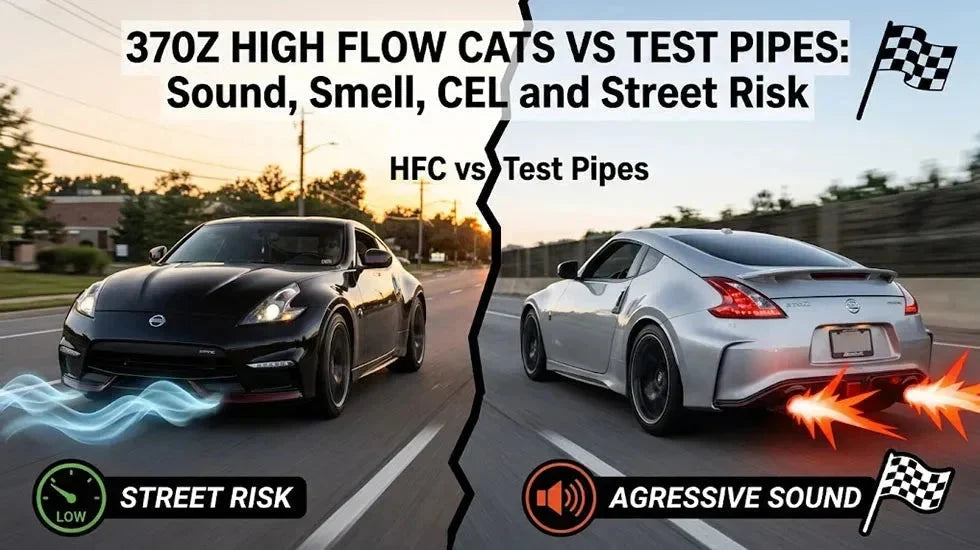
You want the VQ37VHR to breathe harder. I get it. A stock 370Z can sound a little bottled up, almost like Nissan left a thick towel stuffed in the exhaust. But the second you start comparing 370Z high flow cats vs test pipes, the decision gets messy fast.
Test pipes sound nasty in the best way when the setup is right. They are raw, sharp, and angry. But they can also stink, rasp, drone, light up the dash, and make street use a headache. High flow cats are not as wild, but for a daily-driven Z, they often make more sense. Less smell. Less stress. Still louder than stock.
So no, this is not one of those clean little “Pros and Cons” articles written by someone who has never scraped their knuckles on a hot flange. This is the real garage version: sound, smell, CEL, emissions, low-end torque, install pain, and what you may regret after a week of driving.
Quick Answer: HFC for Street, Test Pipes for Track Use
Here is the honest answer before we get deep into it:
- Choose high flow cats if your 370Z is a daily driver, weekend street car, or something you do not want to smell like raw exhaust at every red light.
- Choose test pipes if the car is mainly for track, off-road use, loud meets, or maximum exhaust flow matters more than smell, inspection risk, and cabin comfort.
- If you already have a loud catback, non-resonated test pipes can push the car over the edge. The VQ rasp can get ugly.
- If you hate check engine lights, high flow cats are the safer route, but they are not a perfect CEL guarantee.
- If you want the most livable setup, high flow cats with a resonated catback usually beat straight test pipes for street use.
What High Flow Cats and Test Pipes Actually Replace on a 370Z
On a naturally aspirated 370Z, people often throw around the words “downpipes,” “test pipes,” and “cats” like they are all the same thing. They are not always the same part on every platform. On the Z34 370Z, the key section we are talking about sits where the factory catalytic converters live, right after the exhaust manifolds and before the Y-pipe or mid-pipe section.
That is why the 370Z test pipes vs HFC debate is really a catalytic converter replacement debate. You are deciding how much exhaust filtering, sound control, and legal comfort you are willing to keep.

High Flow Cats on a 370Z
High flow catalytic converters still have a catalyst core inside. Usually it is a less restrictive metallic or ceramic substrate compared with the dense factory cats. That means better flow than stock, more volume, and a sharper exhaust note, while still keeping some exhaust cleanup and odor control.
Do not misunderstand this part. A high flow cat is not automatically legal in every state. It is not automatically CEL-free either. But compared with straight test pipes, it usually gives you a better balance for a street car.
Test Pipes on a 370Z
Test pipes remove the catalytic converter section and replace it with open piping. That gives the exhaust a cleaner path out of the VQ37VHR. Less restriction. More noise. More raw smell. More chance of CEL. More street-use risk.
For a track car, that tradeoff can make sense. For a daily driver that sees traffic, parking garages, cold starts, and emissions checks, listen carefully: test pipes are not just “cheaper high flow cats.” They change the whole personality of the car.
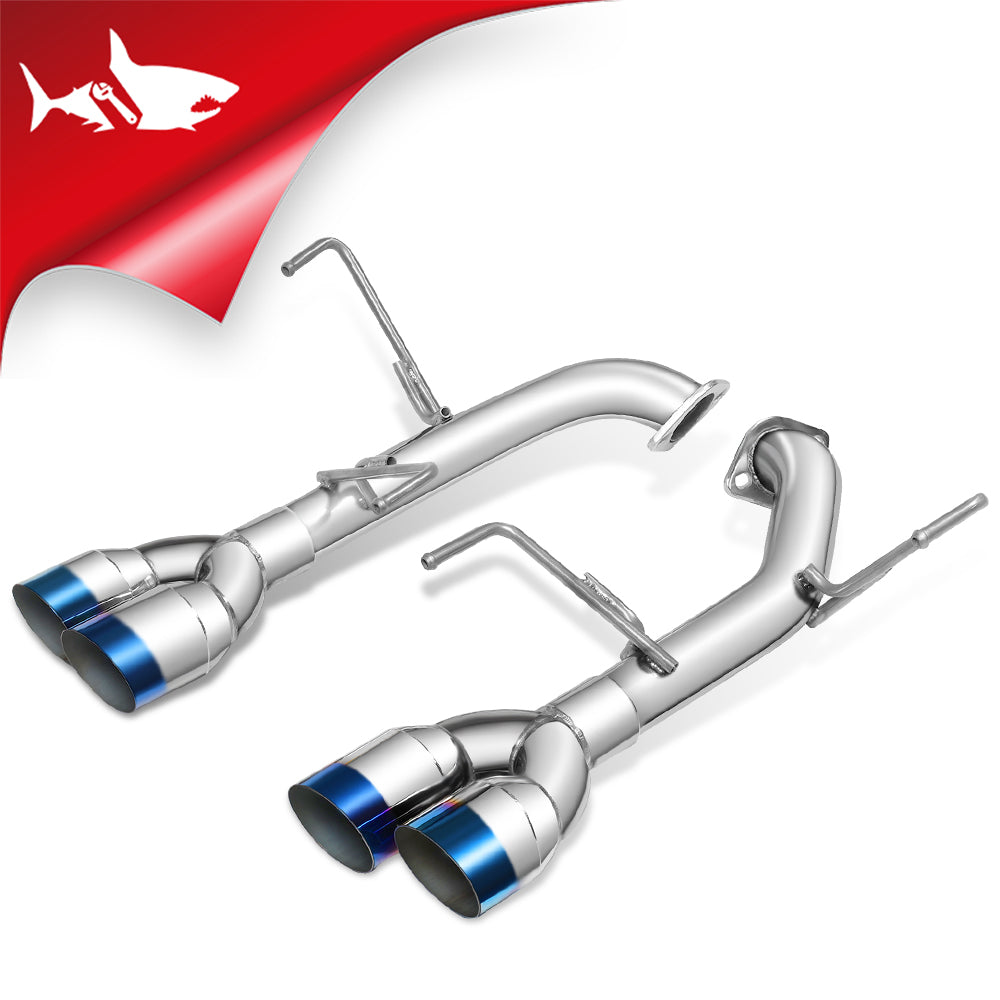
If you are building a track-focused Z and want a direct replacement setup, Flashark offers 370Z test pipes for Nissan 370Z and Infiniti G37 that use 2.50-inch tubing and T-304 stainless construction. Treat that kind of setup for what it is: a loud, free-flowing, off-road and racing-style exhaust upgrade, not a quiet commuter fix.

Flashark Downpipe/Test Pipes for 370Z and G37
Best fit for drivers building a louder, freer-flowing VQ exhaust setup for off-road or track-focused use. Includes stainless test pipes, gaskets, and hardware.
Sale price: $139.99 $175.00
370Z High Flow Cats vs Test Pipes Sound Difference
Sound is why most people start shopping. But “louder” is a lazy way to describe exhaust. A 370Z can be louder and better. It can also be louder and worse. Big difference.
The VQ37VHR has a very specific voice. When you remove too much filtering and do not add enough resonation, it can get sharp in the upper midrange. Some guys call it exotic. Some call it trumpet. Some call it a tin can full of angry bees. Depends on the setup.
Cold Start Volume
High flow cats usually give you a deeper and stronger cold start than stock. The car wakes up, barks for a few seconds, then settles down. It sounds modified, but usually not ridiculous.
Test pipes are different. Cold start gets much more violent. If the car has a single-exit exhaust, muffler delete, or non-resonated catback, the first 20 seconds can be brutal. Garage door open, 6:30 a.m., neighbor’s bedroom window right there? Yeah. That is when some owners start questioning their life choices.
Idle and Low-RPM Tone
At idle, high flow cats tend to keep the tone thicker. Still aggressive, but not hollow. Test pipes make the idle more mechanical and raw. You hear more exhaust pulse. You hear more of the engine’s dirty side.
Some people love that. I do too, on the right car. But on a daily car with a loud rear section, that rawness can turn into cabin boom between 2,000 and 3,000 rpm. That is the range you live in when you are driving through town, not just ripping through a tunnel.

Wide-Open Throttle and VQ Rasp
At wide-open throttle, test pipes are the wild option. The exhaust note gets sharper, louder, and more immediate. HFCs sound smoother. Less metallic. Less crackly up top.
Here is the part the forums argue about for 12 pages: test pipes do not automatically sound better. They sound more exposed. If the rest of the exhaust is tuned well, that exposed sound can be nasty. If the rest of the exhaust is cheap, hollow, or non-resonated, the rasp can ruin the car.
Mechanic’s note: If your 370Z already has a loud single exit, do not assume non-resonated test pipes will make it “deeper.” A lot of the time they make it sharper, thinner, and more annoying inside the cabin.
First-Person Case: The 370Z That Got Too Loud
I remember a 2017 370Z Nismo that came in with a non-resonated single exit and straight test pipes. The owner loved it for about three days. Then the texts started. “Bro, it drones at 3,200 rpm.” “My girlfriend hates riding in it.” “It smells when I reverse into the garage.”
We put the car on the lift and nothing was broken. No massive leak. No bad hanger. The setup was just too raw for how he used the car. After switching to a more resonated mid-section and adding more sound control, the car still sounded mean, but it stopped beating him up on the highway. That is the lesson. The pipe is only one piece. The whole exhaust decides whether the Z sounds expensive or exhausting.
Exhaust Smell: The Part People Downplay Until It Happens
Let me say this clearly: smell is the biggest reason street-driven test pipe cars get old fast.
With high flow cats, you may notice more exhaust odor than stock, especially during cold start or rich running. But there is still a catalyst core doing some work. With test pipes, there is no cat doing that job. Raw exhaust odor gets stronger. Not sometimes. Not maybe. It is part of the deal.
Why Test Pipes Smell Stronger
Factory cats help reduce hydrocarbons, carbon monoxide, and other exhaust byproducts. Remove them, and the smell gets more direct. You notice it most when the car is stationary or moving slowly.
- Cold start in a closed garage
- Sitting at a red light with the windows cracked
- Backing into a parking space
- Idling in a drive-through
- Low-speed traffic on a warm day
That smell does not mean the car is making huge power. It means the exhaust is not being cleaned the same way anymore.
Do High Flow Cats Still Smell?
Sometimes, yes. A high flow cat can smell more than a stock cat because the core is less dense and performance-oriented. But compared with test pipes, the odor is usually much easier to live with.
If your HFC setup smells terrible inside the car, inspect the basics before blaming the part:
- Header-to-cat flange leaks
- Cat-to-Y-pipe gasket leaks
- Loose O2 sensor bungs
- Cracked flex sections
- Tailpipe position under the bumper
- Rear hatch or trunk seal leaks
CEL and O2 Sensor Risk on 370Z Test Pipes vs HFC
The check engine light conversation is where people start looking for shortcuts. O2 spacers. J-bungs. Defoulers. Tunes. Some work better than others. None of them change the fact that the ECU is watching catalyst efficiency.
Why Test Pipes Trigger CEL
The 370Z has downstream oxygen sensors that monitor what happens after the cats. When the catalytic converter is gone, the ECU can see that the exhaust is not behaving like it should after a working catalyst. That is when codes like P0420 or P0430 can show up.
Some test pipes are built with extended bungs to pull the sensor slightly out of the direct exhaust stream. That can help. But I would never promise a no-CEL result on every car, every tune, every state of sensor health, and every exhaust combination. That is how bad advice gets started.
Can High Flow Cats Cause a CEL?
Yes. Lower risk does not mean zero risk. A high flow cat with a very open core can still flow enough that the downstream sensor does not like what it sees. Add a small exhaust leak near the sensor and the odds get worse.
Still, if your priority is fewer dashboard headaches, high flow cats usually beat test pipes. That is one of the biggest practical points in the 370Z high flow cats vs test pipes decision.
O2 Spacers, J-Bungs and Tuning
O2 spacers and J-bungs may reduce CEL frequency by changing how much exhaust the downstream sensor reads. They are common in the 370Z community. But they are not magic.
A tune can help the car run better after exhaust changes, especially when paired with intake, Y-pipe, and catback upgrades. You may see cleaner throttle response and better power delivery. But do not treat tuning as a legal loophole for emissions systems. Street legality and ECU calibration are separate topics.
If you want a deeper dive into CEL behavior and install details, read the best 370Z test pipes and demon bolts guide. That article gets more specific about pipe design, O2 bungs, and the hardware fight under the car.
Emissions and Street-Legal Risk in the USA
This is the section nobody wants to read, but it matters. Especially in the U.S.
Test pipes that replace catalytic converters are generally for off-road or track use only. The EPA has made it clear that a pipe used to replace the catalytic converter section is considered illegal under the revised Clean Air Act. California is even stricter, and CARB-approved aftermarket catalytic converters need to be checked by application and Executive Order, not by guesswork.
You can check official references here:
High Flow Cats Are Not Automatically Legal
This is where a lot of owners get burned. They see the word “catted” and assume the part is legal everywhere. Not that simple.
A high flow cat can be a better street-minded choice than a test pipe, but it still needs to meet the rules where the car is registered. In California-style states, you may need a specific CARB EO number that matches the vehicle. In OBD inspection areas, readiness monitors and visual checks can both matter.
No CEL Does Not Mean Legal
A car can have no check engine light and still fail a visual inspection. It can also pass a basic scanner check in one area and fail in another area with stricter inspection rules.
So when someone online says, “Mine passed,” ask the boring questions. What state? What inspection type? What year? Was there a visual check? Were readiness monitors complete? Was it actually legal or did it just slip through?
Street-use warning: If your 370Z is registered for public-road use, check your local emissions laws before replacing factory catalytic converters. Test pipes are normally sold for off-road, racing, or track applications where emissions equipment rules do not apply the same way.
Do not buy based on sound clips alone. A setup that sounds perfect on YouTube may be a bad idea for your county inspection, commute, or garage.
Power and Low-End Torque: What You Actually Feel
Everybody wants the bigger number. Fine. Let’s talk numbers. But let’s talk about them like adults.
On a healthy naturally aspirated 370Z, test pipes can show roughly 8–12 whp on a tuned bolt-on setup. High flow cats often land closer to 5–9 whp, depending on core design, tune, Y-pipe, intake, and catback. A full exhaust combination can show more, but the pipe alone is not a magic 30-whp button.
The difference you feel most may not be peak horsepower. It may be throttle sharpness, sound, and how freely the car pulls from the midrange to redline.
Low-End Torque Feel
Here is where it gets interesting. Test pipes reduce restriction, but that does not always mean the car feels stronger everywhere. On the street, a setup with high flow cats may feel smoother at low rpm because the exhaust note is calmer and the pulse behavior is less chaotic.
With test pipes, the upper rpm range can feel more open. The engine revs cleaner. But low-speed driving can feel rougher if the exhaust gets boomy or if the tune is not dialed in.
Stock Cats vs High Flow Cats vs Test Pipes
| Setup | Typical Flow | Sound | Smell | CEL Risk | Street Comfort | Typical WHP Change |
|---|---|---|---|---|---|---|
| OEM Cats | Most restrictive | Quiet, muted | Lowest | Lowest | Best for comfort | Baseline |
| High Flow Cats | Moderate to high | Deeper, cleaner, still controlled | Mild to moderate | Low to medium | Best modified street balance | About 5–9 whp with supporting setup |
| Test Pipes | Highest | Loud, raw, more rasp-prone | Highest | High | Depends heavily on tolerance | About 8–12 whp with supporting setup |
Those ranges are realistic street-dyno expectations, not fantasy catalog math. A tuned car with intake, Y-pipe, catback, and healthy sensors can do better than a tired car with leaks and no calibration. That is why I always look at the whole combination, not just the shiny pipe on the floor.
Daily Driving: What You Notice After One Week
The first drive after installing test pipes feels exciting. The car sounds alive. You hit one tunnel and think, “This was worth it.” Then real life shows up.

Morning Starts
High flow cats give you attitude without making every cold start an event. Test pipes make the car announce itself. Some owners like that. Some love it until they move into an apartment complex.
Highway Cruising
Drone is not about volume only. It is about frequency. A setup can be loud and still comfortable, or only moderately loud but miserable at one specific rpm. The 370Z commonly cruises in the range where a bad exhaust combo can sit right on your skull.
Passenger Comfort
You may tolerate the smell and noise. Your passenger may not. That matters if the car is not just a weekend toy.
Old-school car guys like to pretend comfort does not matter. Then they quietly swap parts three months later because the car became annoying. No shame in that. A street car has to be something you actually want to drive.
Cost Comparison: Cheap Pipes Are Not Always Cheap
Test pipes usually cost less upfront than high flow cats. That is true. But the cheapest part is not always the cheapest path.
Upfront Price vs Hidden Cost
Here is where the budget can move:
- O2 spacers or J-bungs
- New gaskets and hardware
- Professional labor if the factory bolts fight back
- ECU tune if the car needs better calibration
- Inspection failure correction
- Swapping back to stock cats
- Buying a resonated mid-section because the sound got too harsh
If you are already shopping for broader exhaust parts, the performance exhaust downpipe collection is a better place to compare options across platforms instead of buying one isolated pipe and hoping the rest of the system behaves.
First-Person Case: Demon Bolts Are Not a Meme
I remember a 2014 370Z that rolled in for what the owner thought would be a quick test pipe install. “Two hours, right?” No. The upper cat bolts were cooked in place. One rounded, one laughed at the extractor, and the passenger side needed heat, extensions, patience, and language I probably should not print here.
That job became expensive because the owner had watched a clean install video from a rust-free car and thought every Z would come apart like that. Many new guys do this. They spray a little penetrant, grab the wrong angle, round the nut, and now the car is stuck on jack stands. I suggest you do not do that.
Before installation, do this:
- Soak the upper cat bolts with penetrating oil the night before.
- Use quality six-point sockets, not worn cheap ones.
- Have extensions, wobble joints, and a breaker bar ready.
- Replace gaskets instead of reusing crushed old ones.
- Check O2 sensor wire routing before tightening everything.
- Start the car and listen for leaks before lowering it fully.
Y-Pipe and Catback Pairing Matter More Than People Think
The pipe after the cats matters. The mufflers matter. Resonators matter. Tube diameter matters. Hanger position matters. That is why two 370Zs with the same test pipes can sound completely different.

Why the Y-Pipe Changes the Result
The Y-pipe merges the two banks of the VQ exhaust. A better-flowing Y-pipe can sharpen throttle response and clean up the transition from front pipes to the rear exhaust. A bad Y-pipe can leak, buzz, or add weird resonance.
If you are already opening up the front of the exhaust, pairing it with a 370Z Y-pipe downpipe exhaust for VQ37VHR builds can make more sense than leaving a restrictive or tired mid-section behind. Just check fitment notes carefully, especially if you are comparing 370Z, G37, coupe, sedan, or AWD-related applications.

Flashark Y-Pipe Downpipe Exhaust for 370Z and G37
A supporting exhaust upgrade for VQ37VHR cars when you want stronger flow through the mid-section instead of only changing the front pipes.
Sale price: $159.99 $199.00
Resonated vs Non-Resonated Test Pipes
Resonated test pipes are not high flow cats. They do not clean exhaust gases like a catalyst. But they can help calm rasp and edge. If you want test pipe flow without the worst high-frequency bite, resonated test pipes are worth considering.
Non-resonated test pipes are the loudest and most raw. They can be fun on a track setup. On a street Z with an already aggressive catback, they may be too much. For a deeper breakdown, read this resonated vs non-resonated test pipes for G37 and 370Z guide before you buy anything.
Stock Exhaust vs Aftermarket Exhaust
With the stock rear exhaust, test pipes may still be tolerable for some owners. With a loud aftermarket catback, the same test pipes can turn the car into a rasp machine. That is why sound clips are dangerous. A microphone does not capture cabin drone, exhaust smell, or your state inspection rules.
If you want to browse more chassis-specific options, the Nissan downpipe exhaust upgrades collection is a cleaner internal path than jumping between random universal parts.
Best Choice by Build Type
Still stuck? Good. That means you are thinking about the car as a whole, not just chasing noise.
Best for a Daily Driven 370Z
Pick high flow cats in most cases. They keep the car more livable, reduce the raw fuel smell, and usually lower CEL risk compared with straight test pipes. The sound is still better than stock, but it does not beat you up every time you drive to work.
Best for a Weekend Canyon Car
High flow cats are still the safe answer. Resonated test pipes can work if you accept odor, inspection risk, and a louder cabin. If you drive the car hard but still take it on public roads often, think twice before going non-resonated.
Best for a Track-Only 370Z
Test pipes make the most sense here. You get maximum exhaust flow, more aggressive sound, lower restriction, and less concern about street comfort. Just be honest about the “track-only” part. Do not call it a street compliance solution.
Best for the Loudest Setup
Test pipes with an aggressive catback will win the volume contest. No surprise there. But loudest does not mean best. If the car sounds great at wide-open throttle but makes you hate the highway, you did not build a better street car. You built a shorter fuse.
Final Verdict: 370Z High Flow Cats vs Test Pipes
The real answer to 370Z high flow cats vs test pipes depends on how honest you are about the car.
If your 370Z is a street car, high flow cats are usually the better choice. They give you more tone, better flow, and a stronger character without turning every drive into a smell-and-CEL gamble. They are not perfect. They are just easier to live with.
If your 370Z is a track-focused build and you want maximum flow, test pipes make sense. They are louder, cheaper, simpler, and more aggressive. But the tradeoff is real: more smell, more CEL risk, more emissions risk, and more chance of rasp.
So here is my garage answer: choose HFC if you want to enjoy the car often. Choose test pipes if you know exactly what you are giving up and you still want the raw version of the VQ. That is the whole 370Z test pipes vs HFC debate in one sentence.
For more background on the test pipe side specifically, the complete 370Z test pipe guide explains horsepower, sound, and fitment basics in more detail.
FAQs About 370Z High Flow Cats vs Test Pipes
Q1: Are high flow cats better than test pipes for a 370Z?
A1: For a daily-driven 370Z, high flow cats are usually better. They keep the sound more controlled, reduce raw exhaust smell, and usually carry less CEL risk than test pipes. For a track-only car, test pipes may be better because they offer maximum flow.
Q2: Do test pipes make a 370Z louder than high flow cats?
A2: Yes. Test pipes usually make a 370Z louder than high flow cats, especially during cold start and wide-open throttle. They also make the exhaust tone more raw and more likely to rasp.
Q3: Will 370Z test pipes make the car smell bad?
A3: Yes, test pipes can make the exhaust smell much stronger because they remove the catalytic converter section. You will usually notice it most at idle, red lights, garage starts, and low-speed driving.
Q4: Do high flow cats smell on a 370Z?
A4: High flow cats can smell slightly stronger than stock catalytic converters, but usually much less than test pipes. If the smell is heavy inside the cabin, check for exhaust leaks before blaming the cats.
Q5: Will test pipes cause a check engine light on a 370Z?
A5: They can, and the risk is high. Since test pipes remove the catalyst, the downstream O2 sensors may detect catalyst efficiency problems and trigger codes such as P0420 or P0430.
Q6: Can high flow cats cause a CEL?
A6: Yes, high flow cats can still cause a CEL, especially if the catalyst core is very open, the O2 sensor position is poor, or there is an exhaust leak near the sensor. The risk is usually lower than with test pipes.
Q7: Do I need a tune for 370Z test pipes or HFC?
A7: A tune is not always required just to install the parts, but it is recommended if you want cleaner throttle response, safer air-fuel behavior, and better power delivery. A tune should not be treated as a street-legal emissions workaround.
Q8: Will test pipes pass emissions on a 370Z?
A8: In most emissions-controlled street-use situations, do not expect test pipes to pass. Even if there is no CEL, a visual inspection can still fail the car because the factory catalytic converters have been removed.
Q9: Are high flow cats street legal in California?
A9: Not automatically. California street use generally requires the correct CARB-approved catalytic converter for the exact vehicle application. Always check the CARB EO and fitment details before buying.
Q10: Do test pipes add more horsepower than high flow cats?
A10: Test pipes usually offer slightly more peak flow and may show more peak horsepower than high flow cats. On many naturally aspirated 370Z setups, the real-world difference is often smaller than the difference in sound, smell, and street risk.
Q11: Which sounds better on a 370Z, HFC or test pipes?
A11: If you want a deeper and cleaner street tone, high flow cats usually sound better. If you want the loudest and rawest exhaust note, test pipes are more aggressive, but they can also create rasp and drone.
Q12: Are resonated test pipes the same as high flow cats?
A12: No. Resonated test pipes use resonators to reduce harsh sound, but they do not contain a catalytic substrate. High flow cats still contain a catalyst core to help control exhaust odor and emissions.
Q13: Will test pipes hurt low-end torque on a 370Z?
A13: Not always, but test pipes do not automatically improve low-end street feel. They can help the engine breathe better up top, while low-rpm feel depends on the tune, Y-pipe, catback, intake, and overall exhaust design.
Q14: What is the best 370Z exhaust setup for daily driving?
A14: For most daily drivers, high flow cats with a resonated catback are the safest modified setup. You get more sound and better flow without maxing out smell, drone, rasp, and CEL risk.

Steven Chen
Automotive Performance Specialist | Engine & Exhaust Systems
Steven focuses on practical engine performance, exhaust fitment, and real-world upgrade paths for classic and modern enthusiast vehicles. He reviews small-block Ford, LS, truck, and street/strip applications with one goal in mind: helping builders choose parts that actually work together. His philosophy: "Good power starts with the right combination, not the biggest part."