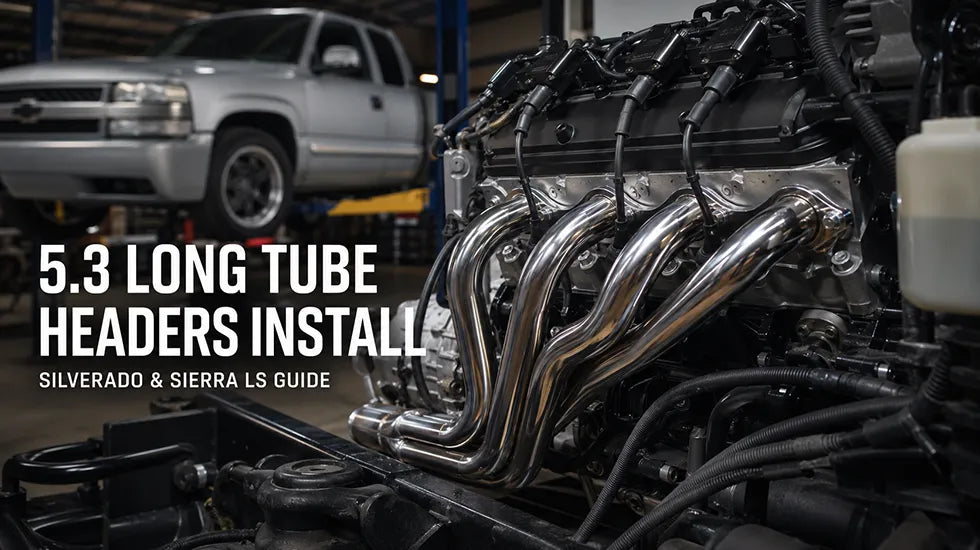
So you are getting ready for a 5.3 long tube headers install on a Silverado. Good. But listen, do not crawl under the truck with a socket set and a half-charged flashlight thinking this is just a louder exhaust weekend.
Honestly, the headers themselves are not usually the part that ruins the job. The ugly stuff is what happens around them: old manifold bolts snapping in the head, a Y-pipe that will not line up, O2 sensor wires stretched tight across hot tubing, plug wires cooking on the primaries, a 4WD front driveshaft sitting right where the pipe wants to live, or a check engine light showing up after the first drive.
This guide is written for Silverado and Sierra owners working around the 5.3L Vortec / LS-based truck platform, especially 1999-2006 GMT800, 2007-2014 GMT900/NNBS, and 2014-2017 Silverado/Sierra 1500 trucks. The goal is not to sell you a fantasy. The goal is to help you prepare the parts, tools, fitment checks, and common mistakes before the truck is already half torn apart.
Quick Answer: What should you prepare before installing 5.3 long tube headers?
- Confirm fitment first: year, engine, 2WD/4WD, transmission, cab/bed layout, current exhaust, and emissions setup.
- Plan the Y-pipe: most long tube installs need a matching Y-pipe or exhaust fabrication because the collector location changes.
- Prepare the small parts: gaskets, bolts, O2 sensor extensions, heat sleeves, anti-seize, penetrating oil, and clamps.
- Expect extra work on older trucks: rusty manifold bolts, broken rear bolts, stuck O2 sensors, and exhaust leaks are common.
- Think about tuning: a stock truck may run, but a tune usually gives better fuel trims, throttle response, power delivery, and CEL control.
- For street use: confirm catalytic converter and local emissions rules before changing the mid-pipe layout.

Is Your 5.3 Silverado Ready for Long Tube Headers?
Before we talk about how to install headers on 5.3 Silverado trucks, we need to talk about whether your truck is actually ready for them. A 5.3 Silverado is not one single vehicle. A 2002 2WD single cab and a 2016 4WD crew cab may both say “5.3” on paper, but underneath, they are different headaches.
Check Your Year, Engine, and Chassis First
The first mistake is ordering by engine size only. Do not do that. “5.3 headers” is too broad. You need to confirm:
- Model year: 1999-2006, 2007-2014, or 2014-2017
- Vehicle: Silverado, Sierra, Tahoe, Yukon, Avalanche, Escalade, etc.
- Engine: 4.8L, 5.3L, 6.0L, or 6.2L
- Drivetrain: 2WD/RWD or 4WD
- Transmission and crossmember layout
- Current exhaust: stock, aftermarket cat-back, custom dual exit, or cut-and-weld setup
- Catalytic converter plan: retained, relocated, catted Y-pipe, or off-road use only
If you own a GMT800 truck, the 99-06 Silverado long tube headers fitment guide is worth reading before buying anything. That generation is popular, cheap to modify, and fun as hell, but old hardware and Y-pipe fitment can turn a simple install into a long night.
2WD vs 4WD Fitment: The Mistake Many Owners Miss
Here is the thing nobody wants to hear: a long tube header can fit the engine and still not make the whole exhaust fit the truck.
On many 2WD Silverado/Sierra builds, the install path is cleaner. You still have to fight bolts, O2 sensors, and exhaust alignment, but the Y-pipe usually has more room to snake back toward the rest of the exhaust.
On 4WD trucks, look harder. The front driveshaft, transfer case, transmission crossmember, and collector angle all matter. I have seen owners bolt the headers to the heads, stand back, smile, and then realize the Y-pipe wants to occupy the same space as the front driveshaft. That is not a “tight fit.” That is a cut, rotate, weld, and re-check job.
Garage Note:
I remember a 2005 Silverado 1500 4WD that came in after the owner had already bought a header set online. He was sure the install was “basically done” because both headers were hanging on the motor. Then we lifted the truck and looked at the Y-pipe path. The front driveshaft clearance was ugly. Not “massage it with a pry bar” ugly. Real fabrication ugly. We ended up cutting and reworking the Y-pipe angle so it could clear under movement, not just sitting still on the lift.
Transmission and Crossmember Clearance
Some installs need the transmission crossmember loosened or removed to get the Y-pipe in place. If that is the case, support the transmission correctly. Do not just start unbolting things and hope the mount carries the story.
Also watch 4L80E swaps and some heavier-duty layouts. They can put bigger cases and bellhousing areas near the header/Y-pipe path. A part that fits a stock 4L60E 2WD truck may need work on a swapped or custom truck.
Parts You Need Before Installing 5.3 Long Tube Headers
The best install starts before the first bolt turns. Lay out the parts. Count the bolts. Check the flanges. Look at the O2 bungs. Match the Y-pipe. If something looks wrong on the floor, it will look worse under the truck.

Long Tube Headers
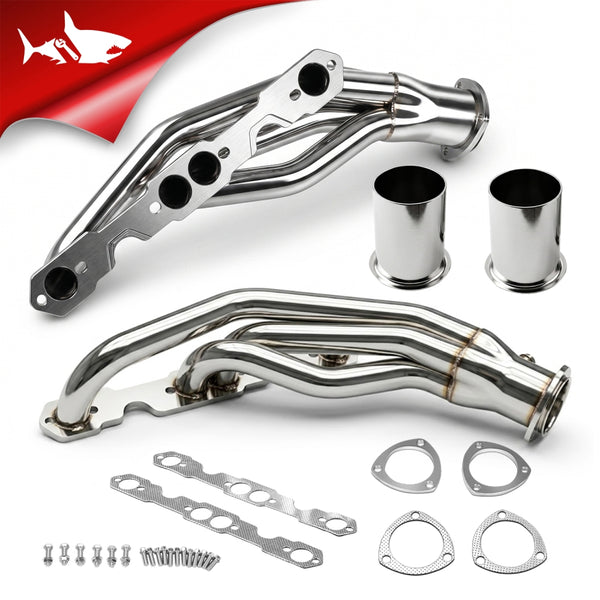
A decent long tube header for a 5.3 Silverado should match the truck’s year range, platform, engine, and drivetrain. Look at the details:
- Primary tube size
- Collector size
- Flange thickness and machining
- O2 sensor bung location
- Stainless steel construction
- Weld quality
- Included hardware and gaskets
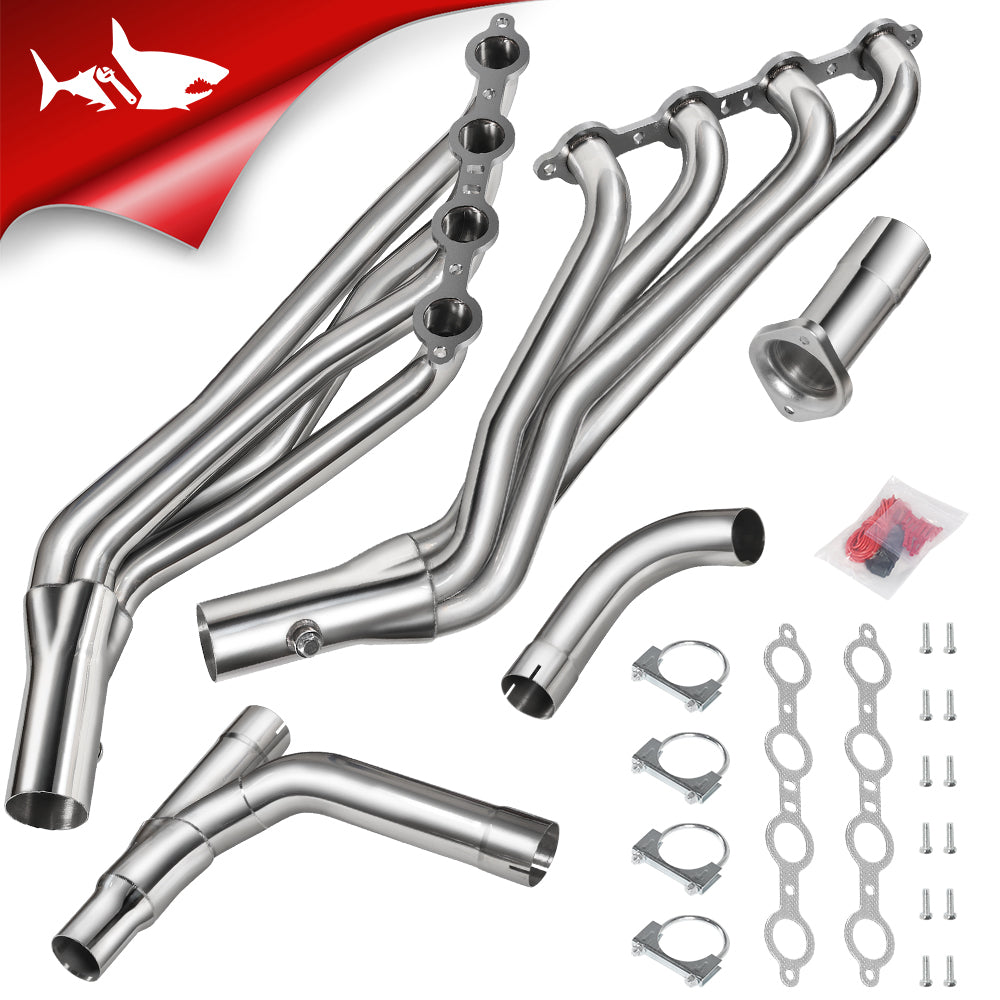
- Whether the kit includes a matching Y-pipe
For most stock or mildly modified 5.3 trucks, a 1-3/4 inch style primary is usually a good street match. Bigger is not automatically better. On a cammed 5.3, a 6.0L swap, or a higher-RPM build, larger primaries can start making more sense. But on a tired stock daily with factory tuning, oversizing the header can make the truck feel lazier down low.
If you are still comparing applications outside the Silverado family, browse the long tube and shorty exhaust headers collection and filter by year, make, model, engine, and header style. Do not guess fitment from photos.
Matching Y-Pipe
This is where many new installers get burned. Long tube headers move the collector farther back compared with stock manifolds or shorty headers. That means your factory Y-pipe usually will not bolt right back up without modification.
Can a muffler shop cut and adapt the old pipe? Sometimes. Is it cleaner to use a matched header and Y-pipe kit when available? Usually, yes.

Best Match for GMT800 Y-Pipe Prep
1999-2006 Silverado 5.3 long tube headers with Y-pipe
A better fit for GMT800 Silverado/Sierra 1500 4.8L, 5.3L, and 6.0L owners who want the headers and Y-pipe planned together instead of fighting the factory mid-pipe during install.
$269.99 $399.99
Check 99-06 FitmentFor example, Flashark’s 1999-2006 GMT800 Silverado/Sierra 1500 long tube kit is built as a header-and-Y-pipe setup, which makes more sense for a truck where the collector position and Y-pipe route need to work together. For the right truck, the 1999-2006 Silverado 5.3 long tube headers with Y-pipe are the first link I would check before trying to piece together random parts.
Header Gaskets and Bolts
Do not ignore the gaskets. A header leak at the flange can sound like valvetrain tick, especially on a cold start. Use good gaskets, clean the head surface, and check the flange before installation. If the old manifold bolts look rough, replace them. Cheap insurance.
On older trucks, rear manifold bolts like to snap. If the truck has lived in the Rust Belt, assume at least one bolt is going to fight you. Maybe you get lucky. Nice. But plan like you will not.

O2 Sensor Extensions
Long tubes move the O2 sensor locations. Sometimes the factory wires reach. Sometimes they reach only if you stretch them like a guitar string across hot steel. Do not do that.
Use proper O2 sensor extensions when needed, route the wiring away from the collectors, and secure it with enough slack for engine movement. A melted O2 harness can create a code-chasing mess that has nothing to do with the header itself.
Spark Plug Wires and Heat Sleeves
Long tubes sit closer to the spark plug boots than stock cast manifolds. On a small-block truck engine bay, it looks fine until the first drive. Then you smell hot rubber. Then the truck starts missing under load. Then you are back under the hood with a bad attitude.
Use heat sleeves or quality angled plug wires where clearance is tight. If the boot is close enough to touch the tube under engine movement, fix it before driving.
Penetrating Oil, Anti-Seize, and High-Temp Supplies
Spray the manifold bolts, collector bolts, and O2 sensors with penetrating oil before install day. A day before is good. Two days before is better. Hit them more than once.
Use anti-seize on O2 sensor threads if appropriate, but keep it off the sensor tip. For clamps and slip joints, follow the kit’s instructions. Do not smear high-temp RTV everywhere like peanut butter. That is not craftsmanship. That is cleanup work for the next guy.
Stock Manifolds vs Long Tube Headers: What Actually Changes?
Here is the practical difference. The stock cast manifolds are compact, quiet, and easy for packaging. Long tube headers are about exhaust pulse timing, scavenging, and moving more air out of the engine at the right RPM range.
| Area | Stock Cast Manifolds | Long Tube Headers | Garage Reality |
|---|---|---|---|
| Flow | Compact but restrictive compared with a performance header | Longer primaries improve scavenging and flow | The gain depends on tune, cam, intake, and downstream exhaust |
| Power Range | Good packaging, limited high-RPM breathing | Stronger mid-to-high RPM pull | A tuned mild 5.3 may see around 12-25 whp; stock trucks feel more sound and response |
| Sound | Quiet, muffled, factory tone | Louder, sharper, more aggressive | Cammed trucks can get rowdy fast, especially with aggressive mufflers |
| Install Difficulty | Factory fit, easier service access | More involved; Y-pipe and clearance matter | Old bolts and 4WD fitment are usually the time killers |
| O2 Sensor Layout | Factory sensor positions | Sensors often move downstream | Plan O2 extensions and heat-safe wiring routes |
| Legal/Emissions | Factory emissions layout | May affect catalytic converter placement | Street-driven trucks need emissions-compliant planning |

For GMT900 / NNBS 5.3 Silverado Builds
2007-2014 Silverado 5.3 long tube headers
For 2007-2014 Silverado/Sierra owners, use a generation-specific header setup instead of assuming older GMT800 headers will fit. This is the cleaner path for 4.8L, 5.3L, and 6.0L truck applications.
$309.99 $459.99
Check 07-14 FitmentTools and Workspace Setup for a Silverado Header Install
A driveway install is possible. I am not saying it is fun. There is a difference.
Basic Tool List
- Quality jack stands or a lift
- Wheel chocks
- Metric socket set
- Long extensions
- Swivel sockets or universal joints
- Breaker bar
- Torque wrench
- O2 sensor socket
- Wrenches for tight header bolts
- Pry bar
- Exhaust hanger tool
- Penetrating oil
- Anti-seize
- Heat sleeves for plug wires
- Gloves and eye protection
Garage vs Lift: How Hard Is This Job Really?
On a lift, with clean hardware and the right kit, a competent installer may knock it out in half a day. On jack stands, with a rusty truck and one stuck O2 sensor, this can eat a full Saturday. If a bolt snaps in the head, stop the clock. You are in repair mode now.
For a clean 2WD truck, the job is manageable. For a 4WD truck with a custom exhaust and unknown history, budget time for fitment work. Not maybe. Budget it.
How Much Time Should You Plan?
- Experienced installer with lift: 4-6 hours if the truck is clean and the kit fits well.
- DIY with jack stands: 8-12 hours is more realistic.
- Rusty truck: add time for broken bolts, seized O2 sensors, and flange cleanup.
- 4WD or custom exhaust: plan for possible cutting, welding, and Y-pipe adjustment.
Expert Tip:
Do not fully tighten the headers before the Y-pipe is loosely fitted. I know it feels good to lock the shiny parts down. Wait. If the collectors are slightly off, you want adjustment room before the whole system starts fighting you.
Pre-Install Inspection: What to Check Before You Remove Anything
This is where you save time. Or lose it.
Inspect the Factory Manifolds and Broken Bolts
GM truck owners know the cold-start tick. Sometimes it is a lifter. Sometimes it is an exhaust leak. Very often on these trucks, it is a warped manifold, cracked manifold, bad gasket, or broken manifold bolt.
Before tearing anything apart, look at the rear manifold bolts. If one is already missing a head, you need a plan. Extractor kit, welding a nut, left-hand drill bits, patience. Whatever method you trust. But do not pretend it is not there.

Spray the Bolts Before Install Day
Many new installers watch a quick video and go straight into removal. Bad move. Spray the manifold bolts, collector bolts, and O2 sensors 24-48 hours before the install. Do it again the morning of the job.
Shop Case:
I remember an older 2003 Silverado 5.3 that came in for headers after the owner had already rounded two collector bolts in the driveway. He had watched a clean Southern truck install online and assumed his Midwest truck would act the same. It did not. We soaked the hardware, heated the flange, worked the bolts back and forth, and still had one manifold bolt break flush. That one broken bolt added more time than hanging both new headers.
Check Catalytic Converter and Emissions Layout
If your truck is street-driven in the United States, do not ignore catalytic converters. Removing or bypassing emissions equipment can create legal problems, inspection problems, and check engine light problems. Some header setups are intended for off-road or racing use only. Some owners use catted Y-pipes. Some states are strict. California-style emissions rules are not something you “figure out later.”
Short version: if the truck needs to pass emissions, plan the catalytic converter setup before ordering parts.
Check the Existing Cat-Back Exhaust
The header and Y-pipe are only part of the system. What is behind them?
- Stock single exit?
- Aftermarket cat-back?
- Custom dual exhaust?
- Cut muffler?
- Different inlet size?
If the rear exhaust has already been modified, the new Y-pipe may not meet it cleanly. Measure first. A tape measure is cheaper than a tow bill.
How to Install Headers on 5.3 Silverado: High-Level Step Overview
This is not meant to replace the product instructions or a service manual. It is the practical order of operations I would want a Silverado owner to understand before starting the job.
Step 1: Disconnect the Battery and Raise the Truck Safely
Let the truck cool completely. Disconnect the battery. Get the truck in the air and support it correctly. Do not work under a truck held up only by a jack. I should not even have to say that, but I have seen enough sketchy driveway setups to say it anyway.
Step 2: Remove Spark Plug Wires, Spark Plugs, and O2 Sensors
Remove the plug wires carefully and label anything you may mix up. On tight installs, I like pulling the spark plugs too. One bad angle with a header tube and you can crack a plug. That is a dumb way to create a misfire.
Remove the O2 sensors with the right socket. Mark their positions. Upstream and downstream sensors should not be treated like random bolts in a coffee can.

Step 3: Remove the Factory Y-Pipe and Manifolds
Start underneath. Loosen the factory Y-pipe, head pipes, or collector connections. Support the exhaust so it does not hang by a sensor wire or smash you in the forearm.
Then move to the manifolds. Work slowly. If a bolt feels like it is going to break, it probably is. Back it out, tighten slightly, spray again, work it gently. This is not the spot for ego.
Step 4: Test-Fit the Long Tube Headers Before Final Tightening
Slide the headers into position and start the bolts by hand. Do not cross-thread aluminum heads. Do not force a flange into place with one bolt. Get all bolts started loosely first.
Check these areas before tightening:
- Steering shaft clearance
- Frame clearance
- Starter wire clearance
- Transmission cooler line clearance
- Spark plug boot clearance
- O2 bung direction
- Collector angle
- Y-pipe alignment

Step 5: Install the Y-Pipe and Align the Exhaust
Fit the Y-pipe loosely. Connect the collectors first, then check where the pipe wants to meet the rest of the exhaust. If it is slightly off, adjust before tightening everything. If it is way off, do not force it with clamps. That will preload the system and create leaks, rattles, or cracked welds later.

Step 6: Reinstall O2 Sensors and Route Wiring Away from Heat
Install the sensors and extensions if needed. Route the wires away from the tubes and collectors. Use proper clips or heat-safe loom. Leave enough slack for engine movement. The engine rocks under load. Remember that.

Step 7: Start the Truck and Check for Leaks
On first startup, listen around the header flange, collector, Y-pipe joints, and O2 bungs. A sharp ticking sound can mean a leak. So can a hiss near a slip joint. Do not burn your hand trying to feel around hot pipes. Use your ears, a piece of hose as a stethoscope, or a light smoke test if available.
Step 8: Heat Cycle and Re-Torque
After the first heat cycle, let the truck cool and re-check bolts and clamps. Then check again after roughly 20-50 miles. Stainless moves with heat. Gaskets settle. Clamps shift. This one step prevents a lot of “my new headers leak” complaints.
Common Silverado Mistakes That Ruin a 5.3 Long Tube Headers Install
Most bad installs do not come from one giant mistake. They come from five small lazy choices stacked together.
Mistake 1: Buying Headers Without a Matching Y-Pipe
This is the big one. Long tube collectors do not usually land where the factory Y-pipe expects them. If you buy headers only, make sure you already have a Y-pipe plan. That may mean a matching kit, a catted Y-pipe, or a local exhaust shop.
Mistake 2: Ignoring 4WD Front Driveshaft Clearance
Header fitment and Y-pipe fitment are not the same thing. On 4WD trucks, the Y-pipe route matters just as much as the header flange. Check the front driveshaft area at ride height and think about movement. A pipe that clears by a finger width sitting still may rub under load.
Mistake 3: Stretching O2 Sensor Wires
Do not stretch O2 wires. Do not run them across the collector. Do not zip-tie them to something hot and call it done. Buy extensions if you need them.
Mistake 4: Reusing Bad Gaskets or Damaged Bolts
Old gaskets and rounded bolts do not become better because the headers are new. Clean the surfaces. Use good hardware. Torque evenly. Re-check after heat cycling.
Mistake 5: Forgetting Spark Plug Wire Heat Protection
If plug wires are close, protect them. Burned wires cause misfires that make people blame the headers, the tune, the coils, the plugs, the moon phase. Sometimes it is just a cooked boot.
Mistake 6: Expecting Big Power Without a Tune
Long tubes help the engine breathe. But airflow changes need tuning to get the full benefit. On a mild 5.3 with a decent exhaust and tune, I have seen dyno results land around 12-25 wheel horsepower. On a stock truck with no tune, the biggest seat-of-the-pants change may be sound and throttle feel, not a giant number.
If horsepower is your main concern, read this deeper guide on how much horsepower headers add to a 5.3L LS engine before setting expectations.
Mistake 7: Ignoring Emissions and Street-Legal Issues
This is where I am going to be blunt. Catless does not automatically mean street legal. “Off-road use” is not a magic phrase that fixes your state inspection. If the truck is registered and driven on public roads, confirm local emissions rules before you change catalytic converter placement or remove anything.
What the Erik Rose Cammed 5.3 Silverado Video Shows About Long Tube Headers
The Erik Rose video with the cammed 5.3 Silverado is a good real-world sound reference. It is not a sterile product demo. It shows what a rowdy 5.3 can sound like when long tubes meet a cammed truck and the rest of the exhaust lets it talk.
Real-World Sound: Long Tubes Can Make a Cammed 5.3 Very Aggressive
On a cammed 5.3, long tubes can sharpen the exhaust note fast. Cold starts get louder. Wide-open throttle gets nastier. The truck can sound less like a stock pickup and more like a street/strip toy.
That is great if you want it. It is not great if you leave for work at 5:30 a.m. and your neighbor already hates you.
Why Cammed or Tuned Trucks Benefit More
A cammed truck moves more air. That is where long tubes start to make real sense. Pair them with the right tune, intake, Y-pipe, and muffler, and the engine can use the extra exhaust flow. On a mostly stock daily, long tubes still change sound and response, but the performance gain is usually less dramatic.
Sound Expectations for Daily Drivers
Think about the whole exhaust, not just the headers:
- Long tubes with catted Y-pipe and a chambered muffler: aggressive but more controlled
- Long tubes with catless pipe and straight-through muffler: loud, sharp, and sometimes droney
- Long tubes with cam and loose converter: very rowdy
- Long tubes on a tow/daily truck: choose the muffler carefully
Recommended 5.3 Silverado Long Tube Headers by Year
This is where fitment matters. If you are shopping Flashark parts, do not use one generic “5.3 Silverado headers” link for every truck. Match the header to the generation.
| Truck Year Range | Best Link Anchor | Why It Belongs Here |
|---|---|---|
| 1999-2006 GMT800 | 1999-2006 Silverado 5.3 long tube headers with Y-pipe | Best match for the article’s install prep focus, especially Y-pipe and old bolt issues. |
| 2007-2014 GMT900/NNBS | 2007-2014 Silverado 5.3 long tube headers | Good internal link for newer 5.3 owners who land on the guide but own a later platform. |
| 2014-2017 Silverado/Sierra 1500 | 2014-2017 Silverado 5.3 long tube headers | Captures EcoTec3 5.3/6.2 owners without sending them to the wrong GMT800 product page. |
Do You Need a Tune After Installing 5.3 Long Tube Headers?
Will the truck run without a tune? Sometimes, yes. Should you tune it? In most serious builds, yes.
Will the Truck Run Without a Tune?
If you keep catalytic converters, use correct O2 sensors, and the truck is otherwise healthy, it may run. But “it starts and drives” is not the same as “the combination is dialed in.”
Long tubes change exhaust flow and sensor behavior. The ECU may adapt some, but it cannot magically optimize everything.
Why a Tune Helps
A proper tune can help with:
- Fuel trims
- Timing
- Idle quality on cammed trucks
- Throttle response
- Transmission shift feel
- Rear O2 behavior
- Power delivery under load
On a cammed 5.3, tuning is not optional in my book. On a basic header install, it is still the cleanest way to get the truck driving like the parts were meant to work together.
CEL and O2 Sensor Codes
A check engine light after headers can come from many things:
- O2 sensor extension issue
- Bad sensor disturbed during removal
- Sensor placed too far downstream
- Catalyst efficiency code
- Exhaust leak before the O2 sensor
- Damaged wiring near the collector
Do not just clear the code and keep driving. Read it. Diagnose it. A leak before the upstream O2 sensor can make the computer chase fuel trims that are not real.
Long Tube Headers vs Shorty Headers for a 5.3 Silverado
There is no single winner for every truck. There is the right header for the build.

For Newer 5.3L / 6.2L Silverado Builds
2014-2017 Silverado 5.3 long tube headers
For 2014-2017 Silverado/Sierra 1500 owners, fitment gets more generation-specific. This option is better suited for newer 5.3L and 6.2L truck builds than older GMT800 or GMT900 header kits.
$299.99 $449.99
Check 14-17 FitmentWhen Long Tube Headers Make More Sense
Choose long tubes when the truck has, or will have:
- Performance tune
- Camshaft upgrade
- Better intake
- Cat-back exhaust
- Higher-RPM use
- Street/strip goals
- Aggressive sound preference
If you want a deeper comparison, the long tube vs shorty headers 5.3 Silverado comparison breaks down power, sound, cost, and fitment in more detail.
When Shorty Headers May Be Better
Shorty headers make sense when you want a simpler manifold replacement, less exhaust modification, and a more factory-like layout. They are usually easier to package. They are also usually quieter and less likely to require Y-pipe surgery.
For a mostly stock daily driver that tows, idles in traffic, and needs to pass inspection without drama, shorties deserve a real look. I still like long tubes for power. But not every truck needs to become a project.
Buyer Guidance
If the truck is stock and you want mild sound with less install drama, consider shorties or a cat-back first. If the truck is tuned, cammed, or built for stronger pull, long tubes are usually the better performance move.
Should You Install 5.3 Long Tube Headers Yourself or Use a Shop?
There is pride in doing your own work. There is also wisdom in knowing when a lift, welder, and experienced exhaust guy will save your weekend.
Good DIY Candidate
You may be a good DIY candidate if you have:
- A safe workspace
- Jack stands or a lift
- Enough tools for tight fasteners
- Patience for rusty bolts
- Basic exhaust alignment experience
- A plan for O2 extensions and wiring
- A backup plan if a bolt snaps
Better for an Exhaust Shop
Use a shop if:
- The truck is 4WD and Y-pipe clearance is uncertain
- It needs cutting or welding
- Manifold bolts are already broken
- The catalytic converter setup must be retained or custom-fitted
- The exhaust behind the Y-pipe is already custom
- You do not have safe vehicle support
Shop Labor Expectations
When asking for a quote, do not just say, “How much to install headers?” Ask what is included:
- Broken bolt repair
- O2 sensor extensions
- Y-pipe fitting
- Welding or fabrication
- Leak check
- Heat shield or plug wire routing
- Re-torque after heat cycle
- Emissions-compliant catalytic converter planning
Final Checklist Before You Start the Install
Print this, screenshot it, or scribble it on a box lid. Just do not skip it.
- Truck cooled down completely
- Battery disconnected
- Vehicle safely supported
- Headers inspected for shipping damage
- Y-pipe test-fitted visually before install
- Gaskets and bolts ready
- O2 sensor extensions ready if needed
- Spark plug wires and heat sleeves ready
- Penetrating oil applied 24-48 hours ahead
- Torque specs checked
- Exhaust shop backup plan ready if fabrication is needed
- Emissions plan confirmed
- Tune plan confirmed
- Leak check planned
- Re-torque plan scheduled after heat cycles
Conclusion: Prep First, Then Install
A 5.3 long tube headers install is not the hardest Silverado job in the world. But it is also not a mindless bolt-on, especially on older trucks or 4WD setups.
The difference between a clean install and a miserable one is preparation. Confirm the year. Confirm the drivetrain. Plan the Y-pipe. Get the O2 extensions. Protect the plug wires. Spray the bolts early. Think about the tune. Think about emissions. Then turn the first bolt.
Do it that way and long tubes can wake up a 5.3 Silverado with a sharper sound, better breathing, and stronger pull where the truck can actually use it. Skip the prep and the same parts can leave you with leaks, codes, rubbing pipes, and a truck stuck on stands.
FAQ: 5.3 Long Tube Headers Install Questions
Q1: Do 5.3 long tube headers fit all Silverado trucks?
A1: No. You need to confirm year range, engine, platform, drivetrain, transmission, exhaust layout, and emissions setup. A 1999-2006 GMT800 kit is not the same as a 2014-2017 Silverado/Sierra kit.
Q2: How hard is it to install headers on a 5.3 Silverado?
A2: It is a medium-to-hard DIY job. The headers are not always the hardest part. Rusty manifold bolts, O2 sensors, Y-pipe alignment, plug wire clearance, and exhaust leaks are usually what slow people down.
Q3: Do I need a Y-pipe for 5.3 long tube headers?
A3: In most long tube installs, yes. Long tube headers move the collector location, so the factory Y-pipe usually does not bolt right up without modification.
Q4: Can I use the stock Y-pipe with long tube headers?
A4: Usually not without cutting and welding. Some owners adapt the stock pipe, but a matched Y-pipe is normally cleaner and less frustrating.
Q5: Do 5.3 long tube headers fit 4WD Silverado trucks?
A5: Some kits can work on 4WD trucks, but you must check front driveshaft, transfer case, crossmember, and Y-pipe clearance. The header may fit while the Y-pipe still needs modification.
Q6: Do I need O2 sensor extensions for long tube headers?
A6: Many installs need them because the O2 sensor locations move downstream. Do not stretch factory wiring across hot exhaust parts.
Q7: Will long tube headers cause a check engine light?
A7: They can, especially if the O2 sensors are moved, catalytic converters are changed, wiring is damaged, or the tune is not adjusted. Always diagnose the actual code before blaming the headers.
Q8: Do I need a tune after installing long tube headers on a 5.3?
A8: A tune is strongly recommended. The truck may run without one, but tuning helps with fuel trims, timing, throttle response, rear O2 behavior, and overall power delivery.
Q9: How much horsepower do long tube headers add to a 5.3 Silverado?
A9: It depends on the build. On a mild tuned 5.3 with supporting exhaust parts, gains around 12-25 wheel horsepower are common in real-world builds. A stock truck may feel more sound and response than peak horsepower.
Q10: Will long tube headers make my Silverado louder?
A10: Yes. Long tube headers usually make a 5.3 Silverado louder, sharper, and more aggressive. The final sound depends on catalytic converters, Y-pipe, muffler, resonator, tailpipe, and whether the truck is cammed.
Q11: Are long tube headers legal on the street?
A11: It depends on the header design, catalytic converter setup, and your local emissions laws. If the truck is street-driven, confirm compliance before removing or relocating emissions equipment.
Q12: Should I replace spark plug wires during header install?
A12: You should at least inspect them. Long tubes sit closer to plug wires than stock manifolds. Heat sleeves or angled plug wires can prevent burned boots and misfires.
Q13: What is the biggest mistake when installing 5.3 long tube headers?
A13: The biggest mistake is buying headers without planning the Y-pipe, O2 extensions, 4WD clearance, gaskets, plug wire heat protection, tune, and emissions setup.
Q14: Can I install Silverado long tube headers at home?
A14: Yes, if you have safe vehicle support, proper tools, time, and patience. If the truck needs welding, broken bolt repair, or custom Y-pipe work, a professional exhaust shop is the smarter move.

Steven Chen
Automotive Performance Specialist | Engine & Exhaust Systems
Steven focuses on practical engine performance, exhaust fitment, and real-world upgrade paths for classic and modern enthusiast vehicles. He reviews small-block Ford, LS, truck, and street/strip applications with one goal in mind: helping builders choose parts that actually work together. His philosophy: "Good power starts with the right combination, not the biggest part."