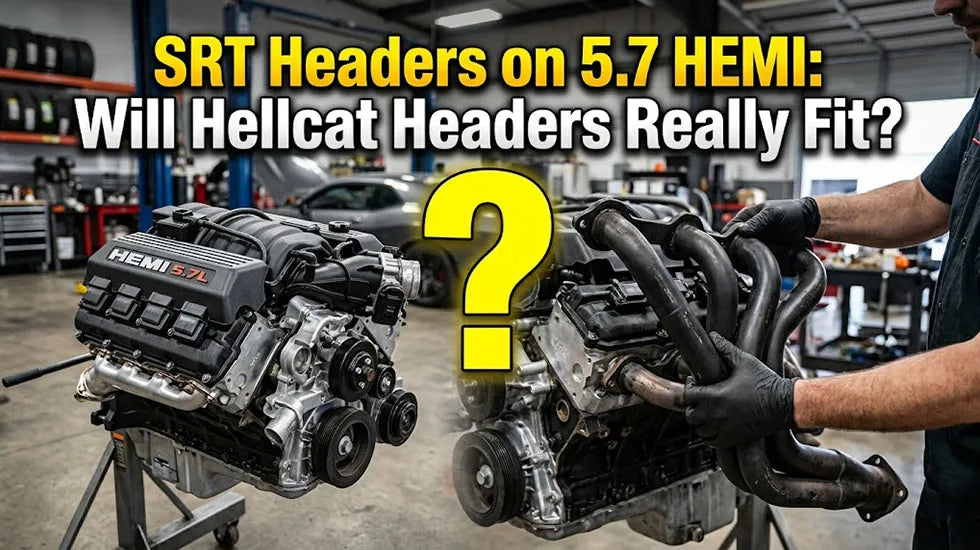
So you found a set of SRT headers or Hellcat take-off headers online. Maybe Facebook Marketplace. Maybe eBay. Maybe some guy in a Dodge group says, “They came off a HEMI, bro, they’ll fit.”
Slow down.
SRT headers on 5.7 HEMI builds can work in some cases, but “fits the engine” and “bolts into your car without drama” are two very different things. I’ve seen this mistake enough times: the flange gets close, the header hangs on the studs, everybody gets excited, then the mid-pipe is two inches off and the O2 sensors are staring at the wrong part of the exhaust.
Same story with Hellcat headers on 5.7 HEMI swaps. Yes, some parts can physically line up on certain platforms. No, that does not mean your stock 5.7 cats, mid-pipes, steering shaft, AWD front shaft, or inspection readiness will be happy.
Quick Answer: Do SRT or Hellcat Headers Fit a 5.7 HEMI?
- Some SRT / 6.1 / 6.4 / 392 headers can fit certain 5.7 HEMI cars, especially compatible Charger, Challenger, Magnum, and Chrysler 300 platform setups.
- Hellcat headers may physically bolt up in some cases, but they usually create more problems around mid-pipes, cats, O2 sensor placement, collector size, and tuning.
- Ram 1500, Durango, and Jeep 5.7 HEMI owners should be extra careful. Truck and SUV chassis clearance is not the same as Charger or Challenger clearance.
- Fitment depends on platform, year, exhaust port shape, drivetrain, cats, and mid-pipe layout. Do not buy headers just because the seller says “HEMI.”
- For most daily-driven 5.7 HEMI builds, a vehicle-specific header kit is the safer move. Used SRT or Hellcat parts only make sense when the full exhaust connection plan is already confirmed.
Understanding What “Fit” Means on a 5.7 HEMI Header Swap
Here’s the part a lot of new guys miss. Header fitment is not one checkbox. It is a chain. If one link is wrong, the whole install gets ugly.
When someone asks whether hellcat headers on 5.7 hemi will work, they usually mean, “Can I buy these cheap used headers and bolt them on this weekend?” But a tech hears a longer question:
- Will the header flange match the cylinder head?
- Does the exhaust port shape line up?
- Will the tubes clear the steering shaft, frame, starter, and transmission tunnel?
- Will the collector connect to the stock cats or mid-pipes?
- Will the O2 sensors reach?
- Will the car pass readiness or throw P0420 / P0430 codes?
- Is this a street car, a track car, or a “my county doesn’t test emissions” car?
Garage rule: A header can bolt to the head and still be the wrong header for the vehicle. The problem usually starts after the collector.
Bolt Pattern and Cylinder Head Fitment
The HEMI family shares a lot of DNA, but do not treat every 5.7, 6.1, 6.4, and 6.2 Hellcat exhaust part like LEGO. Bolt pattern, flange shape, and port alignment matter. If the flange covers the port poorly, you can end up with an exhaust leak, poor sealing, or a step in the exhaust path that hurts flow.
That is why “it came off a 6.4” is not enough information. You need the donor year, donor model, drivetrain, and photos of the flange and collector.
Chassis Clearance
Charger and Challenger guys get most of the forum attention, but a 5.7 HEMI also shows up in Rams, Durangos, Jeeps, Magnums, and Chrysler 300s. Same engine family. Different engine bay. Very different headaches.
A header that slides into a Charger R/T may fight the frame or front driveshaft on a 4WD truck. A header that clears a Challenger may not clear the same way in a Durango. That is why you should browse Dodge exhaust header options by platform instead of shopping only by engine size.
Mid-Pipe and Catalytic Converter Connection
This is the big one. The engine side may fit. The back side may not.
SRT and Hellcat headers were built around their own exhaust system. Your 5.7 stock cats and mid-pipes may sit at a different angle, different length, different flange, or different collector size. If you do not have the matching mid-pipes, the install may turn into cutting, welding, and paying an exhaust shop to finish what the “cheap swap” started.

O2 Sensor and CEL Risk
O2 sensor location matters. If the sensor moves farther downstream, sits behind a different cat, or ends up in a cold spot, the PCM may not like the readings. On long tubes, O2 extensions are common. On catless setups, CEL risk is high unless the build is tuned for off-road use only.
If you are planning a full long-tube setup, read this guide on whether you really need a tune after 5.7 HEMI long tube headers before spending money twice.
SRT Headers on 5.7 HEMI: What Usually Fits and What Does Not
The phrase srt headers on 5.7 hemi gets searched a lot because SRT take-off parts look like a budget shortcut. Sometimes they are. Sometimes they are a box of shiny problems.
6.1 SRT Headers on 5.7 HEMI
Older 6.1 SRT8 headers are a common swap topic for LX-platform cars. Think Charger, Challenger, Magnum, and Chrysler 300 family. In the right year range and chassis, they can be a reasonable upgrade over restrictive factory cast manifolds.
But here is the catch: you still need to check the rest of the exhaust. The 6.1 header outlet and the 5.7 mid-pipe may not always play nicely. If the seller does not include mid-pipes, cats, hardware, and good photos, assume you may need extra parts.
6.4 / 392 SRT Headers on 5.7 HEMI
6.4 / 392 headers can flow better than many stock 5.7 manifolds, especially on a mild street car. But they are not magic. On a stock 5.7 with no tune, no intake, no cat-back, and factory cats still choking the back end, the gains may feel more like a sharper exhaust note and better upper-rpm breathing than a night-and-day power jump.
For a tuned 5.7 with a cam, intake, and freer exhaust, the picture changes. The engine can use the extra flow. But at that point, you should ask a blunt question: why not run headers designed for your exact vehicle?
SRT Headers vs 5.7 HEMI Long Tube Headers
| Setup | Typical Goal | Expected Gain Range | Main Risk |
|---|---|---|---|
| Stock 5.7 manifolds | Quiet factory drivability | Baseline | Manifold leaks, broken bolts, restriction at higher RPM |
| Used SRT headers | Budget OEM-style upgrade | Often modest; around 5-15 whp depending on setup | Mid-pipe mismatch, missing cats, unknown donor fitment |
| Hellcat take-off headers | High-flow OEM take-off swap | Variable; not always better on stock 5.7 low-rpm driving | Collector size, cats, O2 placement, custom fabrication |
| 5.7-specific long tubes | Real performance upgrade | About 20-35 whp with tune and supporting mods | More install labor, tune recommended, emissions planning needed |
If you want the full horsepower discussion, including why shorties and long tubes behave differently on a dyno, the deeper breakdown is here: how much horsepower headers add to a 5.7 HEMI.
Common Mistake: Buying SRT Headers Without the Matching Mid-Pipes
I remember one 2018 Charger R/T case that explains this whole mess. The owner brought in a clean set of used SRT headers. Good price. Nice finish. He was smiling when he dropped them off.
Then we got the old manifolds out, test-fit the headers, and the mood changed. The engine side was fine. The collector angle was not. His factory 5.7 mid-pipe was nowhere close enough to seal without hacking it up. He had bought the headers, but not the matching pipes, not the cats, not the O2 extensions, and not the hardware.
That “cheap” swap ended up needing custom mid-pipe work. Labor went up. Parts went up. The car sat longer. And honestly? If he had started with a proper 5.7-specific kit, the whole job would have been cleaner.
Do not buy used SRT headers unless you know what happens after the collector. Ask for the donor vehicle, mid-pipes, cats, O2 bungs, and flange photos before sending money.
Hellcat Headers on 5.7 HEMI: Why the Answer Is More Complicated
Hellcat headers on 5.7 HEMI sounds cool. Nobody argues with that. A Hellcat is the big dog, so people assume the parts must be better. But bigger is not always smarter on a naturally aspirated 5.7.
Can Hellcat Headers Bolt to a 5.7 HEMI?
Sometimes, physically, yes. But listen carefully: that is not the same as a clean street install.
A Hellcat header was designed around a 6.2L supercharged package. Different airflow demand. Different exhaust support. Different downstream parts. If you hang that header on a stock 5.7 and keep the rest of the exhaust choked down, you may gain sound and lose your weekend to fitment work.
Hellcat Headers and Stock 5.7 Cats
This is where many swaps fall apart. Stock 5.7 cats may not line up with Hellcat header outlets. Even when the flange style looks close in photos, the angle can be wrong. Half an inch at the collector becomes a real problem once the exhaust is hanging under the car.
If the plan is “I’ll just bolt the Hellcat headers to my factory 5.7 cats,” stop and measure first. Better yet, mock it up before final torque.
Are Hellcat Headers Too Big for a Stock 5.7 HEMI?
For a stock daily driver, they can be. Exhaust needs velocity, not just volume. A giant tube on a mild engine can slow exhaust speed at low RPM. That hurts scavenging. Translation: it may sound mean but feel softer leaving a stoplight.
On a cammed, tuned, higher-rpm 5.7, bigger headers start making more sense. But on a bone-stock R/T? I would not chase Hellcat parts just because they look tough in a listing photo.
When Hellcat Headers Make Sense on a 5.7 HEMI
- You already plan to replace or fabricate mid-pipes.
- The car has a tune, intake, cam, or other airflow upgrades.
- You are not trying to keep the install as a simple bolt-on weekend job.
- You can deal with O2 sensor relocation and exhaust shop labor.
- The car is built for performance use where emissions compliance has been properly considered.
When Hellcat Headers Are a Bad Idea
- The car is a stock daily driver.
- You want to keep factory 5.7 cats and mid-pipes with no modification.
- You do not want a tune.
- Your state has strict emissions inspection.
- The seller cannot tell you the donor year, model, or whether mid-pipes are included.
Platform Matters: Charger, Challenger, 300C, Ram, Durango, and Jeep Fitment
Do not shop headers by engine alone. Shop by platform first, then engine, then year, then drivetrain.
Charger, Challenger, Magnum, and Chrysler 300 5.7 HEMI
This is where SRT header conversations make the most sense. LX / LC / LD family cars share more packaging logic than a Ram truck or SUV. Still, year range matters. RWD versus AWD matters. And the connection to the rest of the exhaust absolutely matters.
If you own an older Chrysler 300C, Charger, Challenger, or Magnum, a dedicated kit like the 2005-2011 Chrysler 300C / Charger / Challenger 5.7L HEMI long tube headers is usually a cleaner path than gambling on unknown used SRT parts.
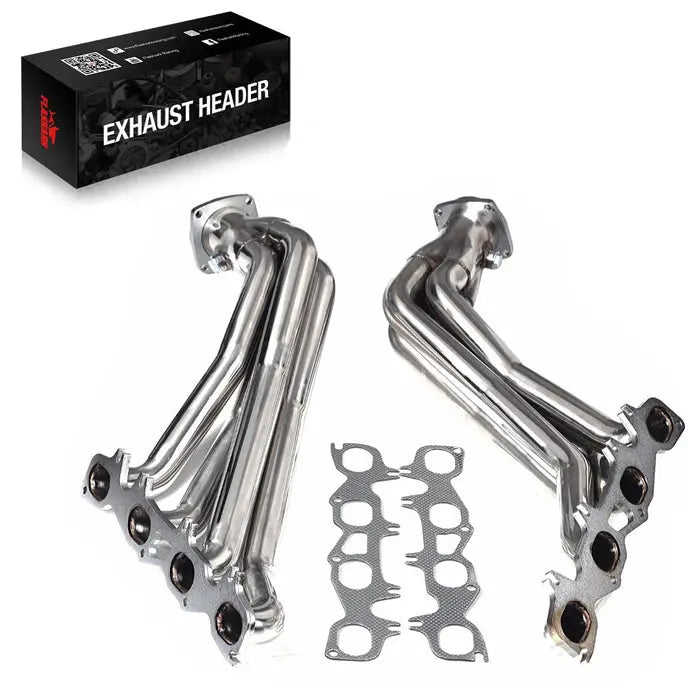
Flashark 5.7L / 6.1L HEMI Long Tube Headers
Built for 2005-2011 Chrysler 300C/S and Dodge Challenger, Charger, and Magnum 5.7L / 6.1L HEMI applications. A better fitment route for older LX-platform owners than gambling on random take-off headers.
Sale Price: $209.99 Regular Price: $300.00
Check FitmentRam 1500 5.7 HEMI
Ram guys, listen to me for a second. A car-platform SRT or Hellcat header is not automatically a truck header. Your frame, steering, Y-pipe, ground clearance, and 4WD hardware are different.
If your goal is a real truck fitment instead of a mystery swap, look at a Ram-specific option like the 2009-2018 Ram 1500 5.7 HEMI long tube and shorty headers. That kind of application-specific fitment saves time, especially when you are fighting rusty manifold bolts and tight engine bay access.
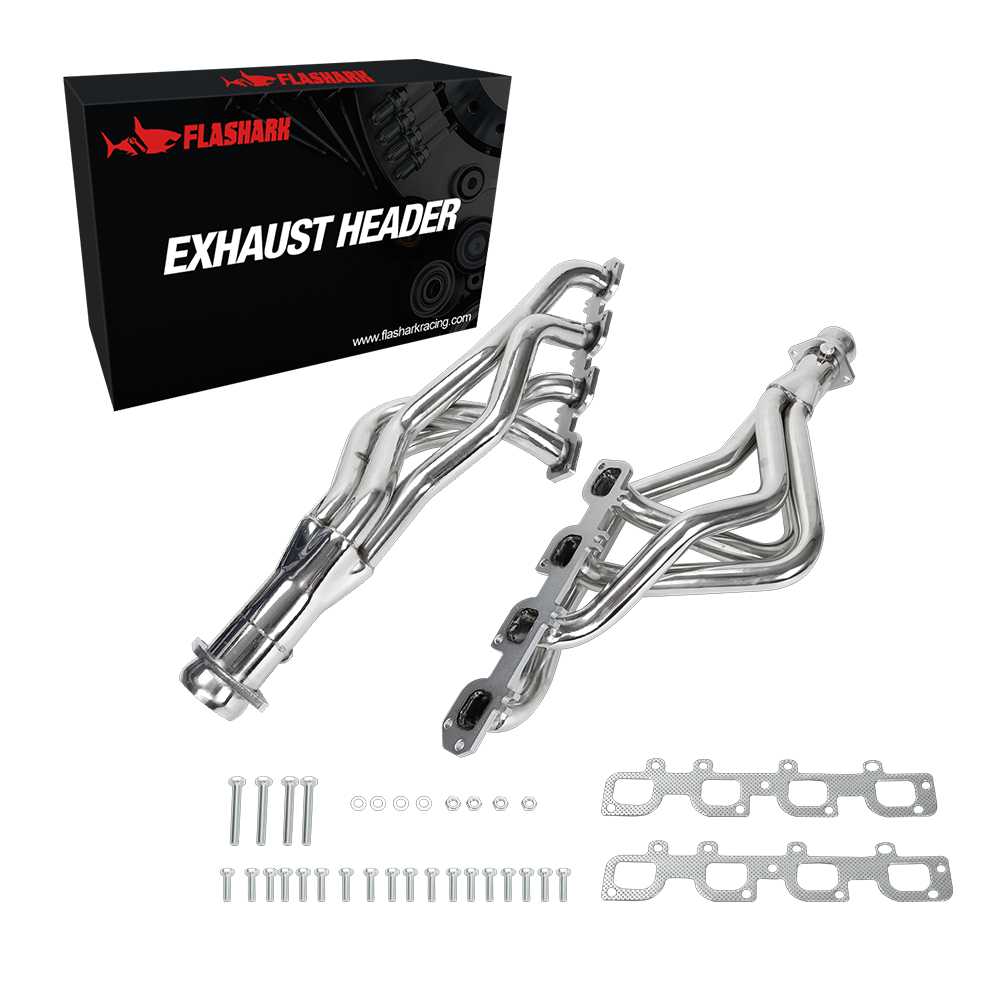
Flashark Ram 1500 5.7 HEMI Headers
Available in long tube and shorty versions for 2009-2018 Dodge/Ram 1500 5.7L HEMI trucks. Useful for better exhaust flow, stronger sound, and manifold leak replacement when fitment notes match your truck.
Sale Price: $209.99 Regular Price: $399.99
Check Ram Header OptionsDurango and Jeep Grand Cherokee 5.7 HEMI
SUVs add another layer of pain. Front driveshafts, AWD/4WD layouts, and tighter exhaust routing can turn a simple-looking header swap into a clearance fight. I would not buy SRT or Hellcat take-offs for these platforms unless you have verified install photos from the same year, same drivetrain, and same engine bay.
D-Port vs Square-Port: The Detail That Can Make or Break Fitment
Port shape is not internet trivia. It matters.

Why Exhaust Port Shape Matters
If the header port does not match the head port, the gasket may not seal correctly. You can get ticking, soot marks, exhaust smell, poor flow, or a leak that sounds like a bad lifter. And no, tightening the bolts harder is not the fix. That is how you break stuff.
Pre-Eagle vs Eagle 5.7 HEMI
Early 5.7 HEMI engines and later Eagle 5.7 engines are not identical. Around the 2009+ era, the 5.7 received updates that changed how many people shop for heads, cams, intakes, and exhaust parts. When browsing used headers, never assume “5.7 HEMI” tells the whole story.
How to Check Your Port Shape Before Buying Headers
- Confirm your exact year, model, engine, and drivetrain.
- Ask the seller for clear flange photos, not blurry driveway pictures.
- Compare gasket shape to your cylinder head port shape.
- Check whether the donor car was 5.7, 6.1, 6.4, or 6.2 Hellcat.
- Check whether the donor car was RWD or AWD.
- Search product fitment notes before trusting forum replies.
If you are still at the research stage, the broader performance exhaust headers for street and track builds category is a better starting point than buying unknown take-off parts first and asking questions later.
Mid-Pipes, Cats, and O2 Sensors: The Hidden Cost of the Swap
Headers are only half the job. Sometimes less than half.
Here is what often gets added after the “cheap” used-header purchase:
- Mid-pipes
- High-flow cats
- O2 extensions
- New gaskets
- Header bolts or studs
- Collector hardware
- Custom welding
- Heat shields or spark plug boot protection
- Tune or readiness troubleshooting
Catted vs Catless Mid-Pipes
For street-driven vehicles in the United States, be careful with catless setups. The EPA treats tampering with emissions-control systems as a Clean Air Act issue, and many states also have inspection rules. I am not your lawyer, but I am telling you the same thing I would tell a customer at the counter: do not build a street car around deleted emissions parts without understanding the legal and inspection risk.
If your car is registered, inspected, and driven on public roads, plan the header system around working catalytic converters and local rules.
O2 Extensions and Sensor Placement
Longer primary tubes or different collector locations can move the O2 sensors farther away from their stock spot. Sometimes the harness will not reach. Sometimes the sensor reads cooler exhaust. Sometimes the rear O2 sensor sees catalyst behavior the PCM does not expect. That is how a clean-sounding install turns into a CEL fight.

Performance: How Much Power Can SRT or Hellcat Headers Add to a 5.7 HEMI?
Let’s be real. Nobody is doing this because they love removing rusty manifold bolts. They want sound, power, and a cleaner pull up top.
Stock 5.7 HEMI Expectations
On a stock 5.7, used SRT headers may give a modest bump. You might feel a sharper throttle response and hear a stronger exhaust note. But if the tune, cats, mid-pipes, and cat-back are still factory-restrictive, do not expect Hellcat-level magic.
For shorty-style upgrades, a realistic gain is often around 8-12 whp on mild setups. For long tubes with tune and supporting exhaust work, 20-35 whp is a more realistic performance window. The bigger number usually does not happen with headers alone.
Tuned 5.7 HEMI Expectations
A tune helps the engine use the airflow. It can clean up fueling, spark, throttle response, and rear O2 strategy depending on your setup and local use case. On a cammed 5.7, long tubes make a lot more sense because the engine is actually asking for more exhaust flow.
Low-End Torque vs High-RPM Power
This is where new builders get trapped. Bigger tubes can move more exhaust, but they can also slow exhaust velocity on a mild engine. If you drive a heavy Ram or a daily Charger in traffic, low-end torque matters. A huge header that only wakes up at high RPM may not feel great in normal driving.
Expert tip: Choose the header for the combination, not the badge. A stock 5.7 does not automatically want a Hellcat-sized exhaust path.
Installation Difficulty: What a Real 5.7 HEMI Owner Should Expect
If you have only done cat-backs and intakes, headers are a different animal. Not impossible. Just less forgiving.

Basic Installation Steps
- Disconnect the battery.
- Raise the vehicle safely and soak manifold bolts with penetrating oil.
- Remove intake or engine bay items that block access.
- Unplug O2 sensors and mark their positions.
- Remove stock manifolds carefully to avoid broken bolts.
- Test-fit the new headers before final tightening.
- Mock up mid-pipes and cats before torquing everything down.
- Install new gaskets, bolts, and O2 sensors.
- Check steering, starter, frame, and wiring clearance.
- Start the engine, check leaks, scan for codes, and heat-cycle the system.
If you want a more step-by-step installation reference, use this long tube headers on a 5.7 HEMI installation guide before you put the car on jack stands.
Common Installation Problems
- Broken factory manifold bolts
- Header flange not sitting flat
- Collector angle mismatch
- O2 sensor harness too short
- Starter heat soak
- Plug wire or boot heat damage
- AWD or 4WD clearance problems
- Exhaust leak after the first heat cycle
DIY vs Exhaust Shop
Many new builders watch one clean YouTube install and think every header job is like that. It is not. Rust, broken bolts, tight access, and custom mid-pipe work can eat a whole weekend.
Another shop-note case: I had a 5.7 Ram owner who wanted to copy a Charger header setup because the price was good. We put the truck in the air and the answer was obvious before the first bolt came out. The steering and Y-pipe routing were not going to cooperate. He was disappointed for about ten minutes. Then we priced the fabrication. After that, a Ram-specific header kit suddenly looked very reasonable.
That is the kind of decision that saves money. Not the cheapest part. The right part.
Should You Buy Used SRT or Hellcat Headers for a 5.7 HEMI?
Used headers can be a deal. They can also be a trap covered in polish.
Used Header Buying Checklist
- Donor vehicle year and model
- Engine: 6.1, 6.4, 392, or 6.2 Hellcat
- RWD, AWD, or 4WD donor drivetrain
- Port shape photos
- Collector outlet size
- Mid-pipes included or missing
- Cats included or gutted
- O2 bungs clean or damaged
- Flanges flat or warped
- Cracks, dents, or previous welding
- Hardware and gaskets included
- Proof of actual same-platform install
Red Flags When Buying Used Headers
- The seller says “fits all HEMI” with no details.
- No mid-pipes are included.
- The cats are missing or hollowed out.
- The flange was cut, welded, or ground down.
- The seller cannot tell you the donor car.
- The price is low but the install requires custom fabrication.
Best Header Setup Recommendations for Different 5.7 HEMI Builds
| Build Type | Best Header Choice | Why |
|---|---|---|
| Stock daily driver | Shorty or mild vehicle-specific headers | Cleaner fitment, less low-end torque risk, easier install |
| Budget LX car upgrade | Used SRT headers only if mid-pipes are confirmed | Can work, but only when the full exhaust path is planned |
| Cammed / tuned 5.7 | 5.7-specific long tube headers | Best airflow and tuning payoff |
| Truck build | Ram-specific shorty or long tube headers | Truck chassis clearance is its own problem |
| Strict emissions area | Catted, compliant, application-specific setup | Lower inspection and CEL risk |
Quick Fitment Checklist Before You Order
Print this mentally before buying. It is not exciting, but it saves money.
- Vehicle: exact year, model, trim, and drivetrain
- Engine: 5.7 pre-Eagle, Eagle, 6.1, 6.4, or 6.2 donor part
- Port shape: verify gasket and flange match
- Collector: confirm diameter and flange style
- Mid-pipe: included, compatible, or custom required?
- Cats: included, high-flow, stock, or missing?
- O2 sensors: bungs present and extensions needed?
- Clearance: steering, starter, frame, transmission, driveshaft
- Tune: required, recommended, or not needed for your setup?
- Legal use: street, off-road, or track-only?
Final Verdict: Are SRT or Hellcat Headers Worth It on a 5.7 HEMI?
Here is the honest answer.
SRT headers on 5.7 HEMI builds can be worth it when the platform matches, the mid-pipes are handled, and the price is actually low after all the missing parts are counted. For older LX cars, they can be a decent OEM-style upgrade.
Hellcat headers on 5.7 HEMI builds are more complicated. They can work in certain performance setups, but they are not the first thing I would recommend for a stock daily driver. Too many people buy the badge instead of the combination.
For most 5.7 HEMI owners, the safer route is simple:
- Daily driver: use a vehicle-specific shorty or mild header setup.
- Street performance car: use 5.7-specific long tubes with catted mid-pipes and a proper tune.
- Ram truck: use Ram-specific headers, not car-platform take-offs.
- Budget SRT swap: buy only when the donor part, mid-pipe, cats, and port shape are confirmed.
- Unknown Hellcat take-offs: measure first, or pass.
Good power starts with the right combination, not the biggest part.
FAQ
Q1: Will SRT headers fit a 5.7 HEMI?
A1: Some SRT headers can fit certain 5.7 HEMI vehicles, especially compatible Charger, Challenger, Magnum, and Chrysler 300 platforms. But fitment depends on year, port shape, drivetrain, mid-pipes, cats, and exhaust layout.
Q2: Will Hellcat headers fit a 5.7 HEMI?
A2: Hellcat headers may physically fit some 5.7 HEMI setups, but they are usually not a complete bolt-on. The biggest problems are stock 5.7 cat connection, mid-pipe alignment, O2 sensor placement, and tuning.
Q3: Do 6.4 headers fit a 5.7 HEMI?
A3: In some LX / LC / LD platform cars, 6.4 or 392 headers are a common swap discussion. However, you still need to confirm flange shape, port match, collector location, cats, and mid-pipes before buying.
Q4: Are SRT headers better than stock 5.7 manifolds?
A4: Usually, yes, they can flow better than restrictive stock cast manifolds. But the real power gain depends on the rest of the setup. A tuned long-tube system usually has more performance potential than used SRT take-off headers.
Q5: Are Hellcat headers too big for a stock 5.7 HEMI?
A5: They can be too large for a stock daily-driven 5.7. Bigger tubes may reduce exhaust velocity at low RPM, which can hurt low-end torque. Hellcat headers make more sense on higher-power, tuned, or cammed 5.7 builds.
Q6: Do I need a tune after installing SRT headers on a 5.7 HEMI?
A6: Not always, especially with mild OEM-style short header swaps. But if you change cats, mid-pipes, O2 sensor locations, or run long tubes, a tune is strongly recommended for performance, drivability, and CEL control.
Q7: Do I need a tune after installing Hellcat headers on a 5.7 HEMI?
A7: Usually, yes, if the swap changes the exhaust layout, cats, or O2 sensor locations. A tune helps the PCM deal with airflow changes and can reduce drivability issues or catalyst-efficiency codes.
Q8: Will SRT headers connect to stock 5.7 cats?
A8: Not always. Many installs fail at the collector and mid-pipe connection. Before buying, verify whether the SRT headers include matching mid-pipes or whether your stock 5.7 cats will physically line up.
Q9: Will Hellcat headers connect to stock 5.7 mid-pipes?
A9: You should not assume they will. Hellcat header outlet size, flange position, and collector angle can differ from the 5.7 exhaust. Custom mid-pipe work may be required.
Q10: Are SRT headers on a 5.7 HEMI worth it?
A10: They can be worth it as a budget upgrade if the parts are complete and fitment is confirmed. If you need custom mid-pipes, new cats, O2 extensions, and a tune, a 5.7-specific header kit may be the better value.
Q11: Are Hellcat headers on a 5.7 HEMI worth it?
A11: They are worth considering only for certain performance builds where fabrication, tuning, and exhaust planning are already part of the budget. For a stock daily driver, they are usually more trouble than they are worth.
Q12: Will SRT headers fit a Ram 1500 5.7 HEMI?
A12: Do not assume car-platform SRT headers will fit a Ram 1500. Truck chassis, steering, frame clearance, Y-pipe routing, and 4WD hardware are different. Use Ram-specific header fitment whenever possible.
Q13: Can I install SRT or Hellcat headers myself?
A13: Experienced DIY owners can install headers, but broken manifold bolts, tight clearance, O2 wiring, and mid-pipe fabrication make this harder than a cat-back install. If welding or custom pipes are needed, use an exhaust shop.
Q14: What parts do I need besides headers?
A14: You may need gaskets, bolts or studs, mid-pipes, catalytic converters, O2 extensions, collector hardware, exhaust clamps, heat protection, and possibly a custom tune.
Q15: Will headers cause a check engine light on a 5.7 HEMI?
A15: They can, especially if cats are changed, removed, moved, or paired with different O2 sensor placement. Exhaust leaks can also trigger fuel trim or catalyst-efficiency issues.
Q16: Are catless SRT or Hellcat headers legal on a street-driven 5.7 HEMI?
A16: Removing or disabling emissions-control equipment on a street-driven vehicle can create federal and state legal problems. Check your local rules and choose emissions-compliant parts for registered street vehicles.

Steven Chen
Automotive Performance Specialist | Engine & Exhaust Systems
Steven focuses on practical engine performance, exhaust fitment, and real-world upgrade paths for classic and modern enthusiast vehicles. He reviews small-block Ford, LS, truck, and street/strip applications with one goal in mind: helping builders choose parts that actually work together. His philosophy: "Good power starts with the right combination, not the biggest part."