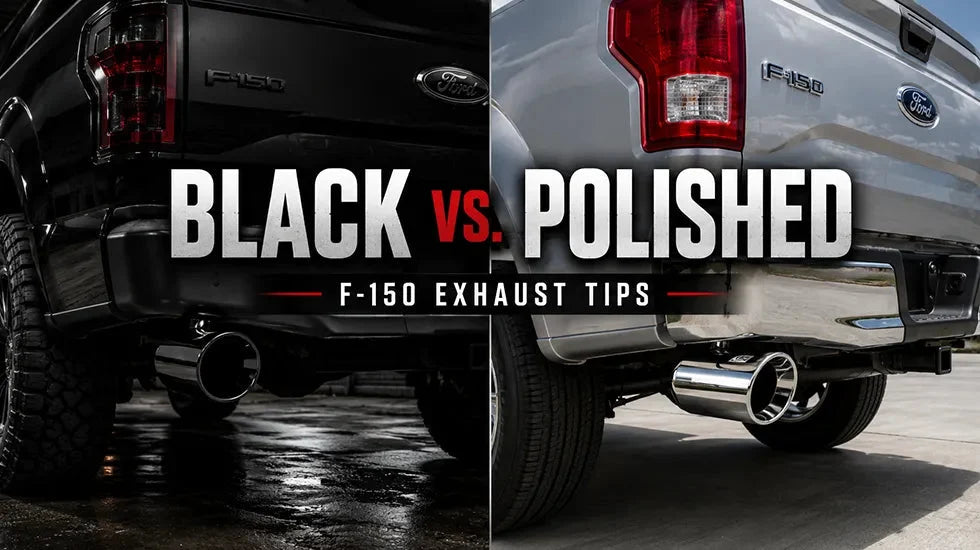
So you’re staring at the back of your F-150 and something feels off.
The wheels look good. Maybe the truck has black badges, a dark bumper, smoked lights, or a clean leveling kit. Then your eyes drop to the factory exhaust outlet and there it is: a plain, tired-looking tip that does nothing for the truck.
That is usually where the rabbit hole starts. Should you run a black exhaust tip on your F-150? Should you keep it polished? Does black hide soot better? Will a polished tip last longer? And does any of this actually change the sound?
Listen, I’ve been around enough F-150 exhaust installs to say this straight: an exhaust tip is a small part, but it can make or ruin the rear-end look of the truck. Buy the right one and the truck looks finished. Buy the wrong one and it looks like a cheap slip-on hanging out of the bumper at a weird angle.

Quick Answer: Black or Polished F-150 Exhaust Tip?
- Choose black if your F-150 has black wheels, a black appearance package, dark badges, smoked lights, or a modern street/off-road look.
- Choose polished stainless if your truck has chrome bumpers, polished wheels, bright trim, or a clean OEM-style build.
- Black tips hide soot better, but cheap painted black tips can peel, fade, or chip if the coating is weak.
- Polished stainless tips are easier to restore with metal polish, but they show carbon, water spots, and road salt faster.
- For durability, material matters more than color. T-304 stainless steel with a quality finish beats thin painted steel almost every time.
- An exhaust tip alone will not add real horsepower. For real sound and flow changes, look at a muffler or cat-back exhaust system.
Black vs Polished F-150 Exhaust Tips: The Real Comparison
A lot of F-150 owners are not trying to rebuild the whole exhaust system. They just want the rear of the truck to look tougher, cleaner, and less factory. Fair enough. But the finish you choose needs to match the truck sitting in your driveway, not just the prettiest product photo online.
Here’s the fast version before we get greasy.
| Category | Black Exhaust Tip | Polished Exhaust Tip | Garage Verdict |
|---|---|---|---|
| Best truck style | Blackout, sport, off-road, dark trim | Chrome bumper, bright trim, classic clean build | Match the tip to the trim first. |
| Soot visibility | Hides carbon better | Shows soot faster | Black wins if you hate wiping carbon rings every week. |
| Scratch visibility | Can show chips if coating is cheap | Can be polished back if stainless | Polished stainless is easier to recover. |
| Long-term durability | Depends heavily on coating quality | Depends on stainless grade and maintenance | T-304 stainless is the safer base material. |
| Sound change | No real change from color alone | No real change from color alone | Size and exhaust layout matter, not color. |
Best For Black Exhaust Tips
A black tip works best when the rest of the truck already leans dark. Black wheels. Black badges. Black grille. Smoked third brake light. Dark gray paint. That kind of build.
On those trucks, a polished tip can look like a random shiny part bolted onto an otherwise stealthy rear end. A black tip blends in, but not in a boring way. It makes the bumper area look cleaner and meaner.
I remember a 2018 F-150 XLT that came into the shop with black 20s, dark tint, and a black grille. The owner had installed a big polished outlet himself. Nice part, wrong truck. From twenty feet back, your eye went straight to the tailpipe instead of the stance. We swapped to a black dual outlet setup, and the truck finally looked like one complete build instead of three different ideas fighting each other.

Best For Polished or Chrome Exhaust Tips
Polished tips still have their place. Don’t let the blackout crowd bully you into thinking chrome is dead.
If your F-150 has a chrome rear bumper, chrome grille bars, polished wheels, or a cleaner stock-plus style, a polished stainless tip usually looks more natural. It gives the rear end a sharper edge without turning the truck into something it is not.
Polished also photographs better in product shots and driveway pictures. But here’s the catch: it only looks clean when it is actually clean. Carbon rings, water spots, and winter salt show fast.

Which Looks Better on an F-150?
Looks are subjective, sure. But fitment, proportion, and trim matching are not. A good exhaust tip should look like it belongs on the truck.
Black Exhaust Tips: Aggressive Without Screaming
A F-150 black exhaust tip gives the rear bumper a darker, more aggressive finish. It is especially good on:
- Black Appearance Package trucks
- STX and Sport builds with dark trim
- Leveled or lifted F-150s with black wheels
- Gray, black, blue, red, and white trucks with contrast styling
- Street trucks where the owner wants a cleaner rear profile
The best black tips do not look like cheap barbecue paint. They have depth. Black chrome, ceramic-coated black, or a smooth satin black finish usually looks better than a flat, thin painted coating.
Polished Exhaust Tips: Bright, Classic, and Easy to Notice
A polished tip is louder visually. Not louder by sound. Louder by eyeballs.
It catches light. It frames the rear bumper. It says, “Yes, there is an exhaust upgrade back here.” On a truck with chrome bumpers, polished accents, or a clean OEM-style appearance, that can be exactly right.
But if you already blacked out the truck, polished tips may fight the theme. That is why I would not pick polished just because it looks shiny on a white-background product image. Walk around your truck first. Look at the bumper, wheels, badges, and tailgate trim. The answer is usually already there.
Body Color and Trim Matching Guide
| F-150 Look | Better Tip Finish | Why It Works |
|---|---|---|
| Black truck, black wheels | Black | Keeps the rear end stealthy and uniform. |
| White truck, black trim | Black | Adds contrast without looking too flashy. |
| Chrome bumper, stock wheels | Polished | Matches the existing bright trim. |
| Gray truck, black wheels | Black or black chrome | Modern, tough, and not too loud visually. |
| Classic clean street truck | Polished stainless | Looks sharp and easy to maintain with polish. |
Which Lasts Longer: Black, Polished, Chrome, or Coated?
Here is where a lot of truck owners get fooled. They compare color when they should be comparing base metal.
The finish is only the skin. The steel underneath is the backbone.
Start With the Base Metal, Not the Color
For an exposed rear exhaust tip, T-304 stainless steel is usually the better material choice. It handles moisture and road grime better than cheap mild steel. T-409 stainless can work fine deeper in the exhaust system, but for a visible tip that gets blasted with water, salt, and carbon, T-304 is the safer bet.
Cheap plated steel is where I get nervous. It looks fine when new. Then the edge gets chipped, winter salt creeps in, and rust starts from the seam or rolled edge. I have seen that movie too many times.

Mechanic’s note: If the listing does not clearly tell you the material, finish type, inlet size, outlet size, and length, slow down. “Fits most trucks” is not fitment. It is a warning label wearing a smile.
Black Chrome vs Powder Coated vs Painted Black Tips
Black does not mean one thing. There are levels.
- Black chrome: Smooth, dark, and more OEM-looking. It usually looks more premium than flat black paint.
- Ceramic-coated black: Better heat and finish resistance when done properly. Good choice for trucks that see regular use.
- Powder-coated black: Can be durable, but sharp chips or poor surface prep can cause peeling.
- Basic painted black: Cheapest option. Also the one most likely to fade, chip, or look tired after heat cycles and road debris.
The black tips on Flashark’s F-150 cat-back option are listed as ceramic-coated black, which makes more sense for a truck part sitting near heat, water, and exhaust soot than a thin cosmetic paint layer.
Polished Stainless vs Chrome-Plated Tips
Polished stainless has one big advantage: you can usually bring it back.
If it gets dull, stained, or covered in carbon, a decent stainless polish and a microfiber towel can clean it up. Chrome-plated tips look bright when new, but if the plating breaks down or pits around the edge, you are not really polishing that back to perfect in your driveway.
So if you want a polished look, I prefer polished stainless over unknown chrome-plated steel. It costs more for a reason.
Real-World Durability Verdict
For long-term daily use, I would rank them like this:
- T-304 polished stainless — best if you like bright metal and do not mind cleaning.
- T-304 stainless with quality black coating — best if you want the dark look and good durability.
- Black chrome on stainless — great OEM+ look if the finish quality is strong.
- Cheap painted black steel — fine for a budget look, but do not expect miracles.
Does a Black Exhaust Tip Hide Soot Better?
Yes. Most of the time, black hides carbon better than polished. That is one reason truck owners like it.
But do not confuse “hides soot” with “stays clean.” Those are not the same thing.
Why F-150 Exhaust Tips Get Dirty
F-150 tips get dirty from cold starts, short trips, moisture, rich startup fueling, road dust, and normal carbon from exhaust flow. EcoBoost trucks can leave visible residue too, especially if the truck sees lots of short drives.
Polished tips show that dark ring quickly. Black tips disguise it. Matte black can hide carbon well but sometimes holds dust and cleaner residue in the texture. Gloss black and black chrome wipe easier but show fine scratches faster.
Black Tips Hide Carbon, But They Still Need Cleaning
If you buy a black tip and never clean it, it will still get ugly. Just slower. Use mild soap, water, and a soft microfiber towel. Avoid harsh acid wheel cleaners unless the manufacturer says the finish can take it.
Many new guys spray wheel acid on everything under the bumper. Don’t. That is how nice black finishes turn cloudy or stained.
Polished Tips Look Cleaner Only When They Are Clean
Polished stainless is like a black truck after rain. Beautiful when clean. Annoying when dirty.
The upside? You can restore it. For a polished stainless tip, wash first, dry it, then use a light metal polish. Do not grind away at it with steel wool like you are cleaning an old grill grate.
Will an Exhaust Tip Change the Sound of an F-150?
Honest answer: a little, sometimes. Not enough to sell it as a sound upgrade by itself.
The color will not change sound. A black tip and a polished tip with the same size, length, and internal shape will sound basically the same.
The Honest Answer: Only Slightly
A larger outlet can slightly change how the sound exits. A longer tip may add a small amount of resonance. A resonated tip can affect tone more than a plain non-resonated tip. But if the muffler, resonator, pipe diameter, and catalytic converters stay the same, you are still listening to mostly the same exhaust system.
If your goal is sound, read that again.
For a deeper tone, you are usually looking at a muffler change or a full cat-back. If you are not sure where the tip fits in the system, this Ford F-150 exhaust diagram is a good place to start because it shows what a cat-back actually replaces.
Black vs Polished Does Not Change Sound by Itself
This is one of those garage myths that keeps coming back. A black tip does not sound deeper because it is black. A polished tip does not sound sharper because it is shiny.
Sound comes from pipe diameter, muffler design, resonator layout, engine, cab/bed length, exit location, and sometimes tuning. Finish color is visual.
Do Exhaust Tips Add Horsepower?
No meaningful horsepower by themselves. Not on a healthy F-150 with a normal exhaust path.
If you see a standalone tip advertised like it adds 15 horsepower, close the tab. A full cat-back is different. For example, Flashark lists its 2015–2020 F-150 3-inch cat-back system with tested gains of +16.28 HP and +13.04 lb-ft at 4,200 RPM. That number is tied to the full system design, not the tip color alone.
If you care more about actual tone than just the rear-end look, check this guide on the best sounding exhaust for 5.0 F-150 before picking parts blindly.
F-150 Exhaust Tip Size: The Fitment Mistake Most Owners Make
This is where good-looking parts turn into return labels.
People see “3 inch” in a title and assume it fits. But 3 inch what? Inlet? Outlet? Main pipe? Factory tailpipe? Tip diameter? Clamp area?
That is why ordering an exhaust tip before measuring your F-150 is asking for a headache.
Measure the Tailpipe Outside Diameter Before You Buy
You need the outside diameter of the tailpipe where the tip will slide on. Not the inside diameter. Not the outlet diameter of the new tip. The factory pipe outside diameter.
Use a caliper if you have one. A tape measure can get you close, but it is not as clean. Measure the straight section where the clamp will sit. If the pipe is crushed, oval, rusty, or already cut, measure twice.

Shop warning: Do not order by engine size alone. A 5.0L badge does not tell you tip inlet size. Cab, bed, trim, previous exhaust work, and model year can all change what you are working with under the bumper.
Common F-150 Exhaust Tip Measurements to Check
- Inlet diameter: The size that slips over your existing tailpipe.
- Outlet diameter: The visible opening at the end of the tip.
- Tip length: Too long can stick out awkwardly; too short can hide under the bumper.
- Clamp area: You need enough straight pipe for the clamp to bite.
- Tailpipe angle: Side exit and rear exit tips sit differently.
- Bumper clearance: Big outlets can get too close to plastic trim.
Outlet Size: 3.5-Inch, 4-Inch, or 5-Inch?
A 3.5-inch outlet looks close to OEM+ on many trucks. A 4-inch tip is usually the sweet spot. Big enough to notice, not so huge it looks like a coffee can.
A 5-inch outlet can look right on a lifted truck with aggressive tires. On a mostly stock F-150, it can look forced. Like wearing work boots with a suit. Can you do it? Sure. Should you? Depends on the truck.
Original vs Aftermarket F-150 Exhaust Tip and Cat-Back Parameters
If you only want appearance, a slip-on tip may be enough. If you want tone and flow, you are in cat-back territory. That is a different job and a different result.
| Parameter | Typical Stock F-150 Rear Exhaust | Aftermarket Tip Only | Flashark 2015–2020 F-150 Cat-Back Example |
|---|---|---|---|
| Main goal | Noise control, cost control, factory packaging | Rear-end appearance | Sound, flow, appearance, throttle feel |
| Pipe size | Varies by year/engine/configuration | Must match existing tailpipe OD | 3" OD major piping, split to dual 2.5" OD piping |
| Sound change | Quiet, factory-tuned | Slight at most | Deep tone with more aggressive growl under RPM |
| Power change | Factory baseline | No meaningful gain | Listed at +16.28 HP and +13.04 lb-ft at 4,200 RPM |
| Install style | Factory welded/bolted layout | Clamp-on or weld-on | Direct bolt-on system using hangers and clamps |
If you are ready to move beyond just the tip, browse cat-back exhaust systems first, then narrow down to truck-specific fitment. For F-150 owners, the cleaner path is usually the Ford F-150 cat-back exhaust upgrades page because it keeps the fitment tighter.
Clamp-On vs Weld-On Exhaust Tips for F-150
Most F-150 owners should be looking at clamp-on tips unless the truck already has custom exhaust work.

Clamp-On Tips: Best for Most F-150 Owners
A clamp-on tip is simple. Slide it over the tailpipe, align it, tighten the clamp. Done. At least that is how it goes when the size is right.
The good stuff:
- No welding needed
- Can be removed later
- Good for driveway installation
- Easy to adjust before final tightening
The bad stuff:
- Cheap clamps can loosen
- Wrong inlet size will not clamp correctly
- Short clamp sections can sit crooked
- Overtightening can deform thin metal
Weld-On Tips: Cleaner but Less Forgiving
Weld-on tips are clean when done right. No visible clamp, no slipping, no movement.
But they are not forgiving. Once welded, you are committed. If the angle is wrong, the tip sits too far out, or the bumper clearance is bad, now you are cutting and reworking.
When Cutting the Factory Tailpipe May Be Required
Some OEM-style or direct-fit tips require trimming the factory tailpipe. That can look great because the finished tip sits exactly where it should. But it is not something you do while guessing.
I remember a 2016 F-150 that came in after the owner watched a quick install video and cut the factory tailpipe before test fitting. The tip ended up tucked too far under the bumper, and the outlet looked like it was hiding. We had to recut, sleeve, realign, and clamp it so the exit sat right. A ten-minute shortcut turned into a two-hour correction.
So here is the rule: mock it up before you cut anything. Stand behind the truck. Check both sides. Make sure the final exit length looks right from five feet and twenty feet away.
Single-Wall vs Double-Wall F-150 Exhaust Tips
Wall design changes the look more than most people expect.
Single-Wall Tips
Single-wall tips are lighter and usually cheaper. The edge looks thinner. On some cars, that can be fine. On an F-150, especially with a large outlet, thin tips can look a little unfinished unless the cut and finish are very clean.
Double-Wall Tips
Double-wall tips look thicker and more premium. They have that “factory performance accessory” vibe. On a full-size truck, the heavier visual edge usually matches the bumper better.
If you are debating between two similar tips and one is double-wall with better stainless, I would spend the extra money. It is a visible part. You will see it every time you walk behind the truck.
Rolled Edge, Slant Cut, Angle Cut, and Straight Cut
- Rolled edge: Smooth, clean, more OEM-looking.
- Slant cut: More aggressive and directional.
- Straight cut: Simple and clean.
- Angle cut: Works well with side-exit layouts.
If you are comparing rear exit and side exit systems, this F-150 side exit exhaust pros and cons guide is worth reading before you commit to the look.
When a Full Cat-Back Makes More Sense Than Just a Tip
Here is the practical split.
If your only complaint is “the rear tip looks plain,” buy a better tip. Measure carefully and move on with your life.
If your complaint is “the truck is too quiet, the rear looks weak, and I want better flow,” then a full cat-back makes more sense. That way the tip is not doing all the work cosmetically while the factory muffler is still choking the character out of the truck.
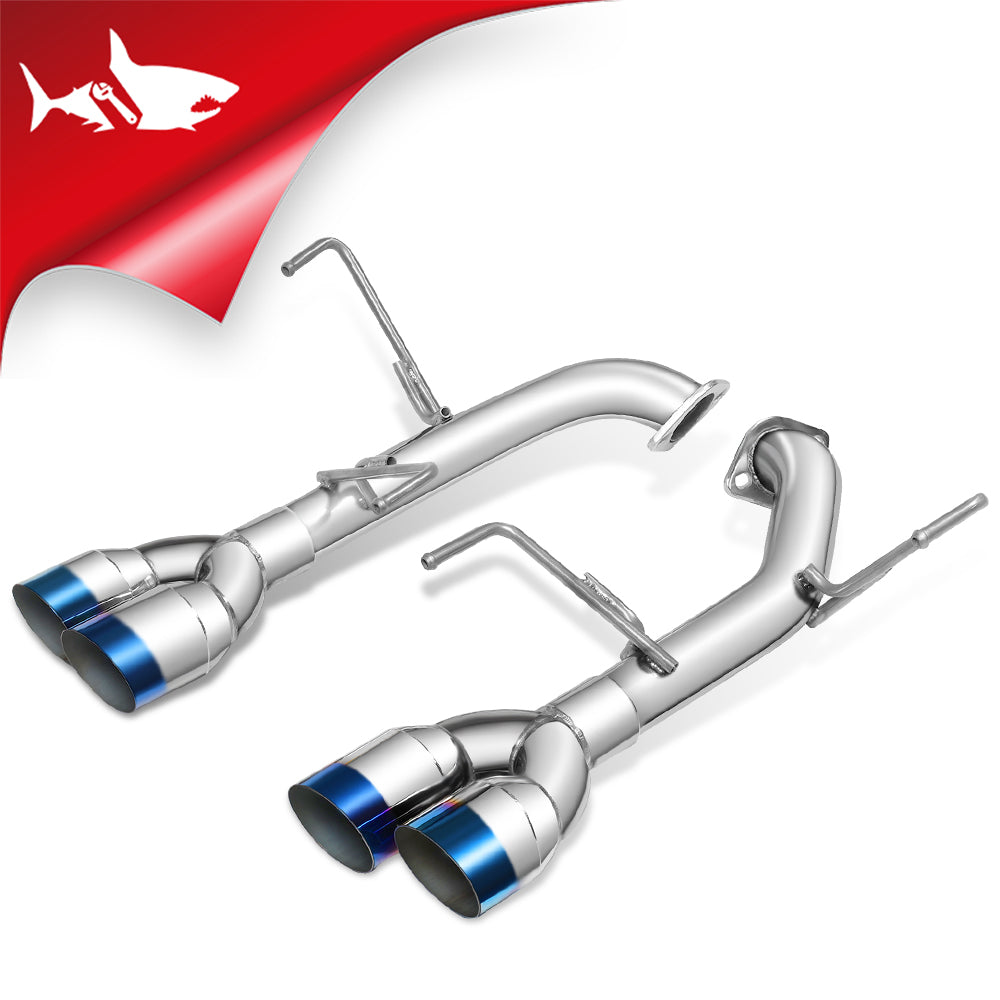
Polished Dual Split Exit Option for a Brighter Rear Look
For owners who want the brighter dual-outlet look, the polished dual-split F-150 cat-back exhaust fits the cleaner, sharper visual style. It makes sense on trucks with chrome, silver wheels, or a more classic OEM-plus look.

Flashark Polished Dual Split Exit F-150 Cat-Back Exhaust
Best match for F-150 owners who want a brighter dual-tip rear finish with a deeper cat-back tone instead of a simple cosmetic slip-on tip.
Sale Price: $369.99 Regular Price: $589.00
Fitment note: 2015–2020 Ford F-150 2.7L / 3.5L / 5.0L, excluding listed configurations and trims. Always verify fitment before ordering.
View Polished Dual Split ExitBlack Dual Split Exit Option for the Blackout Look
If your truck already has black trim, black wheels, or a darker rear bumper, the black dual split exit F-150 cat-back exhaust is the cleaner match. It keeps the rear end dark while still giving you the dual-exit performance look.

Flashark Black Dual Split Exit F-150 Cat-Back Exhaust
Best match for a blackout F-150 build where polished tips would look too bright or out of place. The black dual outlets help the rear bumper look more complete.
Sale Price: $389.99 Regular Price: $589.00
Fitment note: 2015–2020 Ford F-150 2.7L / 3.5L / 5.0L, excluding listed configurations and trims. Check cab, bed, and trim before buying.
View Black Dual Split ExitHow to Choose the Best Exhaust Tip for Your F-150
Do not start with the product. Start with the truck.
Choose by Truck Style First
- Blackout build: Black chrome, satin black, or ceramic-coated black.
- Chrome-heavy truck: Polished stainless or chrome-style finish.
- Work truck: Polished stainless if you want easy cleaning and long service life.
- Lifted/off-road build: Black or darker finish usually looks tougher.
- Street truck: Larger black or polished dual tips can work, depending on trim.
Choose by Climate and Road Conditions
If you live in Arizona, your tip has an easier life. If you live in Michigan, Pennsylvania, New York, Ohio, or anywhere that salts roads hard, your exhaust tip is getting abused every winter.
In snow states, I care more about stainless quality than finish color. Wash the rear bumper area in winter. Salt sits in seams. It does not care how expensive the truck is.
Choose by Maintenance Habit
Be honest with yourself.
- If you clean your truck every weekend, polished stainless is fine.
- If you wash it once a month and call that a detail, black may be better.
- If you use harsh cleaners, avoid delicate finishes.
- If you park outside year-round, buy better material.
Choose by Fitment Confidence
If you are not comfortable measuring and cutting, do not gamble on a vague universal part. Buy something with real fitment notes. Better yet, choose a direct-fit system if you want sound, tip finish, and rear-exit layout solved together.
Installation Checklist Before You Buy
Before you spend money, crawl under the truck. I know. Not glamorous. Still cheaper than returning parts.
Measure These Before Ordering
- Tailpipe outside diameter
- Available straight pipe length for the clamp
- Distance from tailpipe end to bumper edge
- Tip outlet size compared with bumper clearance
- Tailpipe angle and exit direction
- Whether the factory tip is welded, clamped, or part of the tailpipe
- Desired final tip extension beyond the bumper
Tools You May Need
- Caliper or tape measure
- Socket wrench
- Penetrating oil
- Rubber mallet
- Gloves and eye protection
- Pipe cutter or saw only if trimming is required
- Torque wrench if the clamp has a listed torque spec
Common Installation Mistakes
- Buying by engine size instead of tailpipe measurement
- Confusing inlet diameter with outlet diameter
- Installing the tip crooked and only noticing from across the parking lot
- Letting the tip touch or nearly touch bumper plastic
- Overtightening a cheap clamp until the metal deforms
- Cutting the tailpipe before test fitting
- Using harsh cleaner on black coating after the first drive
Black vs Polished F-150 Exhaust Tips: Final Verdict
If your F-150 is dark, sporty, lifted, or blacked out, go black. A quality black tip looks tougher, hides soot better, and makes the rear bumper feel more finished.
If your truck has chrome bumpers, polished wheels, or a clean factory-plus look, polished stainless still wins. It gives the rear end a brighter, sharper finish and can be restored with proper cleaning.
But here is the real answer: buy the right material, the right size, and the right layout before you worry about color. A cheap black tip that chips in two months is not better than a polished stainless tip. A beautiful polished tip that does not fit your tailpipe is just garage clutter.
For a simple visual upgrade, measure carefully and pick the right tip. For deeper sound, cleaner flow, and a complete rear-end change, step up to a full F-150 cat-back system.
FAQ: F-150 Black Exhaust Tip and Polished Exhaust Tip Questions
Q1: Is a black exhaust tip better than polished on an F-150?
A1: A black tip is better if your F-150 has black wheels, dark trim, or a blackout appearance package. A polished tip is better if your truck has chrome bumpers, bright wheels, or a cleaner OEM-style look. Neither is automatically better for every truck.
Q2: Does a black exhaust tip last longer than chrome?
A2: Not always. Durability depends more on the base metal and finish quality than the color. A T-304 stainless black-coated tip can last well, but a cheap painted black steel tip can chip or fade faster than polished stainless.
Q3: Do black exhaust tips peel or fade?
A3: Low-quality painted black tips can peel, fade, or chip, especially after heat cycles, road salt, and harsh cleaners. Better black chrome or ceramic-coated black tips usually hold up better, but they still need careful cleaning.
Q4: What size exhaust tip fits a Ford F-150?
A4: The only safe answer is to measure your tailpipe outside diameter. F-150 exhaust sizing can vary by year, engine, trim, and previous exhaust work. Always match the tip inlet size to the actual tailpipe OD.
Q5: Will a 3-inch exhaust tip fit all F-150 trucks?
A5: No. A 3-inch label can refer to different measurements, and not every F-150 tailpipe is the same. Measure the factory tailpipe before ordering.
Q6: Does an exhaust tip change the sound of an F-150?
A6: A tip can slightly change the way sound exits, especially if it is larger, longer, or resonated. But the change is usually minor. For a real sound change, look at the muffler, resonator, or cat-back exhaust system.
Q7: Does an exhaust tip add horsepower?
A7: A standalone exhaust tip does not add meaningful horsepower on a healthy F-150. A full cat-back exhaust can improve flow and may show measurable gains depending on the system, engine, and test conditions.
Q8: Is clamp-on or weld-on better for an F-150 exhaust tip?
A8: Clamp-on is better for most owners because it is easier to install, adjust, and remove. Weld-on is cleaner and more permanent, but it requires better alignment and usually professional installation.
Q9: Do I need to cut the factory tailpipe to install an F-150 exhaust tip?
A9: Sometimes. Many clamp-on tips do not require cutting, but some direct-fit or OEM-style tips may need trimming for the correct final position. Test fit before cutting anything.
Q10: What is better, black chrome or matte black exhaust tip?
A10: Black chrome usually looks more premium and wipes cleaner. Matte black looks more rugged and low-key, but it can hold dust and cleaning residue more easily. Pick based on truck style and maintenance habits.
Q11: How far should an exhaust tip stick out on an F-150?
A11: Usually just slightly past the bumper line or aligned cleanly with the rear profile. Too far out can look cheap and may create clearance issues. Too far in can look unfinished.
Q12: How do you clean black exhaust tips?
A12: Use mild soap, water, and a soft microfiber towel. Avoid harsh acid cleaners, steel wool, and heavy abrasives unless the manufacturer specifically says the coating can handle them.
Q13: How do you clean polished stainless exhaust tips?
A13: Wash off dirt first, dry the surface, then use a stainless-safe metal polish for carbon and water spots. Do not polish a hot exhaust tip.
Q14: Are expensive F-150 exhaust tips worth it?
A14: If you care about long-term appearance, yes. Better tips usually use better stainless, stronger clamps, cleaner welds, and more durable finishes. Cheap tips can work, but they are more likely to rust, loosen, or look tired early.
Q15: What is the best exhaust tip for a black F-150?
A15: For a black F-150, a black chrome, satin black, or ceramic-coated black tip usually looks best. If the truck has chrome bumpers or polished wheels, a polished stainless tip can still work as a contrast piece.

Steven Chen
Automotive Performance Specialist | Engine & Exhaust Systems
Steven focuses on practical engine performance, exhaust fitment, and real-world upgrade paths for classic and modern enthusiast vehicles. He reviews small-block Ford, LS, truck, and street/strip applications with one goal in mind: helping builders choose parts that actually work together. His philosophy: "Good power starts with the right combination, not the biggest part."