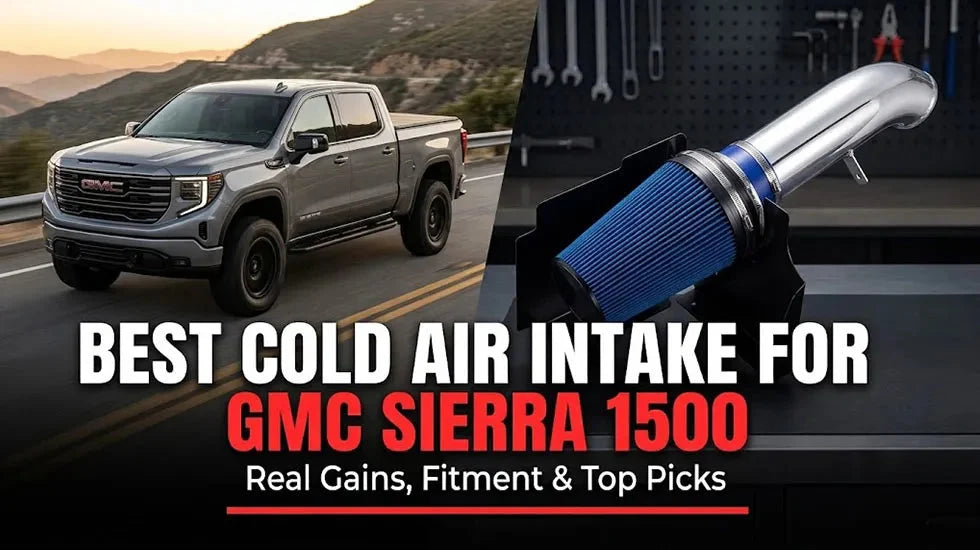
Finding the best cold air intake for GMC Sierra 1500 is not as simple as ordering the biggest tube or the filter with the loudest product photos. A 2003 Sierra 5.3L, a 2011 Sierra 5.3L, and a 2017 Sierra 5.3L may share a displacement badge, but they do not share the same engine generation, MAF arrangement, intake routing, couplers, or mounting points.
That distinction matters. A well-matched intake can give the truck a stronger induction note, clean up the airflow path, simplify filter service, and support later exhaust or tuning work. The wrong one can leave you wrestling with stretched wiring, an air leak, rough idle, or a check-engine light before the truck even leaves the driveway.
I will keep the expectations realistic. You are not bolting 40 wheel horsepower onto a stock 5.3L with an air filter and a piece of aluminum tube. What you can gain depends on the truck, the engine, the intake design, the calibration, the temperature, and everything else already attached to the engine.
Quick Answer: What Is the Best Cold Air Intake for GMC Sierra 1500?
- 1999–2006 4.8L, 5.3L, or 6.0L Vortec: Use a GMT800-specific system that retains the correct factory MAF position and matches the original engine.
- 2007–2008 V8 trucks: Select a dedicated 2007–2008 variant. Do not assume a 2009–2013 tube will fit because both trucks use a 5.3L engine.
- 2009–2013 4.8L, 5.3L, 6.0L, or 6.2L: A heat-shielded intake with a properly positioned MAF and reusable filter is the most practical all-around setup.
- 2014–2018 5.3L or 6.2L EcoTec3: Use a K2XX-specific intake designed around the L83 or L86 engine layout.
- 2019 and newer trucks: Buy only a T1XX-specific kit for the exact 2.7L, 5.3L, 6.2L, or 3.0L engine. The older products discussed below do not fit.
- Best for sound: An open cone filter with a heat shield generally produces the clearest induction growl under heavy throttle.
- Best for low maintenance: A dry, washable filter avoids the cleaning-oil step and reduces the risk of over-oiling near the MAF sensor.
- Best for fuel economy alone: Keep the factory airbox. An intake should not be purchased on the promise of a guaranteed MPG increase.
Best Sierra 1500 Cold Air Intake Picks by Year and Engine
Start with the year and engine. Then look at tube construction, filter type, heat shielding, installation details, and price. Reversing that order is how people end up returning a perfectly decent intake that was never designed for their truck.

| Sierra 1500 | Engines | Recommended Design | Best For | Main Warning |
|---|---|---|---|---|
| 1999–2006 | 4.8L, 5.3L, 6.0L Vortec V8 | 4-inch tube, dry cone filter, heat shield | GMT800 daily drivers and older Vortec builds | Check for engine swaps and Classic body overlap |
| 2007–2008 | Listed 4.8L–6.2L V8 applications | Dedicated 2007–2008 intake variant | Early GMT900 trucks | Different MAF arrangement from later trucks |
| 2009–2013 | 4.8L, 5.3L, 6.0L, 6.2L V8 | Heat-shielded 4-inch or vehicle-specific aluminum intake | Sound, reusable filtration, higher-rpm airflow | Do not extend fitment into 2014 without checking the platform |
| 2014–2018 | 5.3L L83, 6.2L L86 EcoTec3 V8 | 3.5-inch K2XX-specific intake with dry filter | Newer EcoTec3 daily and performance builds | Does not fit 4.3L, 2019+, diesel, or HD trucks |
| 2019+ | 2.7L, 5.3L, 6.2L, 3.0L Duramax | Engine- and T1XX-specific system | Late-model trucks | None of the older Flashark products below are listed for these trucks |
Best Intake for a 1999–2006 GMC Sierra 1500 Vortec
The GMT800 truck is the easy one to recognize and the easy one to misidentify. A clean 2004 Sierra 1500 with its original LM7 5.3L is straightforward. A truck with an engine swap, a later MAF conversion, an aftermarket throttle body, or a 2007 Classic body tag needs a closer look.
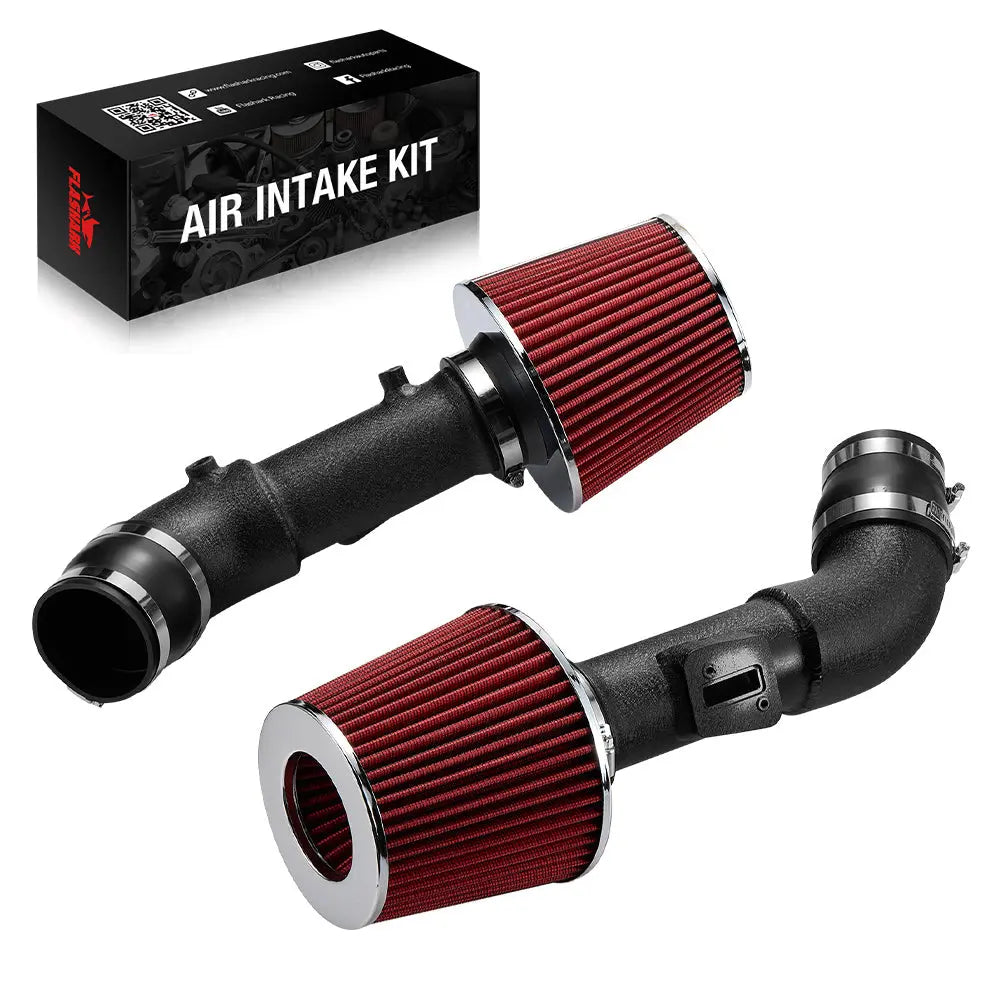
For an original-layout truck, the 1999–2006 GMC Sierra Vortec cold air intake uses a polished 4-inch aluminum tube, dry cone filter, heat shield, and the original MAF sensor. Listed Sierra 1500 coverage includes the 4.8L, 5.3L, and 6.0L Vortec V8.
This is the sort of upgrade that makes an older truck sound much less muted when the throttle opens. On a stock 4.8L or 5.3L, keep the power expectations conservative. A modified 6.0L with headers, exhaust, and a sensible calibration has more reason to take advantage of the reduced intake restriction.

Best for GMT800 Vortec Trucks
Flashark 1999–2006 Chevy/GMC Vortec Intake
For listed Sierra 1500 applications with the original 4.8L, 5.3L, or 6.0L Vortec V8 intake and MAF layout. Includes a polished 4-inch tube, dry reusable filter, heat shield, couplers, and installation hardware.
$79.99 $129.99
Intake-only variant. Promotional price checked July 16, 2026. Confirm the live price and exact fitment before ordering.
Best Intake for a 2007–2008 GMC Sierra 1500
Here is where a lot of catalog mistakes begin. The 2007–2008 new-body GMT900 trucks are not automatically interchangeable with the 2009–2013 trucks. The engine displacement may match, but the MAF housing and intake arrangement can differ.
Flashark offers a 2007–2014 Chevy and GMC V8 cold air intake kit with separate 2007–2008 and 2009–2014 product selections. That drop-down is not decorative. Pick the wrong one and the tube, sensor mounting, couplers, or brackets may not line up.
For an early GMT900 Sierra, choose the 2007–2008 selection and verify the model, engine, MAF plug, sensor housing, and factory tube before removing anything. Honest advice: take a clear engine-bay photo and compare every connection point. Five minutes with the hood open beats paying return shipping.

Separate Year Variants
Flashark 2007–2014 Chevy/GMC V8 Intake
Available as separate 2007–2008 and 2009–2014 selections for listed Chevy and GMC V8 applications. The system uses aluminum piping, a washable cone filter, a heat shield, and included mounting hardware.
From $84.99 No published compare-at price
The 2007–2008 variant was $84.99 and the 2009–2014 variant was $89.99 when checked July 16, 2026. Verify the selected variant before checkout.
Best 4-Inch Intake for a 2009–2013 Sierra 1500 V8
For 2009–2013 trucks, there is a more tightly defined option. The 2009–2013 GMC Sierra 1500 4-inch cold air intake is listed for the 4.8L, 5.3L, 6.0L, and 6.2L V8. It uses a 4-inch 6061 aluminum tube, a dry open-element cone filter, a steel heat shield, silicone couplers, and the factory MAF sensor.
That 4-inch tube makes the most sense when airflow demand is high: a 6.0L or 6.2L under load, a truck that regularly sees higher rpm, or an engine already paired with freer exhaust components. A stock 4.8L daily driver will still get the sound and serviceable filter, but it should not be sold a fantasy about suddenly needing drag radials.
The dry filter is a practical choice. There is no filter oil to measure, spread, or accidentally over-apply. You still have to clean it correctly and allow it to dry completely before reinstalling it.

Focused GMT900 Fitment
Flashark 2009–2013 Sierra 1500 4-Inch Intake
A polished 4-inch aluminum intake for listed Sierra 1500 trucks with the 4.8L, 5.3L, 6.0L, or 6.2L V8. Includes a dry filter, powder-coated heat shield, reinforced silicone couplers, clamps, and mounting hardware.
$99.99 $139.99
Promotional price checked July 16, 2026. The page excludes 2007–2008 trucks, hybrid models, and 2500/3500 HD applications.
The 2014 Sierra 1500 Fitment Trap
Listen to me on this one: do not buy a 2014 intake by displacement alone. The 2014 Sierra 1500 moved into the K2XX generation and introduced Gen V EcoTec3 engines such as the L83 5.3L and L86 6.2L. That is not the same intake architecture as a 2011 GMT900 5.3L.
Flashark currently has one multi-variant product page that lists a 2009–2014 selection and another dedicated product for 2014–2018 L83/L86 trucks. Because 2014 appears in both ranges, verify all of the following before ordering:
- Engine code, not only the 5.3L or 6.2L badge.
- MAF sensor body, connector, bolt pattern, and airflow direction.
- Throttle-body coupler diameter.
- PCV and breather-hose locations.
- Tube routing around the fan shroud and radiator hose.
- Heat-shield shape and factory mounting points.
- Whether the truck is a 1500, an HD model, or a body-style overlap.
Fitment Warning
For a 2014 Sierra 1500 with the L83 5.3L or L86 6.2L EcoTec3, the dedicated 2014–2018 product page provides the clearer K2XX-specific listing. Do not force an earlier tube to fit, drill new sensor holes, stretch the MAF harness, or improvise an unmetered breather connection.
Best Intake for a 2014–2018 Sierra 1500 5.3L or 6.2L
The dedicated 2014–2018 GMC Sierra 1500 5.3L and 6.2L intake is built around the L83 and L86 EcoTec3 layout. It uses a 3.5-inch, or 89 mm, powder-coated aluminum tube, a dry cotton-gauze filter, a steel heat shield, a MAF adapter, and dedicated breather hoses.
That is the setup I would look at for a stock or lightly modified K2XX truck whose owner wants a deeper induction note, a reusable filter, and a cleaner path in place of the corrugated factory tract. The 6.2L has greater airflow demand at high load, but the 5.3L owner may still value the sound and serviceability.
The product is listed for 2WD and 4WD Sierra 1500 configurations with the specified engines. It is not listed for the 4.3L V6, 2.7L turbo, 3.0L Duramax, 2500HD, 3500HD, or 2019-and-newer trucks.

Best for K2XX EcoTec3 Trucks
Flashark 2014–2018 Sierra 1500 Intake
Designed for listed Sierra 1500 trucks with the L83 5.3L or L86 6.2L EcoTec3 V8. Uses a 3.5-inch powder-coated tube, dry cotton filter, steel heat shield, factory MAF adapter, and dedicated hoses.
$128.99 No published compare-at price
Price checked July 16, 2026. Verify the engine code and live product information before purchase.
What About a 2019 or Newer Sierra 1500?
None of the four products above should be presented as a solution for a 2019-and-newer Sierra 1500. The T1XX truck uses different engine, sensor, airbox, mounting, and electronic configurations. The 2.7L turbo, 5.3L V8, 6.2L V8, and 3.0L Duramax also require different intake systems from one another.
Do not cut a coupler, drill a bracket, or relocate a sensor simply because an older tube looks close in a photo. A tube that physically occupies the engine bay is not necessarily a correctly calibrated intake.
How to Choose a Sierra 1500 Cold Air Intake
Fitment Comes Before Tube Size
Big numbers sell parts. Four inches sounds better than three and a half. That does not mean a 4-inch tube is automatically better on every truck.
The MAF sensor estimates incoming airflow so the ECU can calculate fuel delivery. Its reading depends partly on the size and shape of the passage around it. Change that geometry carelessly and the relationship between actual airflow and reported airflow can shift. The engine may still run. It may even sound great. Meanwhile, the fuel trims are drifting farther than they should.
The correct order is:
- Confirm year and body generation.
- Confirm Sierra 1500 rather than 1500 HD, 2500HD, or 3500HD.
- Confirm engine displacement and, where possible, the engine code.
- Inspect the original MAF sensor and connector.
- Compare every breather and vacuum connection.
- Confirm the selected product variant.
- Only then compare tube size, material, filter, and price.
Heat Shield vs. Fully Enclosed Airbox
A metal heat shield is not the same thing as a sealed airbox. It can reduce direct exposure to radiator and engine heat, especially when it seals against the hood or factory inlet area. It cannot create winter air inside a 200-degree engine compartment while the truck sits at a red light.
A fully enclosed box normally offers better separation from underhood air and better protection from dust, splashes, and loose engine-bay debris. It also costs more and may mute some of the induction sound people are paying to hear.
An open filter with a sensible heat shield is the budget-friendly middle ground. It is easy to inspect, easy to service, and loud under load. Just do not pretend the filter is thermally isolated when half of it is exposed to the engine bay.
Dry vs. Oiled Filter
A dry filter is the simpler ownership experience. Remove it, clean it according to its instructions, let it dry fully, and reinstall it. No oiling kit. No guessing whether each pleat has enough oil. No temptation to soak the filter until it drips.
Oiled filters can work well when serviced correctly. The problem is the human holding the bottle. Too much oil can migrate from the filter and collect contamination near the MAF sensing element. That does not mean every oiled filter destroys sensors. It means maintenance technique matters.
Open-Element Sound
Most Sierra owners notice the sound before they notice the stopwatch. At idle, the change may be mild. During normal cruise, it may settle into the background. Open the throttle past the quiet part of the pedal and the V8 starts pulling air through a large cone filter without the factory resonators muting everything.
It is deeper, sharper, and more mechanical. Some owners love it. A driver who wants the truck to remain nearly silent should keep the factory box or use a more enclosed system.
Factory Airbox vs. Aftermarket Cold Air Intake
The factory system is not junk. GM had to make it quiet, weather-resistant, inexpensive to produce, easy to service, and dependable across desert heat, winter salt, heavy rain, dust, towing, and long warranty cycles. An aftermarket intake changes the priorities.

| Comparison | Factory Sierra Airbox | Heat-Shielded Aftermarket Intake |
|---|---|---|
| Noise | Quiet, heavily damped | Deeper and more obvious under load |
| Filter | Disposable flat paper element | Usually a larger washable cone filter |
| Tube | Molded plastic or rubber with resonators and corrugations | Smoother aluminum path with fewer sound-damping chambers |
| Heat control | Sealed box fed from a cooler exterior area | Depends on filter position, shield sealing, and vehicle speed |
| Power change | Factory baseline | Usually modest on a stock engine and more useful at higher airflow demand |
| Risk | Low when maintained correctly | Fitment, MAF, leak, heat-soak, and maintenance errors are possible |
| Best owner | Wants OEM quietness and minimum fuss | Wants sound, serviceability, appearance, and a broader airflow package |
How Much Horsepower Can a Sierra Cold Air Intake Add?
On a healthy, otherwise stock 5.3L truck, a realistic planning range is often around 3–8 additional wheel horsepower through useful sections of the curve. Favorable peak comparisons may land around 6–10 horsepower. That is a planning range, not a Flashark guarantee and not a number that should be pasted onto every engine generation.
Two published 2014 5.3L examples summarized in our guide to 5.3 cold air intake horsepower gain showed estimated peak changes of approximately 6.61 HP at 4,998 rpm and 10 HP at roughly 4,700 rpm. They involved different intake systems and should not be presented as guaranteed results for the products on this page.
Mechanic’s Note
Peak horsepower is one point on a graph. It does not tell you how the truck behaves at 1,800 rpm while towing, at 2,500 rpm during normal acceleration, or after ten minutes of heat soak in traffic. Ask where the gain occurred, whether it was measured at the wheels or estimated at the crank, and what else changed between tests.
What You Usually Notice First
- More induction sound: Most obvious at moderate to wide-open throttle.
- Cleaner high-rpm breathing: More relevant during passing, merging, or a full-throttle pull.
- A slightly sharper response: Possible when the MAF signal remains stable and the intake is sealed correctly.
- Easier filter service: A cone filter is normally visible and accessible without opening a factory airbox.
- Engine-bay appearance: Aluminum piping and a cone filter create a more modified look.
Why a 6.2L May Use the Intake Better
A 6.2L moves more air than a 4.8L at the same volumetric efficiency and engine speed. The airflow demand becomes especially relevant at larger throttle openings and higher rpm. That does not guarantee a dramatic increase, but it gives the larger engine more opportunity to expose a restrictive path.
A 5.3L can still respond well. Just keep the claims in proportion. The owner is more likely to notice the sound and upper-rpm breathing than a huge low-speed torque hit.
Intake-Only Power vs. Intake, Exhaust, and Tune
Suppose a truck gains 4 whp after the intake. It then receives long-tube headers, a freer exhaust, and calibration changes and finishes 18 whp above the original baseline. That is not an 18-whp intake.
It is an intake, exhaust, header, and tuning combination. Each part influences the result, and the calibration may change throttle behavior, spark, fueling, torque management, and transmission response. Give every part the credit it earned. No more, no less.
Is a Cold Air Intake Worth It on a GMC Sierra 1500?
It can be. The answer depends on what you expect to get for the money.
It Is Usually Worth It When You Want
- A deeper V8 induction sound during acceleration.
- A reusable or serviceable filter.
- A smoother, less corrugated intake path.
- A cleaner modified appearance under the hood.
- A supporting part for later exhaust, header, camshaft, or tuning work.
- A bolt-on modification that can normally be returned to stock.
It Is Probably Not Worth It When You Expect
- A guaranteed 20–30 whp on an otherwise stock truck.
- A dramatic low-rpm towing-torque increase.
- A dependable MPG improvement that pays for the kit.
- A substitute for fixing a dirty MAF, weak fuel system, misfire, clogged catalytic converter, or worn engine.
- Factory-level quietness from an open cone filter.
A Realistic Garage Case
A typical complaint goes like this: the Sierra ran normally with the factory box, the owner installed an intake on Saturday, and by Sunday it had a rough idle plus P0171 and P0174 lean codes. The first reaction is usually, “I guess it needs a tune.”
That is not where I start. I check the MAF arrow, connector lock, sensor seal, throttle-body coupler, tube joints, and every breather hose. I also make sure the filter is not collapsing a soft coupler or pulling the tube sideways.
In that failure pattern, a loose downstream coupler or an unseated breather hose is far more believable than the ECU suddenly forgetting how to run the engine. Fix the mechanical installation first. Clear the codes only after the leak is corrected, then monitor the trims instead of repeatedly erasing evidence.
Does a Sierra Cold Air Intake Need a Tune?
Many vehicle-specific intakes are intended to work with the stock calibration when they preserve compatible MAF geometry and sensor placement. “No tune normally required” is reasonable. “A tune can never be needed” is not.
For a deeper explanation of MAF diameter, fuel trims, forced induction, and supporting modifications, read our guide to whether a cold air intake needs a tune.
A Tune Is Usually Not the First Step When
- The kit is explicitly listed for the exact truck and engine.
- The correct product variant was selected.
- The factory MAF sensor is installed in the specified direction.
- The MAF housing dimensions remain compatible with the stock calibration.
- All couplers and breather connections are sealed.
- The engine idles smoothly and no codes return.
- Short- and long-term fuel trims remain reasonable.
Diagnostics or Tuning Becomes More Relevant When
- The MAF housing diameter or shape changes substantially.
- The truck has long-tube headers, a camshaft, injectors, a larger throttle body, or forced induction.
- The engine repeatedly sets P0101, P0171, P0174, or related airflow codes.
- Fuel trims remain abnormal after every leak and sensor issue has been corrected.
- The manufacturer specifically requires calibration.
- The truck enters reduced-power mode, stalls, surges, or runs dangerously lean.
Why a Cold Air Intake Can Trigger a Check-Engine Light
A check-engine light is not a normal badge of honor after an intake install. A compatible and correctly assembled system should not be considered finished if the truck immediately develops a MAF, lean, intake-air-temperature, or throttle-related code.
Common Causes
- Backward MAF sensor: The airflow arrow points away from the engine.
- Loose connector: The plug appears attached but the lock is not fully seated.
- Pinched sensor seal: Air leaks around the MAF adapter or O-ring.
- Loose coupler: Unmetered air enters downstream of the sensor.
- Disconnected breather hose: A port was missed during reassembly.
- Wrong intake variant: The MAF housing or tube is for another model year.
- Contaminated MAF element: Dirt, cleaner, or excess filter oil affects the reading.
- Stretched wiring: Engine movement intermittently pulls on the MAF harness.
My Diagnostic Order
- Write down every stored and pending code.
- Do not clear anything yet.
- Confirm the selected intake part and vehicle application.
- Check MAF direction and connector engagement.
- Inspect the sensor seal and adapter.
- Check all couplers after the MAF.
- Check PCV and breather hoses.
- Inspect wiring tension and bent connector pins.
- Review live MAF data and fuel trims if a scan tool is available.
- Repair the mechanical problem before considering calibration changes.

GMC Sierra Cold Air Intake Installation Checklist
Most bolt-on truck intakes are not mechanically complicated. The job becomes complicated when somebody fully tightens each part before the complete system has been aligned.
Silverado and Sierra trucks from the same platform often share basic installation logic. Our detailed guide explains how to install a cold air intake without MAF codes, including sensor direction, coupler alignment, first-start checks, and post-install inspection.
Before Removing the Factory Airbox
- Work on a cool engine and level surface.
- Photograph the original intake from several angles.
- Confirm the year, model, engine, and selected product variant.
- Lay out every clamp, coupler, bracket, bolt, and hose.
- Inspect the MAF connector for broken locks or brittle wiring.
- Read the kit instructions before unplugging the sensor.
- Keep the factory system intact for future troubleshooting or resale.
During Installation
My rule is simple: assemble the entire intake loosely before final tightening. I fit the heat shield, tube, filter, couplers, brackets, MAF, and hoses first. Then I check clearance. Only after the system sits naturally do I tighten it from the throttle body outward.
Many beginners tighten the throttle-body coupler until it begs for mercy, then discover the heat-shield holes are half an inch away from their mounting points. They pull the tube sideways, stretch the MAF wiring, and blame the bracket. Do not do that.
- Install the MAF with the airflow arrow toward the engine.
- Do not touch the sensing element.
- Seat every tube deeply and evenly inside its coupler.
- Keep clamp screws clear of wiring, hoses, and the hood.
- Route breather hoses without kinks or sharp bends.
- Leave enough MAF harness slack for engine movement.
- Make sure the filter does not rub the body or heat shield.
- Do not overtighten clamps around plastic adapters.
After the First Start
- Let the truck idle and listen for hissing or surging.
- Check for warning lights and reduced-power messages.
- Inspect every joint while the engine is running.
- Confirm the tube does not contact the fan shroud or moving parts.
- Take a short, low-load test drive before using wide-open throttle.
- Recheck the clamps after the first complete heat cycle.
- Inspect again after approximately 50–100 miles.
Common Sierra Cold Air Intake Problems
Heat Soak in Traffic
Aluminum absorbs heat while the truck sits. So does plastic. The filter position and access to outside air usually matter more than arguing about tube material alone.
Once the truck moves and airflow increases, air spends very little time inside the tube. At a long red light, however, an exposed filter can draw warmer engine-bay air. A properly positioned and sealed heat shield helps, but it does not repeal thermodynamics.
Whistling or Hissing
Some intake noise is normal. A light whistle near a specific throttle angle can come from airflow over the throttle blade or a tube feature. A constant hiss at idle deserves inspection.
Check the MAF adapter, breather hoses, throttle-body coupler, and every joint after the sensor. A leak can exist even when the clamp looks tight.
Filter Contact and Rattles
The engine moves on its mounts. A filter or tube that clears the body by one eighth of an inch while parked may hit it during acceleration.
Leave enough clearance around the filter, hood, fan shroud, coolant hoses, wiring, and heat-shield edge. A strip of rubber trim can protect the shield edge, but it should not be used to disguise a badly aligned tube.
Water Exposure
A high-mounted filter inside the engine bay is less exposed than a long intake that places the filter low behind the bumper. Neither should be submerged.
Normal rain is not the same thing as pushing through water deep enough to cover the filter. Off-road drivers and trucks that regularly cross deep standing water should prioritize filter location and protection over maximum induction noise.
Dirty or Incorrectly Serviced Filter
A reusable filter is not maintenance-free. Dust loading eventually increases restriction. Clean it according to the instructions for that exact filter; do not assume every cotton, synthetic, foam, dry, or oiled element uses the same chemical process.
Never reinstall a wet filter because you are impatient. Never blast delicate filter media at close range with high-pressure compressed air unless the manufacturer explicitly allows it.
Who Should Keep the Factory Sierra Airbox?
Keeping the stock airbox is not admitting defeat. For some trucks, it is the smart move.
- The only goal is a guaranteed MPG increase.
- The owner dislikes additional induction noise.
- The truck spends its life in severe dust, mud, or deep water without a suitable enclosed intake.
- The engine is completely stock and rarely sees high load or high rpm.
- The original system is intact, clean, and already meets the owner’s needs.
- No intake has been confirmed for the exact engine and model year.
- The truck must comply with emissions rules that the proposed product has not been documented to meet.
- The owner is troubleshooting an existing lean condition, misfire, or MAF fault.
Where to Compare Flashark Intake Options
Sierra owners who want to stay within the specific truck family can compare the available Silverado and Sierra cold air intake kits. That is the most useful collection when the vehicle is already known.
Drivers comparing pickups, SUVs, gasoline V8s, and selected diesel applications can browse the broader selection of Chevrolet and GMC cold air intake kits. Keep an eye on whether each product is a complete intake, a year-specific variant, or an application for an HD diesel truck.
For other makes and engine families, use the main catalog of cold air intake kits by vehicle. Never carry a fitment assumption from one engine family to another just because the tubes look similar.
Final Verdict
The best cold air intake for GMC Sierra 1500 is the one that matches the truck before it tries to impress the owner. A correct MAF position, sealed couplers, proper breather connections, stable fuel trims, useful heat shielding, and an accessible filter matter more than a giant tube and a wild horsepower claim.
For a 1999–2006 Vortec truck, use a GMT800-specific system. For a 2007–2008 truck, select the early GMT900 variant. For a 2009–2013 V8, the focused 4-inch kit is the cleaner catalog choice. For a 2014–2018 L83 or L86, use the dedicated EcoTec3 product. Owners of 2019-and-newer trucks need a completely different application.
Buy it for the sound, the serviceable filter, the cleaner airflow path, and its role in a complete build. Do not buy it because somebody promised that a cone filter would turn a stock 5.3L work truck into a 6,000-pound sports car.
Frequently Asked Questions
Q1: What is the best cold air intake for GMC Sierra 1500?
A1: The best choice depends on the model year, engine, platform, MAF housing, and intended use. Match the intake to the exact truck first, then compare filter type, heat shielding, tube design, sound, maintenance, and price.
Q2: Is a cold air intake worth it on a 5.3L GMC Sierra?
A2: It can be worthwhile for stronger induction sound, modest high-rpm airflow improvement, a reusable filter, and support for later exhaust or tuning work. It is not worthwhile for an owner expecting an intake-only gain of 20–30 wheel horsepower.
Q3: How much horsepower does a cold air intake add to a 5.3L Sierra?
A3: A healthy stock 5.3L truck may gain roughly 3–8 wheel horsepower through useful portions of the curve, while favorable peak comparisons may show approximately 6–10 horsepower. Results vary by engine generation, intake, temperature, calibration, fuel, drivetrain, and test method.
Q4: Does a 6.2L Sierra benefit more from a cold air intake?
A4: The 6.2L has greater airflow demand, especially at high load and higher rpm, so it may make better use of reduced intake restriction. The actual change still depends on the intake design, engine condition, calibration, and supporting modifications.
Q5: Is the factory GMC Sierra airbox already a cold air intake?
A5: The factory airbox normally draws air from a cooler exterior or fender area, so it already performs part of the cold-air function. An aftermarket intake focuses more on tube smoothness, filter area, serviceability, appearance, and induction sound.
Q6: Does a cold air intake improve GMC Sierra gas mileage?
A6: A small improvement is possible under controlled steady-driving conditions, but it should not be promised. Tire size, speed, traffic, terrain, weather, load, gearing, fuel, and throttle use usually have a greater effect on MPG.
Q7: Does a GMC Sierra cold air intake require a tune?
A7: Many vehicle-specific kits work with the stock calibration when they retain compatible MAF geometry and are installed correctly. Tuning becomes more relevant after major MAF housing changes or when the truck also has headers, a camshaft, injectors, forced induction, or other substantial modifications.
Q8: Can a cold air intake cause a check-engine light?
A8: Yes. Common causes include a backward MAF sensor, loose connector, pinched sensor seal, air leak after the MAF, disconnected breather hose, contaminated sensor, stretched wiring, or an intake designed for another model year.
Q9: Why did my Sierra set P0171 and P0174 after an intake installation?
A9: Both banks reporting lean immediately after installation often points to unmetered air, an incorrect MAF reading, or a shared installation problem. Check the MAF direction, sensor seal, couplers, breather hoses, wiring, and product fitment before replacing parts or changing the tune.
Q10: Is a dry or oiled filter better for a GMC Sierra?
A10: A dry filter is easier to service and avoids the oiling step. An oiled filter can work well when cleaned and oiled correctly, but excessive oil may contaminate the MAF area. The better choice depends on the product, driving environment, and owner’s maintenance habits.
Q11: Is an enclosed airbox better than an open cold air intake?
A11: An enclosed airbox usually offers better separation from underhood heat and more filter protection. An open filter with a heat shield normally costs less and produces more induction sound. Neither design is automatically better for every driver.
Q12: Will a Chevy Silverado cold air intake fit a GMC Sierra 1500?
A12: Some Silverado and Sierra trucks share a platform and intake layout, but fitment must still be confirmed by year, engine, model, MAF arrangement, and product listing. Similar bodywork or the same displacement does not prove compatibility.
Q13: Will a 2009–2013 Sierra intake fit a 2014 Sierra 1500?
A13: Do not assume it will. The 2014 Sierra 1500 moved to the K2XX platform and Gen V EcoTec3 engines. Confirm the engine code, MAF housing, throttle-body coupler, breather connections, tube routing, heat shield, and mounting points.
Q14: Can I install a GMC Sierra cold air intake myself?
A14: Most vehicle-specific bolt-on kits can be installed with basic hand tools by an owner who can transfer a MAF sensor, align couplers, connect breather hoses, and inspect for leaks. Stop if the sensor wiring is damaged, the parts do not align, or the engine runs poorly.
Q15: How long does it take to install a Sierra cold air intake?
A15: A clean bolt-on installation commonly takes approximately 45–90 minutes. Corroded hardware, brittle connectors, missing parts, unfamiliar brackets, or fitment problems can extend the job.
Q16: Is a GMC Sierra cold air intake legal in California?
A16: California legality depends on the exact intake, vehicle, engine, model year, and applicable CARB Executive Order. Do not assume a product is exempt because another intake from the same company or for a similar truck has an Executive Order.
Q17: Can a cold air intake void my GMC warranty?
A17: Installing an aftermarket part does not automatically erase the entire vehicle warranty, but warranty coverage may be disputed for a failure attributed to the modification or its installation. Keep the factory parts, product instructions, receipts, and installation records.
Q18: Will these intakes fit a 2019 or newer GMC Sierra 1500?
A18: No. The products discussed in this guide are for listed 1999–2018 applications. A 2019-and-newer Sierra 1500 requires a T1XX-specific intake for its exact 2.7L, 5.3L, 6.2L, or 3.0L engine.

Steven Chen
Automotive Performance Specialist | Engine & Exhaust Systems
Steven focuses on practical engine performance, exhaust fitment, and real-world upgrade paths for classic and modern enthusiast vehicles. He reviews small-block Ford, LS, truck, and street/strip applications with one goal in mind: helping builders choose parts that actually work together. His philosophy: "Good power starts with the right combination, not the biggest part."