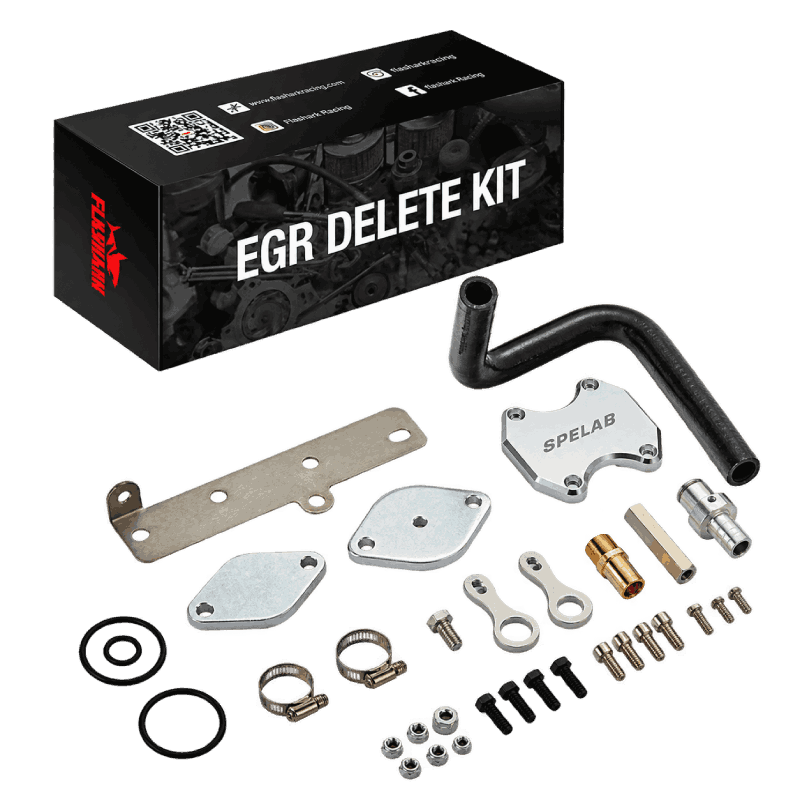
Let’s cut through the marketing noise. You’re not looking at an EGR (Exhaust Gas Recirculation) delete because you want to "save the polar bears." You’re doing it because you’re tired of your diesel engine eating its own soot, dealing with clogged coolers, or staring at a Check Engine Light (CEL) that costs $2,000 to fix at the dealership.
But here is the reality check: deleting an EGR system isn't just about unbolting a valve. It changes the thermodynamics, the software logic, and the legal status of your truck. If you go into this thinking it’s a simple "plug-and-play" for 20% better gas mileage, you are going to be disappointed.
🚀 Quick Summary: The Real "Aftermath"
If you execute a full delete with a high-quality EGR delete kit and proper tuning, here is exactly what happens:
- Reliability: Drastically increased. You eliminate the risk of soot clogging the intake manifold and EGR cooler failures.
- Power: The hardware alone adds zero HP, but the mandatory tuning unlocks 50–150+ HP.
- Fuel Economy: Expect a realistic gain of 1–3 MPG.
- Maintenance: Oil stays amber longer, but warm-up times will increase significantly.
- Legal Status: Strictly for Off-Road/Competition Use Only.
The Hardware Reality: It’s Not Just About Airflow
The stock EGR system recirculates exhaust gas back into the intake to lower combustion temperatures and reduce NOx emissions. The problem? That exhaust is full of soot. When you mix that dry soot with the oily crankcase vapors (from the CCV), it forms a sludge that looks like asphalt.
🛠️ Mechanic’s Log: The "Asphalt" Intake
I remember a 2015 Ford 6.7L Powerstroke that came into our shop back in '19. The owner complained about sluggish throttle response and poor mileage. When we pulled the upper intake manifold, the air passages were choked down to the size of a quarter by thick, sticky carbon sludge. That engine was suffocating. After the EGR delete and a chemical intake cleaning, the truck felt like it had dropped 1,000 lbs of weight. That’s the real benefit—engine longevity, not just peak dyno numbers.

1. Oil Longevity and Engine Health
Post-delete, your engine stops inhaling abrasive soot. If you check your dipstick 1,000 miles after an oil change on a stock truck, the oil is jet black. On a deleted truck, it often stays translucent amber for thousands of miles. Cleaner oil means less wear on your bearings, rings, and turbo shaft.
2. The Coolant Temp Trade-off
Here is something most kit sellers won't tell you: The EGR cooler actually helps your engine warm up faster by transferring exhaust heat to the coolant. Once you delete it, your truck will take longer to reach operating temperature.
If you live in Minnesota or Canada, you need to account for this. We often recommend high-idle switches or winter front grille covers for our northern customers to help maintain heat during idle.
The Software: Where 90% of Rookies Fail

You cannot simply bolt on a block-off plate and drive away. Modern ECUs (like the Ford PCM, GM ECM, or Dodge PCM) monitor EGR flow pressure and position. If the sensor data doesn't match the expected values, the truck goes into Limp Mode.
⚠️ Mechanic’s Warning: The "Cheap Tune" Trap
I see this all the time on forums, but I saw it live with a kid who brought in a 2018 L5P Duramax. He bought a cheap "box tuner" online that claimed to handle deletes but didn't actually unlock the ECM properly. He stripped the hardware, flashed the file, and the truck immediately threw a P0401 code and locked him to 5 MPH (Limp Mode) five miles down the road. We had to tow him back and spend $1,200 just to unlock the ECM correctly with HP Tuners before we could even start fixing his mess. Don't cheap out on the software.
Required Tuning Adjustments
A proper "delete tune" does three things:
- Turns off the Sensors: Disables the EGR valve and cooler efficiency codes so the Check Engine Light stays off.
- Adjusts VGT Maps: The Variable Geometry Turbo relies on exhaust backpressure. When you remove the EGR restriction, the turbo vanes need to be recalibrated to prevent over-boost or lag.
- Injection Timing: Without the inert exhaust gas slowing down combustion, timing can be advanced for better efficiency and power.
The Sensory Experience: Sound and Smell
The "Aftermath" isn't just mechanical; it's sensory.
- The Smell: Without the emissions equipment, your exhaust will smell like an old-school diesel—raw and pungent. Some love it; some hate it. If you idle in your driveway, your neighbors will know.
- The Sound: The EGR system acts as a muffler of sorts. Removing it (especially if combined with a DPF delete) allows the turbo whistle to be heard clearly through the exhaust. Your truck will sound throatier and more aggressive.
Selection Guide: Don't Buy Junk
Universal kits are a myth. Using 6.0L parts on a 6.4L simply doesn't work. When choosing a kit, look for:
- Material: 304 Stainless Steel or Billet Aluminum. Avoid mild steel that will rust out in two years.
- Coolant Reroute: Does the kit simply cap the coolant lines (bad for flow) or does it provide a reroute hose to keep coolant circulating (good for reducing pressure spikes)?
- Completeness: Does it come with new gaskets? Reusing old, soot-caked gaskets is a recipe for a boost leak.

🛑 CRITICAL LEGAL WARNING
For Competition Use Only.
Removing emissions equipment (EGR, DPF, SCR) is a violation of the Clean Air Act in the United States. These modifications are strictly for dedicated off-road competition vehicles that will never be driven on public highways. Shops can be fined heavily for installing these, and street-driven trucks can be impounded. Proceed at your own risk.

Ready to Unlock Your Engine?
If you have a dedicated trail rig or race truck, getting rid of the EGR is one of the best reliability mods you can do. It stops the carbon buildup, lowers EGTs (Exhaust Gas Temperatures) when tuned right, and lets your engine breathe the way it was designed to.
Frequently Asked Questions (FAQ)
Q1: Will an EGR delete increase my horsepower?
A1: The hardware removal alone adds zero horsepower. However, the required ECU tuning to run the delete typically adds 50-150HP depending on the tune level you select.
Q2: Can I install an EGR delete without a tuner?
A2: No. Driving without a tuner will cause the Check Engine Light to illuminate immediately and will likely force the truck into "Limp Mode," limiting speed to 5mph to protect the engine.
Q3: Will my truck pass emissions testing after an EGR delete?
A3: No. An EGR delete removes federally mandated emissions equipment. You will fail visual inspections and OBDII readiness tests in any state that requires emissions testing.
Q4: Does deleting the EGR improve fuel mileage?
A4: Yes, typically. Most drivers report a 1-3 MPG increase. This comes from the engine breathing cleaner air and the tune optimizing timing, not just the part removal itself.
Q5: Will an EGR delete void my warranty?
A5: Yes. Dealers can flag your VIN for tampering with emissions systems (often called a "TD1" flag by Ford), which will void the powertrain warranty on the engine.
Q6: Why does my truck take longer to warm up after the delete?
A6: The factory EGR cooler uses hot exhaust gas to heat the engine coolant during warm-up. Removing this cooler eliminates that secondary heat source.
Q7: What do I do with the coolant lines?
A7: Quality kits come with a coolant reroute hose or block-off plugs. We highly recommend kits that reroute the coolant to maintain proper flow pressure through the heads, rather than just blocking it.
Q8: Will my truck smoke more?
A8: If you only delete the EGR but keep the DPF (Diesel Particulate Filter) intact, you won't see smoke. If you delete both, you may see a light haze at wide-open throttle, but a modern "clean tune" shouldn't roll coal like an old locomotive.
Q9: Is it difficult to install an EGR delete kit yourself?
A9: It depends on the truck. A 6.7L Cummins is fairly straightforward (2-3 hours). A 6.4L or 6.7L Powerstroke is significantly more labor-intensive (6-8 hours) often requiring specialized tools to reach bolts near the firewall.
Q10: Can I reverse the process later?
A10: Technically yes, provided you keep all your original parts. However, reinstalling soot-caked EGR coolers and rusted bolts is usually twice as hard as taking them off.